Optimization and Implementation of Nanocavities Using Physics-Based AI
When will 6G communication be realized?
A technology capable of amplifying terahertz (THz) electromagnetic waves, such as light or infrared rays, by more than 30,000 times has been developed. This technology, which combines artificial intelligence (AI) with a physical model, is expected to accelerate the commercialization of frequencies for 6G communication.
UNIST (President Yong-Hoon Lee) announced on the 20th that Professor Hyung-ryul Park’s team from the Department of Physics, together with Professor Junsu Lee’s team from the University of Tennessee, USA, and Professor Mina Yoon’s team from Oak Ridge National Laboratory, USA, developed an optimization technology for THz nanoresonators used in 6G communication.
They made it possible to easily design tasks that previously took a long time even on supercomputers, using AI learning based on physical theory models, on personal computers.
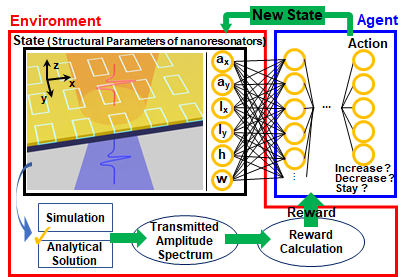 Schematic diagram of the AI inverse design method. After calculating the transmission spectrum using the physical solution, the reward is calculated and reinforcement learning is applied to the AI for inverse design.
According to the research, the team analyzed the efficiency of the newly developed nanoresonator through THz electromagnetic wave transmission experiments. Compared to the electric field generated by general electromagnetic waves, it was able to produce an electric field amplified by more than 30,000 times. This result shows an efficiency improvement of over 300% compared to THz nanoresonators reported in academia so far.
Until now, an ‘AI inverse design technology’ that combines optical simulation and AI to find the optimal design method has been used. It mainly designed optical devices operating in the visible or infrared spectrum.
Professor Hyung-ryul Park said, “AI inverse design technology mainly designed optical device structures that are one-tenth or one-hundredth the size of the wavelength,” adding, “However, compared to the wavelength in the 0.075 to 0.3 THz range, which is the frequency for 6G communication, the size is about one-millionth, making it difficult to apply.”
When designing nanoresonators operating at 6G frequencies, even using high-performance computers, a single simulation takes tens of hours. In other words, optimizing one device using the previously known inverse design method could take hundreds of years.
To solve this problem, the research team newly designed THz nanoresonators by combining AI inverse design methods with physical theory models. They were able to optimize devices within 40 hours on personal computer specifications.
 (From left) Researcher Kim Jeong-hoon, first author Researcher Lee Hyung-taek, Professor Park Hyung-ryeol.
First author Researcher Hyung-taek Lee explained, “The optimized nanoresonators can be used not only for ultra-precise detectors but also for sensors detecting trace molecules and bolometer research,” adding, “The methodology applied in this research is not limited to specific nano structures and can be utilized in various studies involving different wavelengths or physical theory models of structures.”
Professor Hyung-ryul Park of the Department of Physics said, “The core of this research is improving the efficiency of AI-based technology by understanding physical phenomena,” adding, “Although it may seem that AI can solve all problems, it is still important to first have a good understanding of physical phenomena.”
This research was published online on December 7 in the internationally renowned journal Nano Letters. The research was supported by the National Research Foundation (NRF) of Korea under the Ministry of Science and ICT, the Global Core Talent Training Project and University ICT Research Center Support Project (IITP) of the Institute for Information & Communications Technology Planning & Evaluation, and the A.I. Distribution and Expansion Support Project of Ulsan National Institute of Science and Technology.
© The Asia Business Daily(www.asiae.co.kr). All rights reserved.


















