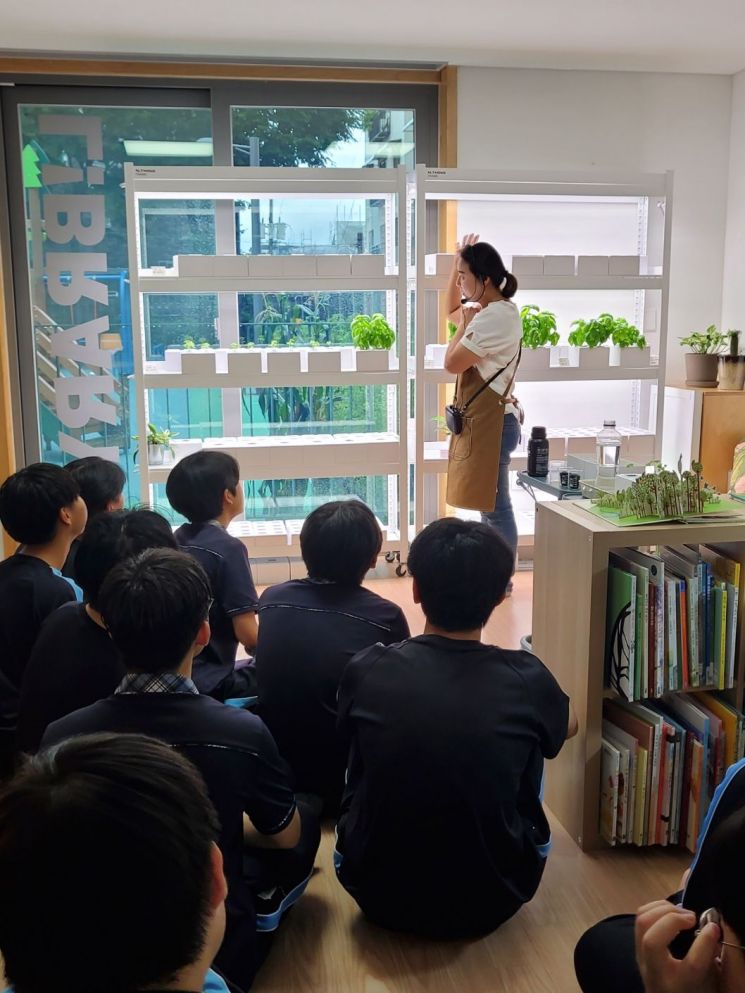
Gangbuk-gu, Seoul (Mayor Lee Soon-hee) is gaining attention for operating a ‘Smart Farm Artificial Intelligence Education’ program aimed at reducing carbon emissions for elementary and middle school students to protect the global environment.
The Smart Farm AI Education is a program designed to improve urban living environments with the vision of a ‘sustainable city.’ It provides crops with an optimized growth environment using information and communication technology, increasing production while reducing unnecessary labor time.
From July to December this year, the district conducted 21 sessions of smart farm experiential education for a total of about 390 students from 6 elementary schools and 7 middle schools at the Pureunbyeol Environmental Library (51-gil Samyang-ro 22).
The smart farm education consisted of ‘Micro Carbon Garden’ and ‘Modular Smart Farm Experiential Activities’ based on the Internet of Things to reduce carbon emissions. The program included theoretical education on the 6th industry rural convergence food tech and practical training using teaching aids, with four professional instructors holding national qualification certificates and professional licenses in charge of the lectures.
The Micro Carbon Garden class is a program where students grow carbon-absorbing excellent species using Wise Planter 3D-printed pots. Students directly understand the concept through IoT sensors and attempt ecological transformation through smart farm activities during the class.
The education proceeded with ▲Understanding the 6th Industry Food Tech ▲Smart Farm Arduino MMB Board Utilization Education (Coding Kit) ▲Service Design Toolkit Class (Imagining a Day on Earth).
The Modular Smart Farm Experiential Activity class involves creating a crop environment using thin-film hydroponic cultivation instead of soil and pesticides. Since the modular smart farm grows crops with a medium and circulating nutrient solution, agricultural products can be supplied without a washing stage. Not only does it eliminate the need for pesticides, but it also saves up to 98% of water compared to open-field cultivation, thereby reducing carbon emissions.
The education was conducted in the order of ▲Basics of Future Gardening to Reduce Carbon Emissions ▲Carbon-Absorbing Excellent Species Smart Home Gardening (3D-printed pots provided) ▲Presentation of Impressions and Survey.
A satisfaction survey of students who attended the Smart Farm AI Education showed that over 92% were ‘very satisfied.’ Comments included “It was so fun,” “The class time was too short, which was disappointing,” “I want to learn other programming,” and “I want to come again.”
Lee Soon-hee, Mayor of Gangbuk-gu, said, “Advanced countries are already preparing for the 6th industry era. The future where children will live as social leaders is a new world where digital technology, physics, and biology converge. I hope this smart farm education will serve as an opportunity to increase students’ interest and enthusiasm for future food tech.”
© The Asia Business Daily(www.asiae.co.kr). All rights reserved.
![Clutching a Stolen Dior Bag, Saying "I Hate Being Poor but Real"... The Grotesque Con of a "Human Knockoff" [Slate]](https://cwcontent.asiae.co.kr/asiaresize/183/2026021902243444107_1771435474.jpg)











