Fair Trade Commission to Promote Platform Competition Act
Pre-regulation Targets Set to Restrict Self-preferencing
Concerns Over Hindering Innovation Competition and Reducing Consumer Welfare
Claims of Reverse Discrimination Against Overseas Platforms Also Raised
Concerns are pouring in over the proposed 'Platform Competition Promotion Act (tentative name),' which includes preemptive regulations on domestic platform companies such as Naver and Kakao. The worry is that labeling these large platforms as subjects of preemptive regulation will stifle normal business activities. There is a growing voice that blocking their innovation competition will harm consumer welfare and only benefit foreign platforms.
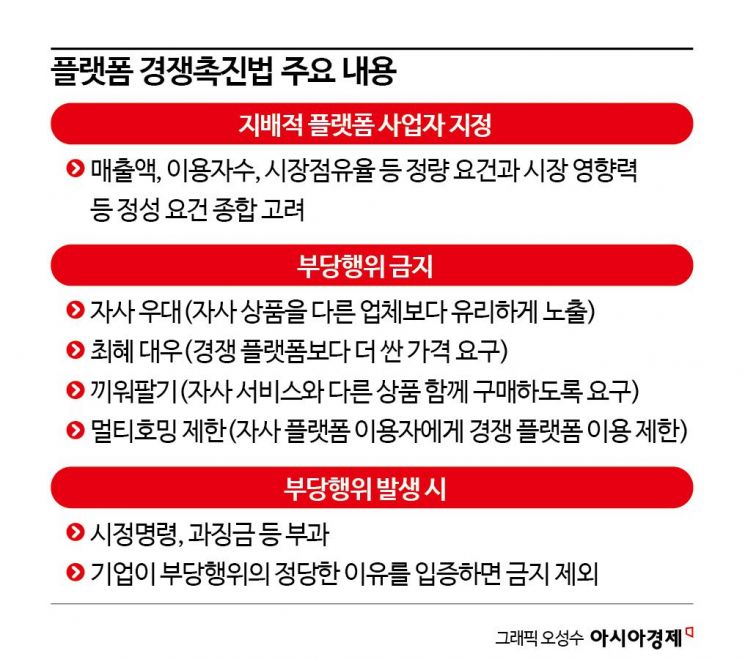
On the 19th, the Fair Trade Commission reported to President Yoon Suk-yeol at the Cabinet meeting regarding the introduction of the Platform Competition Promotion Act. The act includes pre-designating certain platforms as 'dominant operators' and fundamentally prohibiting unfair practices such as self-preferencing. For example, it means that a platform cannot engage in self-preferencing by setting Naver Pay as the default payment method on Naver Shopping. From a business perspective, decisions made to enhance shopping convenience would become subject to preemptive regulation. Therefore, platform companies are concerned that their management activities will be restricted and their motivation to strengthen service competitiveness will decline.
Dominant Operator 'Stigma'... "Normal Business Activities Also Restricted"
The core of the Platform Competition Promotion Act is to pre-designate and manage large platforms with significant influence. It plans to consider quantitative criteria such as sales, number of users, and market share, as well as qualitative criteria like the platform's market influence and entry barriers in the relevant market. Although detailed standards have not been released, platform companies such as Naver, Kakao, and Coupang are expected to be included.
These platform companies are already subject to the Fair Trade Act. If they unfairly interfere with the business activities of other operators, the Fair Trade Act is applied, resulting in corrective orders or fines. In the case of Kakao Mobility, which was fined for violating the Fair Trade Act, the illegal act was manipulating the dispatch algorithm to favor its own affiliated taxis, thereby restricting market competition. If the Platform Competition Promotion Act is added on top of this, Kakao Mobility would be subject to preemptive regulation simply for setting Kakao Pay as a payment method or not dispatching calls to taxis affiliated with other platforms, regardless of illegal acts. It stigmatizes preemptive regulation without distinguishing between monopolies arising from consumer choice and monopolies through unfair means. From a business perspective, concerns about double regulation inevitably reduce the motivation to strengthen service competitiveness.
"Markets Where Innovation Disappears, Only Consumer Harm"
There is also strong opposition to the preemptive regulation content. Dominant platform operators would be prohibited from ▲ self-preferencing by exposing their own products or content more favorably than others, ▲ demanding 'most-favored-nation' treatment by requiring prices equal to or lower than competitors, ▲ tying sales by forcing customers to purchase other products together with their own services, and ▲ restricting multi-homing by prohibiting users from using other platforms.
The industry points out fairness issues with distributors that both distribute and sell private brand (PB) products or film companies that both produce and distribute movies. A platform company official said, "If platforms are regulated simply because they both sell products and mediate transactions, it is questionable whether the same standards can be applied to other businesses," adding, "This could rather reduce consumer welfare." For example, due to the nature of platforms that gather and retain users, it is common to combine and prioritize their own services such as shopping, payment, and content, which constitutes self-preferencing. If there is no need to grow their own services, innovation disappears, ultimately leading to a decline in consumer welfare.
"Claims of Reverse Discrimination Against Foreign Platforms"
Issues of reverse discrimination against foreign platforms are also raised. Based on sales and number of users, foreign companies like Google and Meta could also be subject to regulation. However, considering concerns about trade friction with the United States, many expect foreign companies to be excluded. The American Chamber of Commerce in Korea (AMCHAM) has also expressed opposition to the government's preemptive regulation of platforms. Even if regulations are applied to foreign platforms, there is a high possibility they will circumvent them through loopholes. In fact, Google calculates its domestic revenue not through Google Korea but through Google Ireland.
Ultimately, if only domestic platforms are regulated, it is expected that foreign companies will take over the domestic market. The Digital Economy Alliance, a coalition of domestic IT associations, lamented in a statement, "It is like sentencing domestic platforms to death while fiercely competing with foreign platforms." An IT industry official said, "In the search market, we are losing to YouTube; in generative artificial intelligence (AI), we are competing with Microsoft (MS); and in shopping, China's AliExpress is advancing," adding, "Excessive regulation will cause the domestic market to be taken away by foreign companies."
© The Asia Business Daily(www.asiae.co.kr). All rights reserved.

















