Court: "Minister of Justice's involvement in disciplinary procedure violates due process"
Deficiencies in quorum requirements for recusal decision and disciplinary resolution
Law: "Illegality due to infringement of plaintiff's right to defense"
President Yoon Suk-yeol won the second trial of the 'disciplinary appeal administrative lawsuit' against the two-month suspension he received from the Ministry of Justice during his tenure as Prosecutor General.
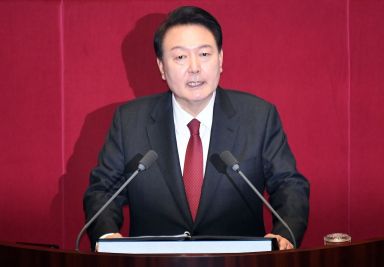 President Yoon Suk-yeol is delivering the policy speech on the 2024 budget proposal at the National Assembly plenary session hall in Yeouido, Seoul, on October 31. Photo by Kim Hyun-min kimhyun81@.
The Seoul High Court Administrative Division 1-1 (Presiding Judges Shim Jun-bo, Kim Jong-ho, Lee Seung-han) overturned the lower court's ruling that dismissed President Yoon's lawsuit against the Minister of Justice seeking cancellation of the disciplinary action and ruled in favor of the plaintiff on the 19th.
The court stated, "The involvement of the Minister of Justice in the disciplinary procedure violates the disqualification provisions under the Prosecutor Disciplinary Act and the principle of due process, making it illegal," adding, "The principle of due process is a constitutional fundamental principle that applies not only to criminal procedures but also to legislative, judicial, and administrative actions across all state functions, and therefore must be observed in disciplinary procedures against prosecutors."
Furthermore, the court noted, "There are defects in the quorum requirements for the decision on the recusal request and the disciplinary resolution," and "It is illegal for disciplinary committee members who received the recusal request to all participate in the disciplinary resolution without a lawful decision on the validity of the recusal."
Additionally, the court found that the Ministry of Justice violated President Yoon's right to defense during the disciplinary resolution process. The court explained, "The committee adopted the statement written by Prosecutor Shim Jae-cheol as key evidence for recognizing the disciplinary reasons but unreasonably dismissed the plaintiff's request to examine witnesses for impeachment and did not provide an opportunity to use alternative impeachment methods, thereby failing to guarantee the plaintiff's right to defense, which violates the principle of due process."
Previously, former Minister of Justice Choo Mi-ae excluded President Yoon from his duties as Prosecutor General in November 2020 and held a disciplinary committee in December of the same year, imposing a two-month suspension.
The disciplinary reasons cited by the Ministry of Justice at the time were ▲the creation and distribution of documents alleging surveillance of major case trial panels ▲obstruction of inspection and investigation related to the 'Channel A case' ▲damage to the dignity and reputation of prosecutors due to political neutrality violations.
President Yoon's side argued that these disciplinary reasons were either untrue or not problematic, and thus both the exclusion from duty and the disciplinary action should be canceled. They applied for a suspension of execution (suspension of effect) for both the exclusion from duty and the disciplinary action, and the court accepted both within a week, allowing him to return to duty.
During the trial process, President Yoon's side claimed, "The disciplinary committee members who were subject to the recusal request left the meeting, and the decision on the recusal request made by the remaining three disciplinary committee members did not meet the quorum (majority attendance of seven members) and is therefore invalid." The disciplinary committee, during two deliberation sessions, allowed the members whom President Yoon's side requested to be recused to leave only during their own recusal decisions and alternately participate in other members' recusal decisions, dismissing all recusal requests.
However, the first trial court ruled, "A recusal request alone does not exclude the disciplinary committee member subject to the recusal request from the attending members counted for quorum in the recusal decision," and "Even if the member temporarily leaves during the decision process, they are not excluded from the attending members counted for quorum."
The court also recognized the disciplinary reasons of ▲the creation and distribution of documents alleging surveillance of major case trial panels ▲obstruction of inspection and investigation related to the 'Channel A case,' judging that these alone sufficiently justify the disciplinary action.
The first trial court stated, "These disciplinary reasons constitute serious misconduct that undermines the legality and fairness of prosecutorial affairs," and "According to the relevant disciplinary standards, dismissal or more severe disciplinary actions are possible." It implied that the two-month suspension was actually lighter than the lower limit of the disciplinary range set by the standards.
© The Asia Business Daily(www.asiae.co.kr). All rights reserved.

















