Hana Financial Research Institute Publishes Monograph Compiling 10 Years of Wealth Research
Hana Financial Management Research Institute has published a report book containing the results of a study on wealthy individuals (those with financial assets of 1 billion KRW or more) conducted over more than 10 years since 2012. The asset threshold for the wealthy was generally identified as 10 billion KRW, and the proportion of inheritance-type wealthy individuals remained around 60%, unchanged even after 10 years.
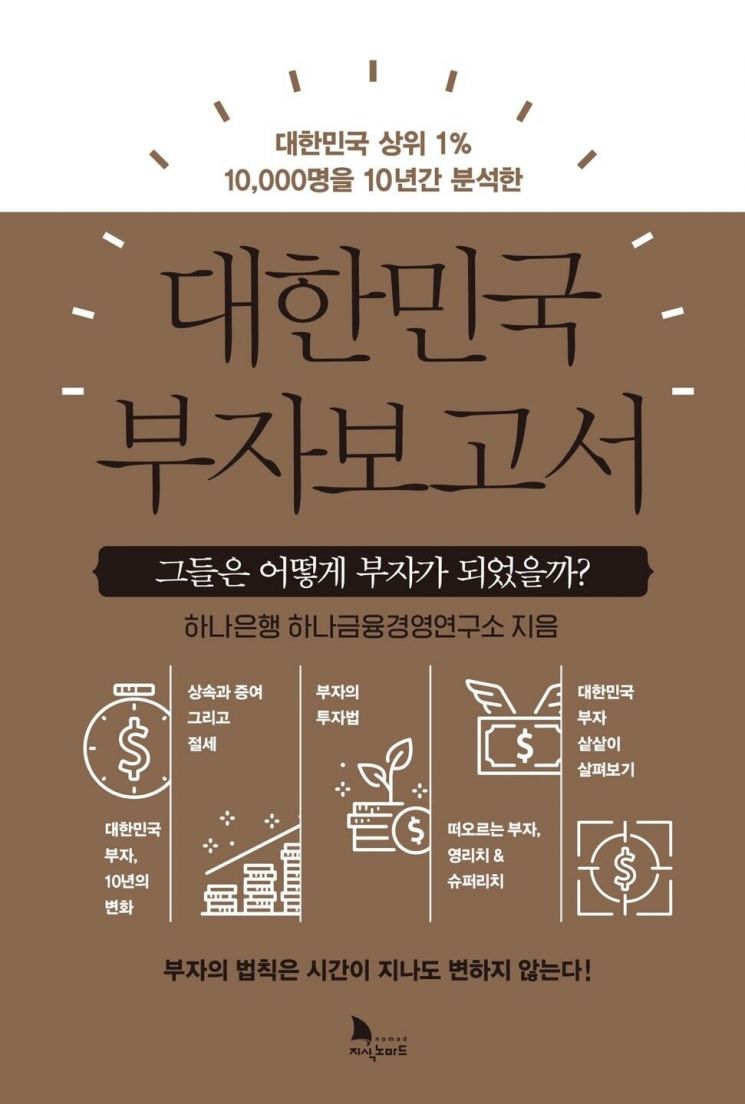
On the 19th, Hana Financial Management Research Institute announced the publication of the 'Korea Wealth Report' book. The 'Korea Wealth Report' is a specialized asset owner data published annually by Hana Bank and Hana Financial Management Research Institute since 2007. The research results from 2012, when it began to be disclosed externally, were compiled and published as a book this time. Through this, it shed light on the changes in wealthy individuals over the past decade, their asset formation processes, and asset management methods.
The asset standard considered by the wealthy is '10 billion KRW'
According to the report, people with financial assets of 1 billion KRW or more did not perceive themselves as wealthy. Only about 2 to 3 out of 10 considered themselves wealthy. This was explained by the fact that the level of wealth was based more on relative comparison psychology than on absolute standards. The asset threshold for the wealthy, as compiled by Hana Financial Management Research Institute, increased from an average of 11.4 billion KRW in 2012 to 18.7 billion KRW in 2021, but dropped back to 12.8 billion KRW in 2022, showing significant annual fluctuations. The report interpreted this as psychological factors influenced by liquidity and economic conditions that year.
However, the proportion of those who considered the asset threshold for the wealthy to be 10 billion KRW rose nearly 20 percentage points from 28% in 2020 to 46% in 2022. Additionally, from 2022, the proportion of those who viewed this threshold as 30 billion KRW or more also exceeded 10%. This indicated a trend toward distinguishing 'ultra-high-net-worth individuals.'
Korean wealthy have a significantly higher real estate ratio... 60% are inheritance 'gold spoons'
More than half (55% as of 2022) of the total assets held by wealthy individuals consisted of real estate. Compared to overseas wealthy individuals whose real estate ratio is 15%, this is more than three times higher. 95% of the wealthy owned their own homes, and the proportion holding additional real estate exceeded half. Real estate was seen as the most suitable investment for maintaining assets and also offered considerable returns. However, there was a shift in interest from income-generating real estate such as commercial buildings or officetels to apartments. Interest in overseas real estate investment also increased. It was analyzed that the preferred types of real estate changed depending on real estate policies and interest rates.
Over the past decade, the proportion of earned income as a source of wealth gradually increased, but the number of self-made wealthy individuals did not grow. It was explained that 6 out of 10 wealthy individuals were inheritance-type, a figure that had not changed much over 10 years. The scale of inheritance and gifts showed polarization, becoming either larger or smaller than in the past. The timing of receipt tended to be delayed until after the 40s until 2018, but after the COVID-19 pandemic, the proportion of minors holding stocks also increased significantly.
In the past, the representative types of inheritance and gift assets were real estate, but recently, the use of cash, deposits, or trust products for gifting has been spreading. In particular, demand for testamentary substitute trusts, which allow safe inheritance of assets without family disputes, has increased sharply.
Emergence of Young Rich and Super Rich
The 'Young Rich,' referring to wealthy individuals under their 40s, had a higher proportion of financial assets than real estate and were actively engaged in financial technology, with more than 7 out of 10 investing in overseas stocks. 20% of the Young Rich held virtual assets and were unhesitant about new investments such as foreign currency assets, physical assets, and project funds.
Interviews with 'Super Rich,' who hold financial assets of 10 billion KRW or more or total assets of 30 billion KRW or more, were also included in the book. They stated, "By chance and due to the family atmosphere, we naturally learned the value of money." They adjusted their portfolios faster and more boldly according to economic conditions, securing investment returns that ordinary wealthy individuals could not reach. They preferred foreign currency assets and showed high interest in art investment as well.
A representative from Hana Financial Management Research Institute said, "Through this book, it is possible to confirm that the characteristics and investment patterns of wealthy individuals have changed over the past 10 years, and it will be interesting to observe how the appearance of Korea's wealthy will change in the next 10 years."
© The Asia Business Daily(www.asiae.co.kr). All rights reserved.
![User Who Sold Erroneously Deposited Bitcoins to Repay Debt and Fund Entertainment... What Did the Supreme Court Decide in 2021? [Legal Issue Check]](https://cwcontent.asiae.co.kr/asiaresize/183/2026020910431234020_1770601391.png)
















