UNIST Professor Choi Won-Young's Team Creates Metal-Organic Framework with Origami Pattern
Quantum Computing Applications Possible at Molecular Level... Published in Nature Communications
A new name was needed to replace the meaning of ‘solid (固體),’ which means hardened and unchangeable.
A new material applying origami, which folds in a certain way, has emerged. A metamaterial that can be folded like paper has been developed, opening up new possibilities for applications.
UNIST (President Yong-Hoon Lee) announced on the 19th that Professor Won Young Choi’s and Professor Seung Kyu Min’s teams in the Department of Chemistry developed a two-dimensional Metal-Organic Framework (MOF) based on origami patterns.
The study also observed the operating principle of origami, which was difficult to confirm at the molecular level.
Origami has influenced various fields beyond a simple form of play, such as engineering and architecture. In particular, the operating principle of origami has expanded into technology fields and is being utilized in various areas from solar cells to medical devices.
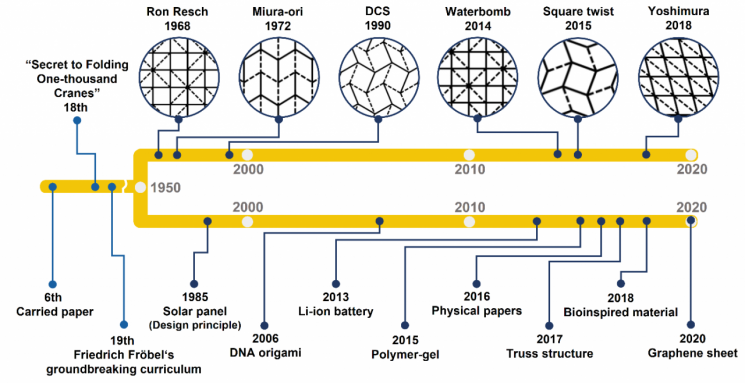
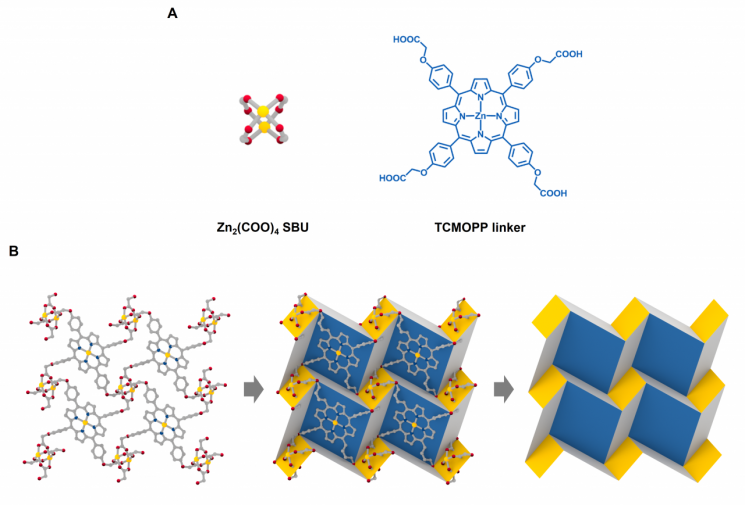
Although materials inspired by the origami principle have been steadily developed, creating materials at the ‘molecular level’ has been a challenging task.
The research team synthesized metal nodes and organic ligands to create a framework capable of transformations like origami. Metal-Organic Frameworks can impart flexibility to solid materials depending on the characteristics of their constituent components.
The team analyzed the fabricated two-dimensional Metal-Organic Framework by measuring the diffraction phenomenon of X-rays, which have wavelengths similar to radio waves or light. The fabricated framework responded to temperature changes and demonstrated an operating principle similar to origami.
Along with structural changes, the team discovered the characteristic of negative Poisson’s ratio (NPR) in the material. Poisson’s ratio refers to a coefficient that shows how most objects, like jelly, expand vertically when force is applied horizontally, whereas materials with NPR contract vertically.
The team analyzed that the main cause of this unusual phenomenon was the internal structural arrangement of the Metal-Organic Framework composed of flexible structural components.
The inherent flexibility of the material enables movements similar to origami folding. This characteristic is a feature found in metamaterials with properties difficult to find in nature and is expected to be utilized in various fields of new material development.
First author Eunji Jin explained, “This study opened new possibilities for the operating principle of origami at the molecular level and introduced the concept of ‘origami-based Metal-Organic Framework.’”
Jin added, “We understood the movement of Metal-Organic Frameworks and suggested potential applications in the field of mechanical metamaterials.”
Professor Won Young Choi of the Department of Chemistry stated, “Implementing movements like origami folding at the molecular level is a discovery of new materials with unique mechanical properties,” and evaluated, “Exploration of various functional groups and research on the operating principle of origami have opened new paths for specific applications such as the advancement of quantum computing.”
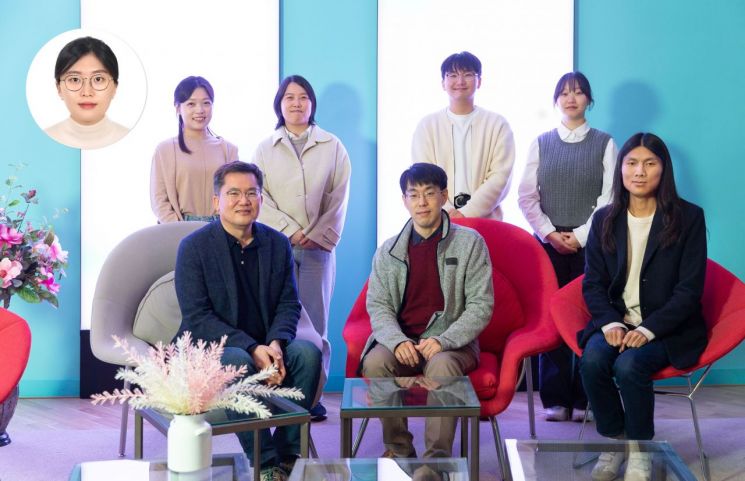 UNIST research team. (In the circle) First author Eunji Jin, (back row from left) Jeonghye Lee, Invited Professor Eunyoung Kang, Juhan Nam, Hyunsu Cho, (front row from left) Professor Wonyoung Choi, Professor Seunggyu Min, Inseong Lee.
The research results were published online on December 1 in Nature Communications, a sister journal of the prestigious international journal Nature. The research was supported by the Mid-Career Researcher Support Program, Future Hydrogen Source Technology Development Project, Support Program for Leading Research Centers (SRC), Global Ph.D. Fellowship Program (GPF) of the National Research Foundation of Korea (NRF) under the Ministry of Science and ICT, and the Korea Environmental Industry & Technology Institute (KEITI).
The research involved Eunji Jin, Changmo Yang, Juhan Nam, Hyunsoo Cho, Eunyeong Kang, Junghye Lee, and Hyukjun Noh from Professor Won Young Choi’s team, and Inseong Lee from Professor Seung Kyu Min’s team, along with Dohyun Moon from the Pohang Accelerator Laboratory as a joint participant.
© The Asia Business Daily(www.asiae.co.kr). All rights reserved.
!["The Woman Who Threw Herself into the Water Clutching a Stolen Dior Bag"...A Grotesque Success Story That Shakes the Korean Psyche [Slate]](https://cwcontent.asiae.co.kr/asiaresize/183/2026021902243444107_1771435474.jpg)


















