The Seoul Metropolitan Government announced on the 19th that it has developed the 'Public Restroom Universal Design Application Guidelines,' which strengthen the concept of Crime Prevention Through Environmental Design (CPTED) from the existing public restroom construction guidelines, and will apply them to the construction and improvement of public restrooms starting next year.
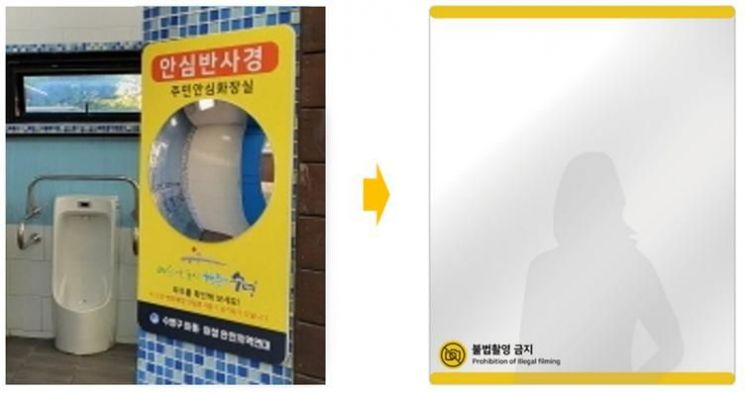
The new 'Public Restroom Universal Design Application Guidelines' add the concept of Crime Prevention Through Environmental Design (CPTED), which enhances the 'safety aspect' to the existing universal design, aiming to increase both design universality and safety. The guidelines include standards for restroom layout, development of separate circulation routes and partition wall designs for male and female restroom entrances, detailed installation standards for safety and convenience facilities such as emergency bells, safety mirrors·and CCTV, as well as practical guidelines such as checklists for different user types including designers and reviewers.
First, ‘restroom layout’ should be considered from the early stages of architectural design for safety, especially placing restrooms in locations with high foot traffic and good visibility to enable quick response in emergencies. Additionally, the ‘circulation routes for male and female restroom entrances’ provide separation plans and safety facility installation methods that can be applied depending on site conditions. For the ‘male and female restroom partition walls,’ semi-transparent materials are used to allow natural surveillance, simultaneously fulfilling openness and security, and the upper part is left open to allow sound transmission in case of safety incidents.
Meanwhile, installation and operation standards for safety facilities such as emergency bells·safety mirrors·and CCTV, which previously had no separate standards, have also been specified. Emergency bells will have clearer markings and improved visibility to be easily noticed when needed. In addition, simple-design safety mirrors focused on mirrors will be installed to enable immediate rear surveillance.
The city plans to distribute the guidelines to related organizations·and autonomous districts so that restroom designers·managers can actively utilize them, promoting systematic public restroom construction and management. The guidelines are structured to be easily used from design to construction and operation even without architectural knowledge, and include checklists that can be used at each stage.
Choi In-gyu, Seoul’s Design Policy Officer, said, “Through the advancement of these guidelines, we expect convenient and safe public restrooms to spread throughout Seoul,” adding, “As ‘clean and safe restrooms’ play an important role in fully conveying Seoul’s charm and advancing it as a world-class tourist city, we will continue to strive for the safety and qualitative improvement of public·and private restrooms.”
© The Asia Business Daily(www.asiae.co.kr). All rights reserved.

















