Dividing the region into 5 zones, joint cavity surveys are conducted sequentially each year... From this year, the joint cavity survey scope expands from roadways to sidewalks and roadways... This year, joint surveys completed at 36 sites out of a total exploration length of 114 km... Joint cavity survey reports shared with adjacent underground facility management agencies where cavities occurred, requesting inspection of underground facilities
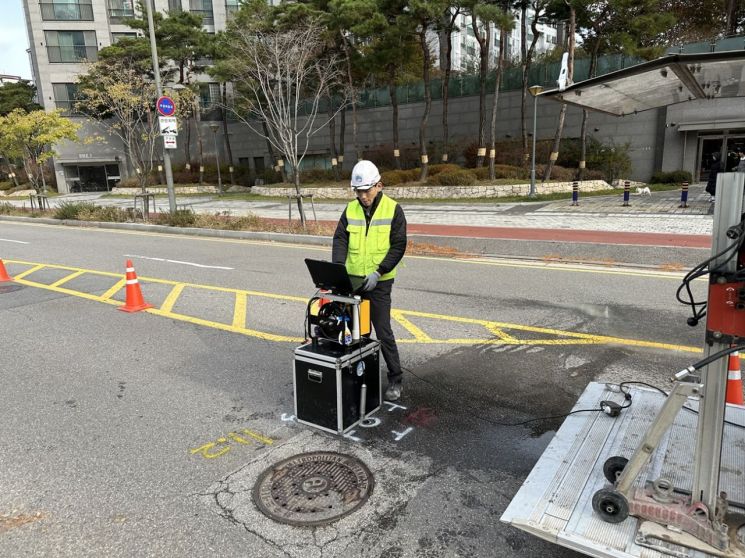
Nowon-gu, Seoul (District Mayor Oh Seung-rok) announced that it will conduct an annual cavity investigation service to prevent road and sidewalk ground subsidence accidents.
According to the Underground Safety Act, it is required to check for cavities in underground facilities and surrounding ground at least once every five years through Ground Penetrating Radar (GPR) surveys.
However, to respond urgently to frequently occurring ground subsidence and to enhance the effectiveness of accident prevention, the district has divided the area into five zones (Zone 1 - Junggye, Zone 2 - Hagye·Wolgye, Zone 3 - Gongneung, Zone 4 - Sanggye 1, Zone 5 - Sanggye 2) and decided to conduct the investigation service sequentially by region every year.
Also, starting this year, the scope of the cavity investigation has been expanded from roads to both sidewalks and roads. This is based on the recognition that due to the usage characteristics of sidewalks, the fatality rate is higher compared to roads, requiring special management.
This year, the district conducted a cavity investigation targeting a total survey length of 114 km of sidewalks and roads in Zone 1 Junggye.
The cavity investigation proceeds through the first survey and analysis, the second cavity investigation and confirmation, and rapid cavity repair. Using the ‘vehicle-integrated extended GPR survey equipment,’ with a maximum survey width of 1.8 to 2.4 meters and a maximum survey speed of 40 to 80 km/h, the exact location of cavities is identified by utilizing road surface cameras, high-precision GPS, and radio Doppler (distance meter). For places where sidewalks and vehicles cannot access, ‘multi-hand GPR survey equipment’ is used. Both AI analysis and human analysis are conducted simultaneously to prepare a precise cavity investigation report.
Subsequently, the cavity scale was confirmed through hand GPR, drilling, and endoscopic filming, finalizing 38 locations (including 4 below standard size). Among them, 36 locations had small-scale cavities and were immediately addressed on-site by injecting filling material, while 2 locations will undergo additional excavation investigations to identify the cause of cavity occurrence and will be promptly repaired through the underground facility management agency.
Regardless of size, among the 38 locations where cavities occurred, 32 are adjacent to underground facilities such as sewage pipes, heat pipes, and communication ducts. The cavity investigation report was shared with the management agencies, requesting inspection for cracks and damage to underground facilities.
Meanwhile, the district establishes an underground safety management plan annually, organizes an underground safety management team, maintains an emergency contact system, and responds according to the action manual in case of ground subsidence.
District Mayor Oh Seung-rok said, “Ground subsidence accidents are becoming more likely due to changing climate patterns such as prolonged monsoon and heavy rain in summer,” adding, “We will do our best to prevent accidents in advance through annual cavity investigation services and ensure that residents can live safely with prompt measures.”
© The Asia Business Daily(www.asiae.co.kr). All rights reserved.
![Clutching a Stolen Dior Bag, Saying "I Hate Being Poor but Real"... The Grotesque Con of a "Human Knockoff" [Slate]](https://cwcontent.asiae.co.kr/asiaresize/183/2026021902243444107_1771435474.jpg)
















