Ruling Party Pushes 'Concurrent Regression'... "Potential Constitutional Violation"
Lee Tan-hee: "Holes Left Unsealed... Neglect of Duty"
4 Months Before General Election... Reform Plan May Be Nullified
The National Assembly's Special Committee on Political Reform discussed the 'Satellite Party Prevention Act' for the first time on the 18th, but only confirmed the differences between the ruling and opposition parties without narrowing the gap. With less than four months remaining until next year's general election, the ruling party, which wants to return to the 'parallel system,' firmly holds the position that the Satellite Party Prevention Act is an 'unnecessary law,' while the opposition party is also divided internally on the direction of electoral system reform.
On the same day, the Political Reform Special Committee convened the 2nd Subcommittee on Bill Examination in the morning and put the Satellite Party Prevention Act on the agenda, but failed to reach any significant conclusion after confirming the differences in views between the ruling and opposition parties. The bills submitted include amendments to the Public Official Election Act requiring parties participating in the general election to nominate both constituency and proportional representation candidates, and amendments to the Political Funds Act that drastically reduce subsidies to satellite parties and parties merging with them.
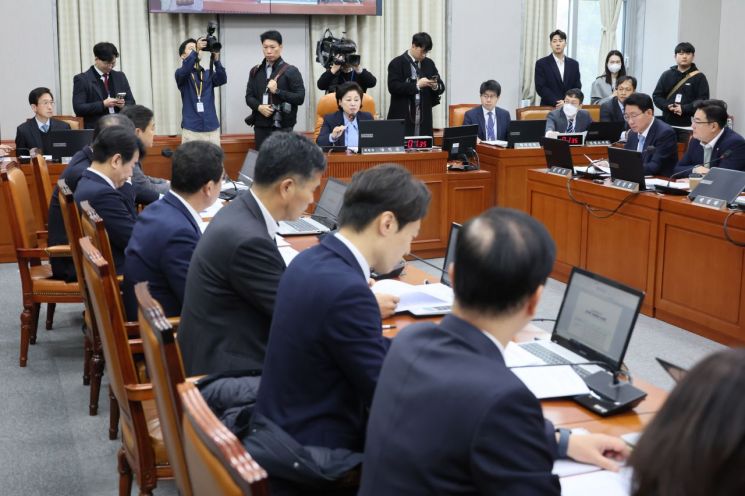 The Special Committee on Political Reform held a plenary session at the National Assembly on the 5th.
 [Image source=Yonhap News]
The People Power Party has decided its party line on electoral reform as a return to the 'parallel system,' which makes the creation of satellite parties virtually impossible, and opposed the Satellite Party Prevention Act, arguing that it may itself violate the Constitution.
Kim Sang-hoon, the ruling party's secretary of the Political Reform Special Committee, pointed out, "The Satellite Party Prevention Act conflicts with the constitutional freedom to establish political parties and thus has the potential to be unconstitutional," adding, "An electoral system that does not require the creation of satellite parties should be adopted first." Kim's remark is interpreted as meaning that if the system returns to the parallel system, the Satellite Party Prevention Act would be unnecessary.
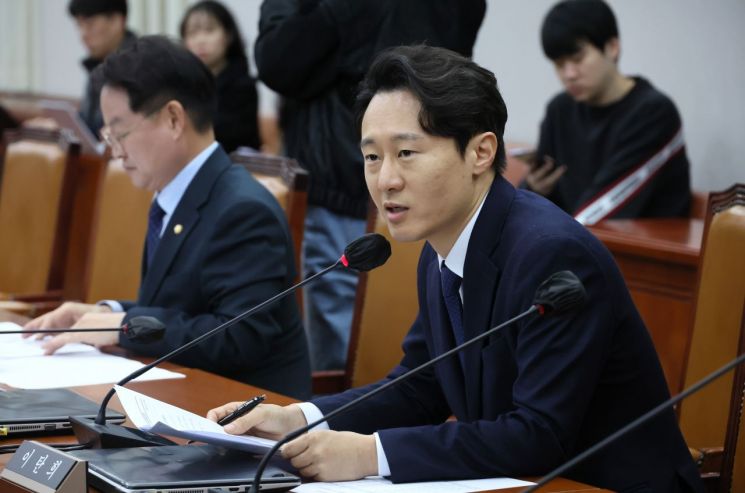
On the other hand, Lee Tan-hee, a Democratic Party lawmaker, criticized in a press briefing after the subcommittee meeting, "It makes no sense to say 'let's leave the hole in the wall open because we might tear down the entire wall' when a law was introduced to plug the hole in the wall." He continued, "When the Political Reform Special Committee was formed, improving the mixed-member proportional representation system was on the agenda, but neglecting legislation is dereliction of duty."
Shim Sang-sung, a Justice Party lawmaker, also questioned, "The ruling party says that even if the law is made, it cannot prevent satellite parties, but does that mean criminal law is unnecessary because it cannot prevent all robberies or murders?" He added, "Isn't finding the most effective method the essence of improvement?"
Although the National Assembly's discussion on the Satellite Party Prevention Act has belatedly taken its first step, there is a possibility that the bill itself will become moot depending on the direction of electoral reform, as no consensus has been reached between the ruling and opposition parties on the proportional representation electoral system. The ruling party has already set returning to the parallel system as its party line, and the Democratic Party is divided internally. While party leader Lee Jae-myung and other party leaders hint at a return to the parallel system under the pretext of 'winning the general election,' there is also considerable public opposition insisting on maintaining and supplementing the semi-proportional representation system introduced under opposition leadership in the last general election.
Meanwhile, the subcommittee also put forward an amendment to the Political Funds Act proposed by Democratic Party lawmakers Lee Won-wook, Kim Young-bae, and Jang Kyung-tae. The amendment includes local council members, who are elected representatives but excluded from the designation of sponsorship committees and thus unable to raise political funds, as eligible to designate sponsorship committees. Under current law, only central parties, members of the National Assembly (candidates), presidents, and presidential primary candidates are allowed to have sponsorship committees.
© The Asia Business Daily(www.asiae.co.kr). All rights reserved.


















