The area around the Sampyo Remicon site in Seongsu-dong, Seongdong-gu, Seoul, which has been used as a factory for 45 years, will be transformed into an innovative hub driving business, tourism, and culture within Seoul. The Seoul Metropolitan Government will begin formal preliminary negotiations this month and aims to start construction in 2025.
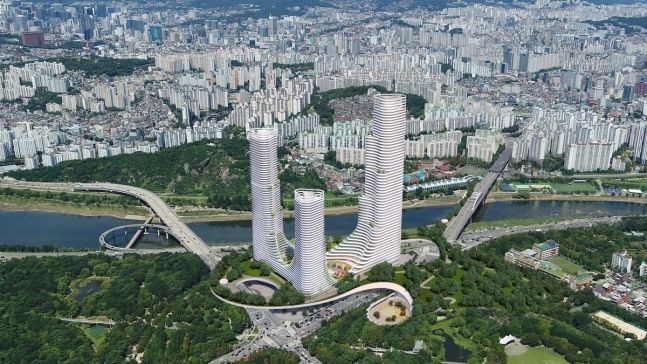 Example of an architectural rendering for the building to be constructed on the Sampyo site in Seongsu-dong
On the 17th, Seoul announced that it had conducted an international design competition to create a global future business district specializing in advanced industries on the Sampyo site and the Seongsu area, ultimately selecting the proposal "Heart of Seoul Forest" by the American firm Skidmore, Owings & Merrill (SOM). SOM is a world-renowned architectural and engineering firm based in Chicago. They have designed famous international buildings such as Burj Khalifa (Dubai), Tianjin CTF Finance Centre (China), and 35 Hudson Yards (USA), and in Korea, they were responsible for the design of the 63 Building and Haeundae LCT.
The Sampyo site, where a ready-mixed concrete factory operated for about 45 years since 1977, emerged as a new strategic site after the company voluntarily agreed to dismantle the factory last year in line with the city's development vision for the Seongsu area. Mayor Oh Se-hoon announced during his European trip in March his plan to develop the Seongsu area, including the Sampyo site, into a global future business district along the Han River. Accordingly, since March, the city has prepared guidelines for an international design competition to introduce innovative architectural designs and invited world-class architects to participate.
Participants in the competition included SOM, British architect David Chipperfield who designed the Amorepacific headquarters in Yongsan-gu, and German architect J?rgen Mayer, known for designing the Zipper-RKM 740 in D?sseldorf, Germany.
The Sampyo site and Seongsu area will be developed according to five goals: ▲ a new destination ▲ a place for cultural exchange ▲ an innovative business hub ▲ cutting-edge residential spaces ▲ and a global icon. As this is the first case of an "architectural innovation-type preliminary negotiation," the city incorporated ample creative and innovative design guideline elements.
The plan is to organically connect the construction site with the nearby Seoul Forest and revitalize the site and surrounding areas to create a space where dynamic culture springs forth. Efforts will focus on creating a creative work environment to establish the area as a world-class business district. Residential spaces harmonizing with nature such as the Han River and Seoul Forest will be developed, and the buildings themselves will be designed to become new landmarks and icons of art and culture.
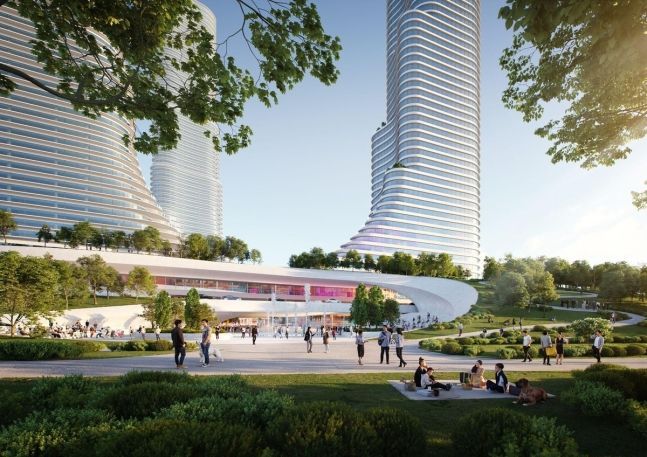
Specifically, the three buildings will incorporate multifunctional mixed-use plans including office, commercial, cultural, lodging, and residential functions, serving as a global future business complex and advanced industry hub. The lower and upper floors will be provided as open spaces, and a sunken plaza connecting the lower floors of the three buildings will be created to enable seamless pedestrian movement and interaction. Additionally, the project will feature top-tier eco-friendly buildings certified by international evaluation systems (LEED Platinum). A pedestrian network linking Seoul Forest Station, the Sampyo site, Jungnangcheon Stream, and Eungbong Station (Eungbongsan) will also be established.
Plans include regional specialized facilities such as the "Seoul Unicorn Startup Hub" to drive changes in the surrounding commercial and business landscape, and synergy with the Seongsu IT Industry Development Promotion District (semi-industrial area) near the Sampyo site to foster a global business district.
The plan also includes measures to enhance connectivity, accessibility, and publicness to actively encourage linkage with the surrounding area, a metropolitan transportation plan considering areas prone to traffic congestion, and public contribution plans such as environmental improvements around Seoul Forest. The plan will be finalized through the "Negotiation Coordination Council," composed of Seoul city officials, SOM, and experts from various fields. Through the preliminary negotiation system, the city plans to actively encourage the use of public contributions to invigorate the entire region. The preliminary negotiation system is a framework where the city, as the licensing authority, and private developers negotiate to establish detailed development plans for large sites over 5,000㎡. Part of the planning gains from zoning upgrades is secured as public contributions to improve local conditions and create necessary facilities.
The city plans to complete preliminary negotiations with the project operator SP Seongsu PFV Co., Ltd. by next year, decide on the district unit plan, and proceed with permits and construction aiming for 2025.
Hong Seon-gi, Director of Future Space Planning at Seoul City, said, "We will systematically establish the development plan for the Sampyo site and Seongsu area so that they can become representative industrial, tourism, business, and art and culture hubs of Seoul, and draw out reasonable public contributions."
© The Asia Business Daily(www.asiae.co.kr). All rights reserved.


















