16 Regional Specialized Regeneration Projects
1 Innovation District, 3 Certified Projects
Expected to Create About 9,000 Jobs
Including Gimpo and Yeoncheon in Gyeonggi, Nam-gu in Gwangju, and Cheongdo in Gyeongbuk, a total of 20 locations nationwide have been selected as new sites for urban regeneration projects. A total of 1.2032 trillion KRW will be invested to enhance urban competitiveness by leveraging the unique characteristics of each region, improve residential environments, and establish regional hubs.
On the 15th, the Ministry of Land, Infrastructure and Transport announced that 20 new urban regeneration project sites were selected for the second half of this year through the 33rd Urban Regeneration Special Committee review.
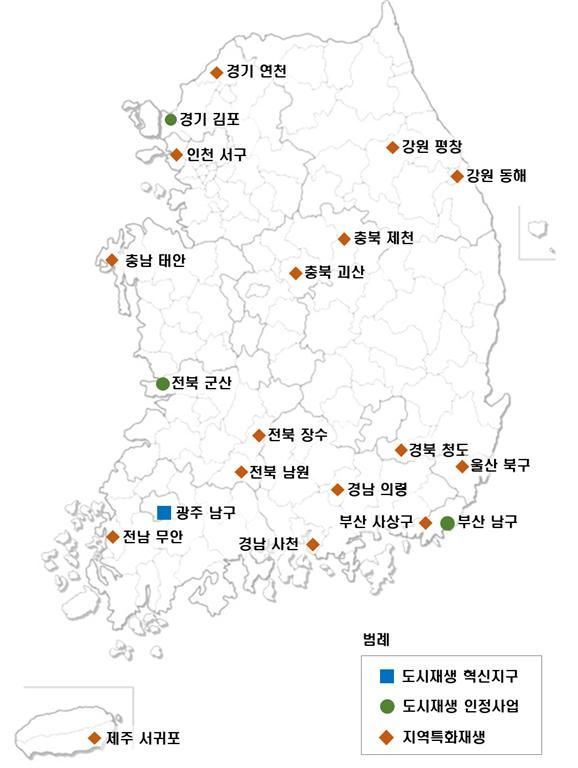 Location map of newly selected urban regeneration project sites. [Data provided by the Ministry of Land, Infrastructure and Transport]
A total of 49 candidate sites applied for three types of projects?'Innovation Districts,' 'Recognition Projects,' and 'Regional Specialized Regeneration Projects'?based on the 'New Government Urban Regeneration Promotion Plan' announced last July. The final selections were made after evaluating feasibility and project validity.
Innovation Districts are district-level development projects that create regional hubs where industry, commerce, and residential areas are concentrated. Recognition Projects are point-based projects implemented without an activation plan for rapid small-scale regeneration. Regional Specialized Regeneration aims to revitalize central and alleyway commercial districts and strengthen urban competitiveness by highlighting regional characteristics.
The selected project sites include many region-led and private-participation regional specialized regeneration projects.
These include 16 locations: Sasang-gu in Busan (regional commercial district revitalization), Seo-gu in Incheon (creation of an eco-friendly demonstration city), Buk-gu in Ulsan (creation of leisure and cultural hub spaces), Yeoncheon in Gyeonggi (creation of a prehistoric specialized street), Jecheon (building diverse cultural content) and Goesan (tourism hub creation) in Chungbuk, Taean in Chungnam (specialized food development hub), Namwon (startup platform linked with regionally specialized schools) and Jangsu (red food specialized hub) in Jeonbuk, Muan in Jeonnam (F&B content hub facilities), Cheongdo in Gyeongbuk (Hwayang cultural hub), Sacheon (Palpopallak platform creation) and Uiryeong (experience facility creation) in Gyeongnam, Seogwipo in Jeju (win-win stay-type workation village creation), Donghae (East Sea cultural hub and cultural street creation) and Pyeongchang (tourism hub platform through industry-academia-research cooperation) in Gangwon.
Three locations?Nam-gu in Busan (complex cultural space creation), Gimpo in Gyeonggi (complex cultural exchange center creation), and Gunsan in Jeonbuk (senior citizen hub space creation)?were selected as Recognition Projects.
Nam-gu in Gwangju, selected as an Innovation District, is expected to establish a regional economic hub including a transportation hub and an industry-academia-research cluster.
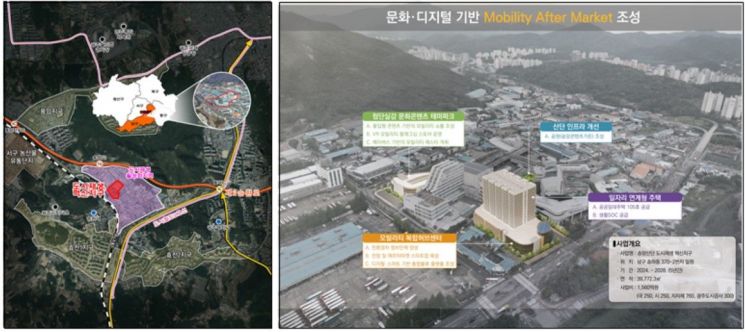 Location map (left) and bird's-eye view of Nam-gu, Gwangju, selected as an Innovation District. [Source: Ministry of Land, Infrastructure and Transport]
The evaluation criteria for project site selection included urban regeneration project implementation performance and whether linked projects with other ministries were included. Additional points were awarded if a disaster prevention plan was established using the National Spatial Disaster Diagnosis System to prepare for disasters and accidents.
The National Spatial Disaster Diagnosis System is a solution that divides the entire national territory into 100-meter grid units and diagnoses the risk level of disasters and accidents at the analysis target site on a scale from 1 to 5.
A total of 1.2032 trillion KRW, including 277.7 billion KRW in national funds and 210.7 billion KRW in local funds, will be invested in the newly selected urban regeneration project sites to regenerate 4.45 million square meters of declining areas.
Through this project, the Ministry of Land, Infrastructure and Transport expects the establishment of 36 community-oriented shared facilities, 20 startup support spaces, and public rental housing, which will improve new housing supply and residential environments, while creating approximately 9,000 jobs.
Furthermore, since 17 out of the 20 newly selected project sites (85%) are located outside the metropolitan area and 95% are in small and medium-sized local cities (with populations under 500,000), it is expected to contribute to balanced national development.
Meanwhile, among the Innovation District applicants, Dong-gu in Incheon, Seobuk-gu in Cheonan, Chungnam, and Seo-gu in Busan were selected as candidate sites to enhance the completeness of their plans and will be supplemented in the first half of next year.
© The Asia Business Daily(www.asiae.co.kr). All rights reserved.
![User Who Sold Erroneously Deposited Bitcoins to Repay Debt and Fund Entertainment... What Did the Supreme Court Decide in 2021? [Legal Issue Check]](https://cwcontent.asiae.co.kr/asiaresize/183/2026020910431234020_1770601391.png)
















