Ministry of Trade, Industry and Energy Announces Vision and Strategy for Advanced Robot Industry
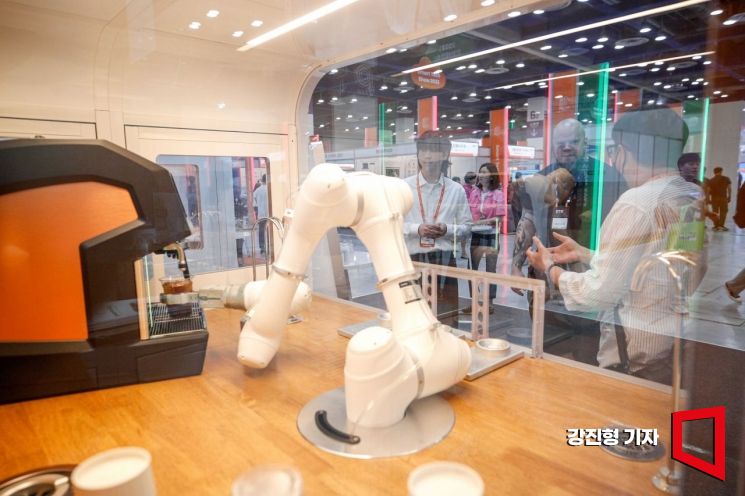 Foreign buyers attending the "12th Smart Tech Korea - Robo Tech Show" held at COEX in Gangnam-gu, Seoul on June 28 are watching a barista robot. Photo by Jinhyung Kang aymsdream@
The government has decided to invest 3 trillion won by 2030 to foster the robot industry and distribute more than one million robots across all industrial sectors.
On the 14th, the Ministry of Trade, Industry and Energy held an 'Advanced Robot Industry Strategy Meeting' at the Mando Next M building in Pangyo, Gyeonggi Province, chaired by Minister Bang Moon-kyu. The meeting was attended by executives from major robot companies and related associations and organizations, where they announced the 'Advanced Robot Industry Vision and Strategy' (hereinafter referred to as the Robot Strategy) outlining these industrial development goals.
Attendees included LG Electronics Vice President Jang Ik-hwan, Doosan Robotics CEO Ryu Jeong-hoon, TiRobotics CEO Ahn Seung-wook, HL Mando CEO Jo Sung-hyun, HiZen RNM CEO Kim Jae-hak, Komotech CEO Yoon Jung-seok, POSCO DX Executive Director Yoon Seok-jun, CMES CEO Lee Sung-ho, as well as Korea Robot Industry Association Chairman Kim Wan-soo and Korea Machinery Industry Promotion Association Chairman Cho Young-chul.
On this day, the government presented a goal to invest more than 3 trillion won from the public and private sectors by 2030, aiming to nearly quadruple the domestic robot market from 5.6 trillion won in 2021 to over 20 trillion won. The government expects the number of 'star companies' with sales exceeding 100 billion won to increase from five in 2021 to 30. Based on the expanded domestic market, robot exports are also expected to grow from 1.1 trillion won in 2021 to 5 trillion won by 2030.
To strengthen the foundation for the development of the K-Robot industry, the localization rate of parts, which was 44.4% in 2021, will be raised to 80% by 2030. The government will focus on securing eight core technologies: servo motors, reducers, sensors, grippers, controllers, autonomous mobility software, autonomous manipulation software, and human-robot interaction technology (HR). To this end, the government plans to establish a roadmap for securing these eight core technologies by the first half of next year.
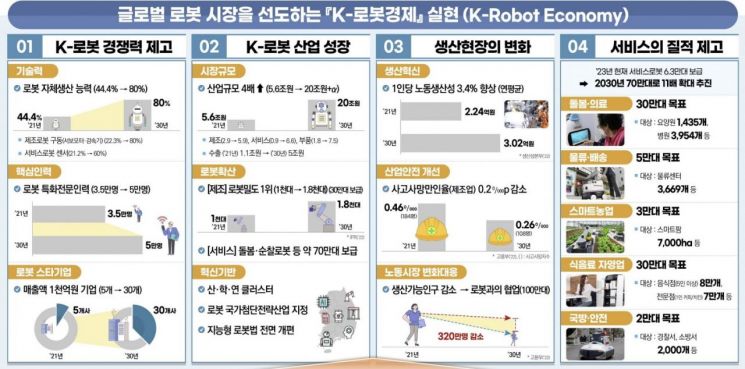
A quantitative goal was also presented to deploy and utilize one million robots on a large scale across industrial and social sectors. Initially, the target is to supply a total of 680,000 robots in industrial fields such as manufacturing, agriculture, logistics, small businesses, and industrial safety.
According to the International Federation of Robotics (IFR), Korea ranks first in the world with a 'robot density' of 1,012 robots per 10,000 manufacturing workers. However, Korean robots are concentrated in specific manufacturing sectors such as automobiles and electrical electronics, with relatively low utilization in other fields. The government expects to fill the labor shortage gap caused by the declining working population and activate the 'K-Robot economy' by expanding robot deployment in sectors facing increasing labor shortages, such as agriculture, logistics centers, parcel delivery, and restaurant cooking and serving.
For various robots serving the food and beverage self-employed sector, such as food serving robots that have already started appearing in restaurants, the goal is to distribute 300,000 units by 2030. Currently, Chinese-made serving robots, which are competitively priced, occupy more than 50% of the domestic market.
In the social sector, which is still in the early stages of market formation compared to industrial use, a total of 320,000 robots will be distributed. 'Cook robots' that assist with meal preparation will be deployed, and robots will be used for dangerous tasks such as surveillance and reconnaissance. Additionally, 20,000 'robot military and police' units will be deployed in defense and safety sectors, assisting with routine police patrols.
The government has set a target to distribute 300,000 care and medical robots across hospitals, nursing homes, and homes, and is also working on establishing institutional foundations. This includes reflecting rehabilitation robot medical fees, conducting surgical robot demonstrations in medically underserved areas, distributing AI companion robots for the elderly, and providing public benefits for care robots.
From 2024 to 2028, the government will invest about 200 billion won to create a 'National Robot Test Field' on a 166,973㎡ site in Dalseong-gun, Daegu. Furthermore, the government plans to nurture more than 15,000 professionals in the robot industry by 2030 to support the development of the robot industry.
© The Asia Business Daily(www.asiae.co.kr). All rights reserved.


















