Joint Statement Released... Also Demanding the Introduction of the Regional Doctor System
Members of the Gwangju Metropolitan Council and Jeonnam Provincial Council urged the establishment of a national medical school in Jeonnam.
On the 14th, they issued a joint statement at the Gwangju City Council calling for the establishment of a national medical school in Jeonnam and the introduction of a regional doctor system to secure basic medical rights and build a stable medical system.
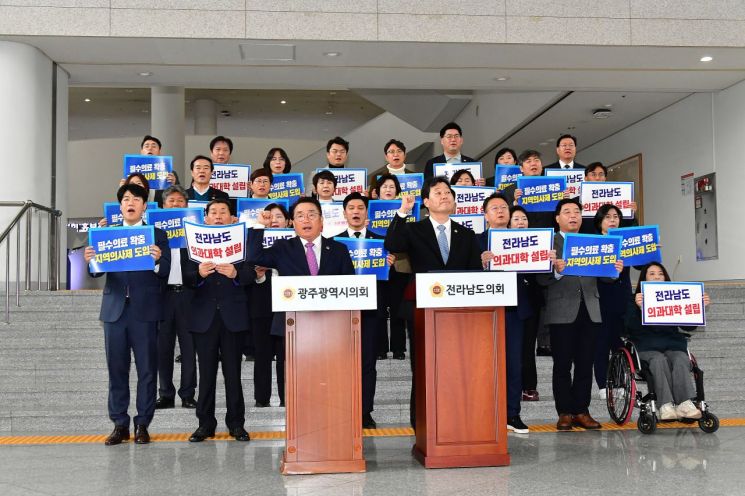
The council members stated, “The government has announced plans to increase medical school quotas starting in 2025 and to consider establishing regional medical schools as part of strengthening essential and public healthcare,” adding, “We welcome and support the full-scale discussion on expanding medical school quotas, which had been frozen for 18 years, and expect that the government will surely respond to the aspirations of the 3.5 million residents of Gwangju and Jeonnam for the establishment of medical schools and the introduction of a regional doctor system.”
They continued, “However, Jeonnam, which lacks a medical school, has not even been able to participate in the medical school quota demand survey, and the establishment of a medical school remains a distant task, causing great disappointment among residents,” explaining, “Jeonnam has only 2.6 doctors per 1,000 people, which is about half of Seoul’s 4.8 doctors. The number of emergency medicine specialists is also only 0.4 per 100,000 people, far below the national average of 1.2.”
They added, “Jeonnam is in an extremely poor medical situation with no foundation for a medical school and no advanced general hospitals equipped with more than 20 clinical departments to treat severe and complex diseases,” asserting, “As a result, 830,000 residents annually travel to other cities and provinces for advanced emergency and trauma treatment, with medical expenses flowing out amounting to a staggering 1.6 trillion won.”
Furthermore, they emphasized, “The number of re-transfers by 119 emergency medical teams in the Gwangju-Jeonnam area has exceeded 2,600 cases over the past five years, and there are only four neonatal intensive care units, with one doctor responsible for 23.8 beds,” stressing, “The recurring ‘emergency room cycling’ and the pediatric medical crisis reaching its limits clearly reveal the harsh reality of the collapse of essential medical care in the Gwangju-Jeonnam region.”
© The Asia Business Daily(www.asiae.co.kr). All rights reserved.

















