Improvement Trend After June Deficit (-83 Trillion Won) Within Government Forecast (-58.2 Trillion Won)
The national budget deficit, which had exceeded 70 trillion won until last September, improved to 52.2 trillion won. The figure fell within the government's initially projected forecast (58.2 trillion won). Since peaking at an 83 trillion won deficit at the end of June, the deficit has been steadily narrowing.
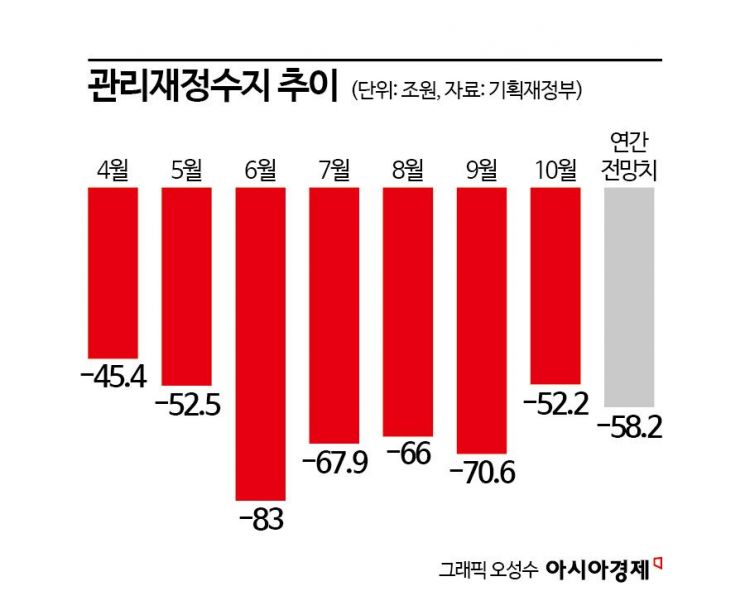
According to the 'Monthly Fiscal Trend (December issue)' released by the Ministry of Economy and Finance on the 14th, the managed fiscal balance recorded a deficit of 52.2 trillion won through October. The managed fiscal balance is the figure obtained by subtracting social security funds from the integrated fiscal balance (total revenue - total expenditure), reflecting the overall national budget status.
The deficit size improved by 18.4 trillion won compared to the end of September's 70.6 trillion won deficit. Compared to the same month last year, it improved by 34.1 trillion won, bringing the figure within the government's forecast for the managed fiscal balance (-58.2 trillion won). Since recording an 83 trillion won deficit at the end of June, the managed fiscal balance showed a general trend of narrowing deficits with figures of -67.9 trillion won in July, -66 trillion won in August, and -70.6 trillion won in September.
The improvement in the managed fiscal balance was largely influenced by value-added tax (VAT) revenues received in October. A Ministry of Economy and Finance official explained, "VAT revenues come in January, April, July, and October, and typically the October figures show improvement." The integrated fiscal balance recorded a deficit of 10.4 trillion won, an improvement of 18.4 trillion won compared to the same month last year.
Despite ongoing tax revenue shortages and the government's belt-tightening efforts, national debt slightly increased. As of the end of October, total expenditure was 502.9 trillion won, down 77.8 trillion won compared to the same period last year, but central government debt rose by 5.9 trillion won from the previous month to 1,105.5 trillion won. This is still 3.8 trillion won above the government's budget forecast (1,101.7 trillion won). The official stated, "Considering the schedule for redeeming government bonds at year-end, the figure is expected to converge with the forecast." National debt refers only to central government debt.
With decreases in national taxes and non-tax revenues, total revenue recorded 492.5 trillion won, down 45.2 trillion won compared to the same period last year. Among this, national tax revenue was 305.2 trillion won, a decrease of 50.4 trillion won compared to the same period last year, mainly due to declines in income tax, corporate tax, and VAT. Income tax fell by 14.6 trillion won due to a contraction in real estate transactions, and corporate tax decreased by 23.7 trillion won due to poor corporate performance. Last month, the issuance scale of government bonds was 6.9 trillion won, and 5 trillion won based on competitive bidding. As inflation slowed in major countries and global interest rates declined, government bond yields recently decreased.
© The Asia Business Daily(www.asiae.co.kr). All rights reserved.

![Clutching a Stolen Dior Bag, Saying "I Hate Being Poor but Real"... The Grotesque Con of a "Human Knockoff" [Slate]](https://cwcontent.asiae.co.kr/asiaresize/183/2026021902243444107_1771435474.jpg)















