Jasaeng Korean Medicine Hospital, Economic Evaluation Analysis of Pharmacopuncture Treatment
"More Cost-Effective Than General Physical Therapy"
A study from the Korean medicine community has found that pharmacopuncture treatment for patients with neck pain is more cost-effective than general physical therapy.
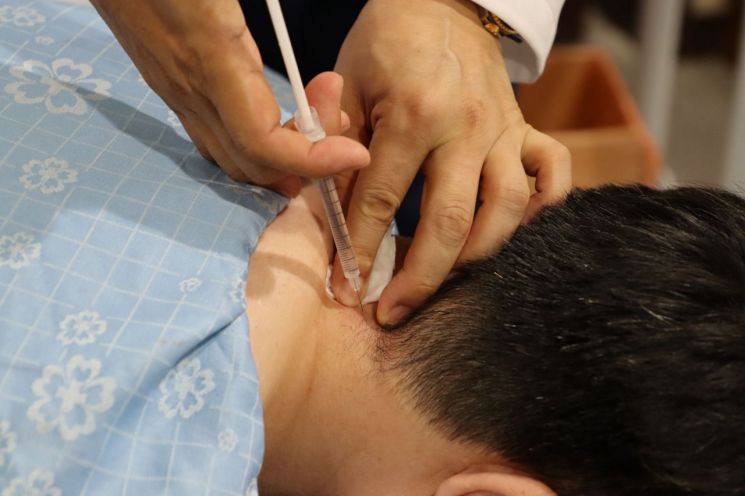 Medical staff at Jaseng Hospital of Korean Medicine are administering pharmacopuncture treatment to a patient with neck pain.
 [Photo by Jaseng Hospital of Korean Medicine]
On the 14th, Jaseng Hospital of Korean Medicine announced that a research team led by Korean medicine doctor Kim Doori from the Spine and Joint Research Institute compared and analyzed the cost-effectiveness of pharmacopuncture treatment and general physical therapy for patients with chronic neck pain, confirming that pharmacopuncture is a more cost-efficient treatment method. The study analyzed treatment costs from the perspectives of quality of life, healthcare system, and society.
According to Jaseng Hospital of Korean Medicine, neck pain (cervical pain) is one of the most common musculoskeletal disorders worldwide, with an adult prevalence rate of about 50%. Especially in modern society, where computer and smartphone use is widespread, the number of patients is continuously increasing, leading to a growing socioeconomic burden. Neck pain can worsen into conditions such as cervical disc herniation and easily become chronic, necessitating appropriate treatment.
Therefore, interest in conservative treatments like pharmacopuncture, which can provide stable effects without surgery, is also increasing, the hospital explained. Pharmacopuncture, which involves refining effective components of herbal medicine and injecting them directly into the body in the form of injections, is a representative treatment method for neck pain primarily used in Korean medicine. Pharmacopuncture combines the physical stimulation of acupuncture with the effects of herbal medicine to quickly reduce inflammation and pain and promote the regeneration of damaged nerves, thus offering therapeutic benefits.
However, the research team noted that although many studies have demonstrated the therapeutic effects of pharmacopuncture, there is a lack of research clarifying its cost-effectiveness.
The research team randomly divided 101 adult patients suffering from chronic neck pain for more than six months into a pharmacopuncture treatment group and a general physical therapy group, which included thermal therapy and electrical therapy, and conducted treatments twice a week for four weeks. An additional follow-up observation was conducted for eight weeks thereafter.
The team performed cost-effectiveness analysis using the Quality-Adjusted Life Year (QALY) indicator and analyzed from healthcare system and societal perspectives. QALY measures the improvement in quality of life due to treatment, with higher values indicating greater cost-effectiveness. The healthcare system perspective analysis considered costs, time, and various opportunity costs invested in treatment. The societal perspective analysis additionally included productivity loss costs due to absenteeism and reduced work performance.
EQ-5D and SF-6D, tools for measuring quality of life, were used to calculate QALY. The results showed that all indicators were higher in the pharmacopuncture group compared to the general physical therapy group. From both healthcare system and societal perspectives, the pharmacopuncture group’s costs were $26 and $1,157 lower, respectively, than those of the physical therapy group. The research team explained that pharmacopuncture, with higher QALY and lower costs, was analyzed as a more cost-effective treatment method compared to general physical therapy.
Time costs and productivity loss costs related to treatment showed statistically significant differences between the two groups. Time costs were about $35 lower in the pharmacopuncture group, and productivity loss costs were approximately $1,130 lower. This indicates that pharmacopuncture shows higher effectiveness relative to treatment time. Even when the fee for pharmacopuncture, set at $17 per session as a non-reimbursed treatment, was doubled for analysis, pharmacopuncture was confirmed to be a cost-effective treatment from a societal perspective, the research team explained.
Kim Doori, the first author of the paper, said, "We hope this study, which proves the cost-effectiveness of pharmacopuncture widely used in neck pain treatment, will help in the future establishment of related policies," adding, "We also hope more research will be conducted on the cost-effectiveness of other integrated Korean medicine treatments, not just pharmacopuncture."
Meanwhile, this paper was published in the SCI(E)-level international journal 'BMC Health Services Research (IF=2.908)'.
 Korean Medicine Doctor Kim Doori, Spine and Joint Research Institute, Jaseng Hospital of Korean Medicine.
 [Photo by Jaseng Hospital of Korean Medicine]
© The Asia Business Daily(www.asiae.co.kr). All rights reserved.
![Clutching a Stolen Dior Bag, Saying "I Hate Being Poor but Real"... The Grotesque Con of a "Human Knockoff" [Slate]](https://cwcontent.asiae.co.kr/asiaresize/183/2026021902243444107_1771435474.jpg)

















