Establishment of Annual Economic Security Dialogue Between Two Countries... Completing Global Semiconductor Alliance
Yoon on Alliance: "Building Cutting-Edge Technology, Solving Problems, Sharing Information"
Emphasizing "Best Relations" with Netherlands and "Wider Horizons for Relations"
Cooperation in Economic Security, Supply Chains, Nuclear Power, Carbon-Free Energy, ICT, Defense, etc.
South Korea and the Netherlands have established a 'semiconductor alliance.' This signifies not just simple economic cooperation but a commitment to immediate and efficient response and support in the event of supply chain crises. President Yoon Suk-yeol stated, "The goal of the semiconductor alliance between South Korea and the Netherlands is to create the world's best super-gap," while Dutch Prime Minister Mark Rutte emphasized, "It is a promising initiative and a true 'win-win' in every sense."
On the 13th (local time), President Yoon held a press conference after a summit with Prime Minister Rutte in The Hague, the seat of government, saying, "Until now, the semiconductor-related relationship between South Korea and the Netherlands was a 'close cooperative relationship,' but with this visit, we have elevated this cooperative relationship to an 'alliance relationship.'" President Yoon explained the 'semiconductor alliance' as "meaning that we will maintain a semiconductor super-gap, jointly build cutting-edge technology, discuss and solve major scientific and technological issues together, and share information closely."
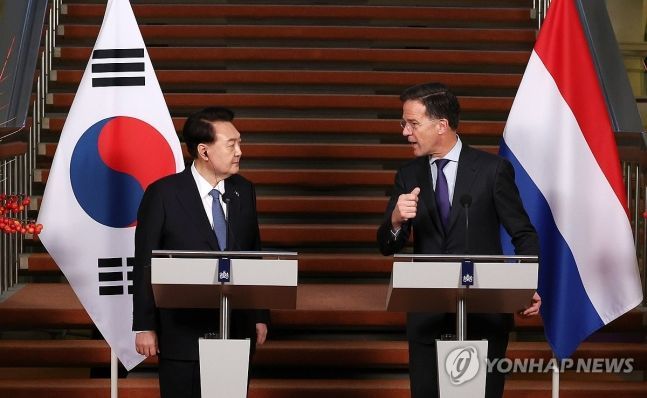 President Yoon Suk-yeol, on a state visit to the Netherlands, is holding a joint press conference with Dutch Prime Minister Mark Rutte at the Prime Minister's Office in The Hague on the 13th (local time).
 [Photo by Yonhap News]
'A Semiconductor Alliance Encompassing Government, Industry, and Academia'… "Maximizing Cooperation Effects and Value"
On this day, President Yoon referred to the bilateral relationship as a 'semiconductor alliance encompassing government, industry, and academia,' adding, "The Netherlands, the world's largest semiconductor equipment producer, and South Korea, a semiconductor manufacturing powerhouse, occupy key positions in the global supply chain." He further stated, "Our two countries aim to combine each other's strengths to maximize the effects and value of semiconductor cooperation."
The establishment of an annual economic security dialogue through the 'Economic Security Cooperation MOU' between the two countries is in the same context. It is a follow-up measure following the formalization of the 'semiconductor alliance' between the two nations. The Presidential Office noted that although cooperation channels have been established with major global semiconductor powers such as the United States, Japan, and the United Kingdom, the new semiconductor dialogue with the Netherlands completes a 'global semiconductor supply chain alliance' connecting the entire cycle of design, materials/components/equipment, and manufacturing.
Evaluating the South Korea-Netherlands relationship, President Yoon expressed confidence, saying, "This is the best relationship among all our past relations." He added, "The most crucial aspect is the elevation from semiconductor cooperation to a semiconductor alliance. Going forward, based on advanced science and technology and semiconductors, the horizon of bilateral relations will broaden and deepen across all areas including security, economy, and culture."
Prime Minister Rutte also expressed his willingness to cooperate. Regarding the South Korea-Netherlands relationship, he said, "I believe we have reached an unprecedented level of cooperation. It has never been this good." He elaborated, "Not only in traditional fields such as horticulture and agriculture but also in cybersecurity, extensive defense cooperation, and semiconductors, which are very important areas."
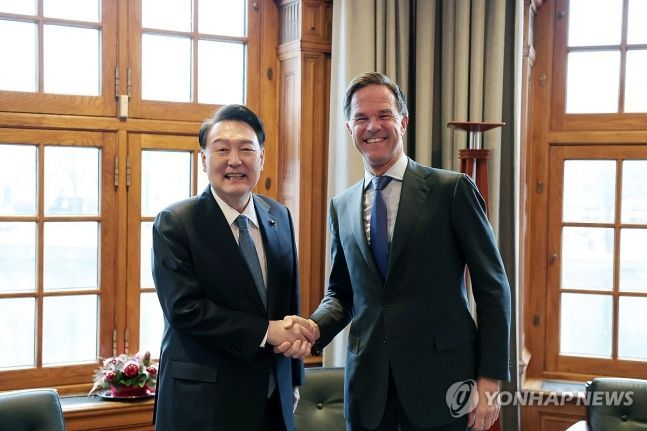 President Yoon Suk-yeol, on a state visit to the Netherlands, shakes hands with Dutch Prime Minister Mark Rutte during a private meeting at the Prime Minister's Office in The Hague on the 13th (local time).
 [Photo by Yonhap News]
A Bond Forged in Blood... Now a 'Strategic Partnership' Covering All Fields
President Yoon evaluated the bilateral cooperation by stating, "The alliance forged in blood during the Korean War over 70 years ago has now evolved into a 'strategic partnership' encompassing all fields including security, economy, culture, and global agendas." In particular, the two leaders declared, "We recognize the special complementary relationship between our two countries in the semiconductor value chain and reaffirm our commitment to building a semiconductor alliance encompassing government, industry, and academia."
This strategic communication intent was also reflected in the joint statement issued by the two leaders. It was concretized through the establishment of a dialogue between foreign and industry ministers, annual policy consultations at the deputy minister level (Ministry of Foreign Affairs), an economic joint committee (Ministry of Foreign Affairs), and an innovation joint committee (Ministry of Trade, Industry and Energy). Additionally, the creation of an annual economic security dialogue involving director-general level officials, promotion of working-level consultations on comprehensive security issues, and annual meetings of a cross-ministerial cyber policy council were included.
Cooperation in defense, defense industry, and emerging security fields will also be pursued. First, a memorandum of understanding (MOU) on defense cooperation will be signed, and the holding of a joint defense industry and military logistics committee will be promoted. They agreed to participate as observers in the 2025 JPOW (Joint Project Optic Windmill) exercise, an air defense and missile defense command post exercise led by Germany and the Netherlands.
The two leaders also shared joint views on cooperation regarding the Korean Peninsula and the Indo-Pacific region. They strongly condemned North Korea's provocations and included the Netherlands' support for the 'Bold Initiative,' which involves more bold and active economic support and investment based on North Korea's commitment to denuclearization, as well as strengthening cooperation to improve North Korean human rights.
In the science and technology sector, they declared the signing of an ICT cooperation MOU, expansion of cooperation in the digital domain, and promotion of agreements or MOUs in science and research fields. Furthermore, they plan to strengthen cultural, artistic, and human exchanges. Exchanges and cooperation between policy research institutes of both countries will be enhanced, and the number of participants in the working holiday MOU program will be doubled.
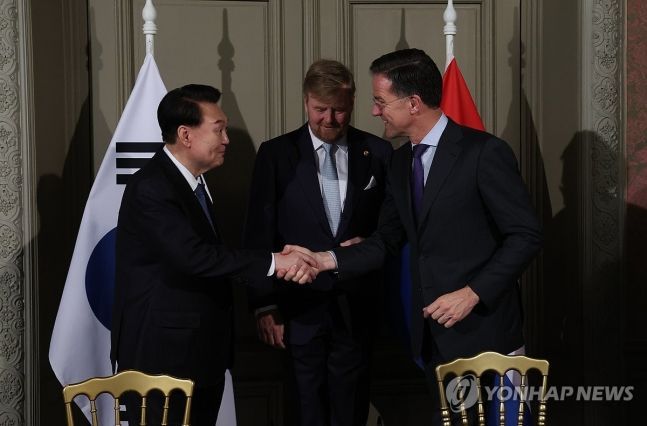 President Yoon Suk-yeol, who is on a state visit to the Netherlands, shakes hands with Dutch Prime Minister Mark Rutte after the signing ceremony of the Korea-Netherlands MOU held at the Prime Minister's Office in The Hague on the 13th (local time). In the center is King Willem-Alexander.
 [Photo by Yonhap News]
Six MOUs Signed Covering Economy to Security… Focus on Diversifying Economic Cooperation
On the occasion of President Yoon's state visit, a total of six memoranda of understanding (MOUs) were signed, focusing on economic security, supply chains, nuclear energy, carbon-free energy (CFE), information and communication technology (ICT), and defense cooperation. The MOUs signed include ▲Economic Security Cooperation MOU ▲Core Item Supply Chain Cooperation MOU ▲Government-to-Government Cooperation MOU in the Nuclear Field ▲Carbon-Free Energy Cooperation MOU ▲ICT Cooperation MOU ▲Defense Cooperation MOU, with an emphasis on diversifying economic cooperation based on semiconductors.
Through the 'Economic Security Cooperation MOU,' the two countries will establish an annual economic security dialogue. The 'Core Item Supply Chain Cooperation MOU' (between South Korea's Ministry of Trade, Industry and Energy and the Netherlands' Ministry of Foreign Affairs) aims to enhance bilateral cooperation for supply chain crisis response, including the operation of an early warning system related to supply chains. The nuclear cooperation MOU (between the Ministry of Trade, Industry and Energy and the Ministry of Economic Affairs and Climate Policy) focuses on cooperation across the entire cycle of nuclear power technology, personnel, and fuel.
Additionally, through the 'Carbon-Free Energy Cooperation MOU' signed between the Ministry of Trade, Industry and Energy and the Ministry of Economic Affairs and Climate Policy, the two countries will support exchanges and joint technology development in carbon-free energy policies and the fields of hydrogen, wind power, and solar power. The 'ICT Cooperation MOU' (between the Ministry of Science and ICT and the Ministry of Economic Affairs and Climate Policy) includes strengthening cooperation in artificial intelligence, quantum technology, and next-generation networks.
The 'Defense Cooperation MOU' was signed after a year of review between the defense authorities of both countries following the Dutch side's proposal during Prime Minister Rutte's visit to South Korea last year. Through the defense cooperation MOU, the two countries plan to enhance defense exchanges and cooperation in areas such as security issues, peacekeeping operations (PKO), cyber, artificial intelligence, maritime security, and defense industry, and encourage the expansion of joint training.
© The Asia Business Daily(www.asiae.co.kr). All rights reserved.
![Clutching a Stolen Dior Bag, Saying "I Hate Being Poor but Real"... The Grotesque Con of a "Human Knockoff" [Slate]](https://cwcontent.asiae.co.kr/asiaresize/183/2026021902243444107_1771435474.jpg)


















