[Sudden Acceleration Accident Controversy ②]
Limitations of Scientific Proof... Increase EDR Reliability
Shift Defect Proof to Manufacturers, Evaluate Effectiveness
Secure Private Verification Personnel for Third-Party Investigation
Safety Devices Needed to Reduce Driver Misoperation Possibility
"I think sudden unintended acceleration accidents are like 'ghosts.' There are definitely people who have seen and experienced them, but they have no tangible existence. That means scientific proof is that difficult."
This is the statement of a vehicle technician who has worked in the field of traffic accident investigation for over 20 years. Experts unanimously agree that scientifically identifying the cause of suspected sudden acceleration incidents is virtually impossible with current technology. Victims question whether manufacturers avoid investigation for their own benefit, but experts insist there are parts that cannot be explained technically.
The same applies in legal battles after accidents. When a suspected sudden acceleration incident occurs, civil and criminal lawsuits proceed simultaneously. In civil lawsuits, drivers must prove vehicle defects to claim damages from manufacturers. In criminal cases, prosecutors must prove driver negligence. However, there are ambiguous cases where neither the manufacturer is responsible in civil lawsuits nor the driver in criminal cases. Investigating these cases in the gray area and resolving responsibility issues is a future challenge.
Can the Event Data Recorder (EDR) be trusted?
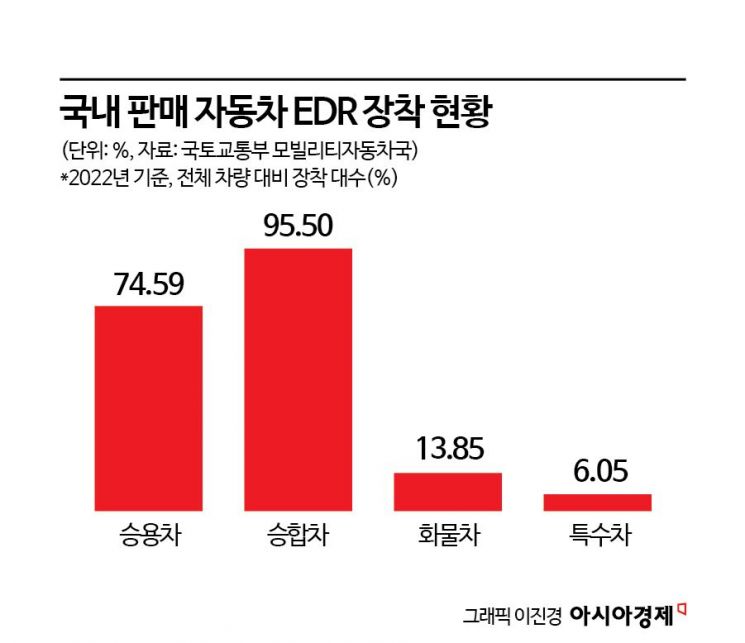
First, enhancing the reliability of the EDR is the most urgent task. Victims raise doubts about whether the EDR records can be trusted in suspected sudden acceleration vehicles, as the electronic control unit (ECU) is also malfunctioning. The ECU corresponds to the brain in a human. It's like asking if you can believe everything a person with a brain injury says. On the other hand, manufacturers counter that there is no evidence that the ECU was malfunctioning at the time of the accident. They retort that no matter what evidence is presented, drivers simply 'do not want to believe it.'
Of course, the reliability of the EDR is not 100% guaranteed. However, courts still adopt EDR records as key evidence in lawsuits. Therefore, it is important to create EDRs that both consumers and manufacturers can trust. To this end, the Ministry of Land, Infrastructure and Transport is currently considering increasing the mandatory EDR recording items from 15. Previously, only brake operation ON/OFF was recorded, but now detailed data such as brake pressure sensor values indicating the force applied to the brake pedal will be added. The expansion and recommendation of pedal black box installation are also under review. If doubts arise about EDR records, pedal black box footage capturing the driver's foot can be compared with EDR data.
Can manufacturers identify sudden acceleration accidents?
Drivers of vehicles suspected of sudden acceleration argue that manufacturers should bear the burden of proving vehicle defect responsibility. The logic is that manufacturers, who have superior expertise and access to related information compared to the general public, should prove the absence of defects. This approach is adopted in the United States, but cases recognized as vehicle defects are extremely rare.
A representative case is Toyota's large-scale recall in the U.S. from 2009 to 2011. Consumers claimed a malfunction in the throttle valve control device that regulates engine air intake, but Toyota did not acknowledge this. The U.S. government even commissioned NASA to investigate electronic control unit defects, but in 2011, the case was ultimately closed with Toyota found not guilty. Eventually, Toyota conducted a recall acknowledging the possibility that the accelerator pedal could get stuck under the floor mat, rather than an electronic equipment defect.
However, in October 2013, a meaningful verdict was delivered by a court in Oklahoma, USA. The jury ruled that Toyota must pay $3 million in damages to the family of a sudden acceleration accident victim. This was the first time a court recognized that the cause of the accident was a vehicle electronic device defect. The party that revealed this fact was neither the manufacturer nor the U.S. government, but a private software consulting firm called BARR Group. Considering such cases, the effectiveness of shifting the burden of proof in sudden acceleration accidents is a matter to be examined. There are calls to increase third-party private investigative advisory personnel rather than relying solely on the driver and manufacturer involved in the lawsuit.
What is the ultimate solution?
Experts point to the advancement of scientific accident investigation techniques, accident prevention campaigns to reduce driver errors, support for installing advanced safety devices, and expansion of mandatory safety device requirements as effective measures.
The National Forensic Service analyzed the causes of suspected sudden acceleration accidents from 2013 to 2018 and found that 76% of the total 269 cases were due to driver pedal misoperation. Even reducing the proportion of accidents caused by driver mistakes can significantly decrease the scale of damage. Recently, there have been calls in the international community to establish international standards to prevent pedal misoperation accidents. Under the UN's WP29, a technical expert group centered on Japan has been formed. Discussions are underway aiming to submit new UN standard documents by May next year.
Japan, which entered an aging society early, started a 'Support Car' purchase subsidy program for elderly drivers in 2017. Support Cars are equipped with emergency automatic braking systems (AEBS) and sudden acceleration suppression devices caused by pedal operation errors. Since May last year, Japan has also introduced a 'restricted license' system allowing elderly drivers to operate only vehicles equipped with AEBS.
Professor Kim Pil-su of Daelim University said, "Since it is difficult to identify the causes of sudden acceleration accidents, it is necessary to seek realistic measures that can find a compromise between consumers and manufacturers," adding, "Technical improvements such as pedal black boxes or engine/electronic equipment shutdown buttons should also be considered."
© The Asia Business Daily(www.asiae.co.kr). All rights reserved.
![Clutching a Stolen Dior Bag, Saying "I Hate Being Poor but Real"... The Grotesque Con of a "Human Knockoff" [Slate]](https://cwcontent.asiae.co.kr/asiaresize/183/2026021902243444107_1771435474.jpg)

















