U.S. Treasury Secretary Janet Yellen on the 12th (local time) assessed that the U.S. economy is heading toward a so-called 'soft landing' where inflation decreases without a severe economic slowdown. She dismissed concerns that the final stage (last mile) to achieve the 2% price stability target could be difficult, saying it would not be particularly challenging.
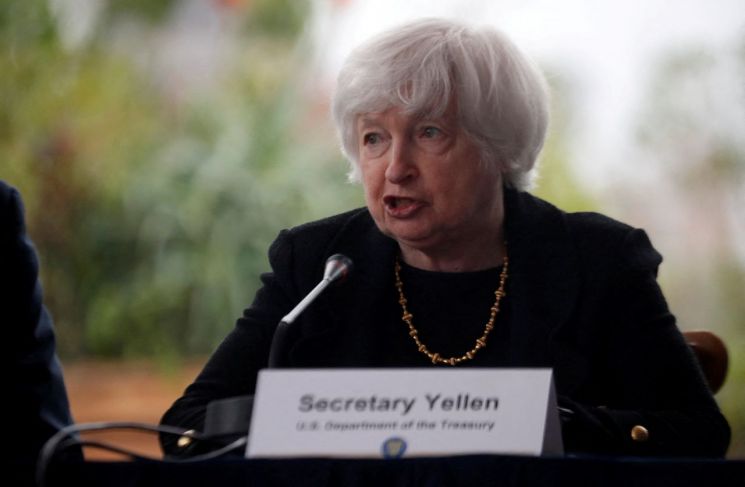
Secretary Yellen made these remarks while attending the Wall Street Journal (WSJ) CEO Council Summit, stating, "Inflation is definitely coming down meaningfully." She added, "In my view, a soft landing means the economy continues to grow and the labor market remains strong while inflation decreases," and said, "That is the path we are on."
These comments came shortly after the release of the November Consumer Price Index (CPI) for the U.S., which met expectations, just one day before the Federal Open Market Committee (FOMC) announces its final interest rate decision of the year. According to the U.S. Department of Labor, the November CPI rose 3.1% year-over-year, continuing the deceleration trend. However, concerns were confirmed as the so-called 'supercore' inflation, which excludes housing costs from the core CPI, showed little sign of easing. Bloomberg reported that the November supercore CPI increased 3.93% year-over-year and 0.44% month-over-month.
Yellen, an economist and former Federal Reserve (Fed) Chair, recently diagnosed that inflation is meaningfully slowing and moving toward the 2% price target. She said, "I see no reason why inflation cannot gradually decline to levels consistent with the Fed's mandate and goals under current conditions."
Furthermore, Yellen stated, "Personally, I do not see any particular reason why the last mile would be especially difficult." This contrasts with many officials and economists who believe the path ahead to reach 2% inflation could be more challenging than the process of lowering inflation to its current level. She added, "Because long-term inflation expectations have never been meaningfully elevated, all we needed to do to reduce inflation was to normalize the economy and return the labor market to full employment."
When asked whether the Fed is likely to begin cutting interest rates soon due to progress on inflation, Yellen was cautious. Instead, she explained that lower inflation means real interest rates are rising, which "in some ways causes monetary tightening. This is a factor that can weigh on the Fed's decisions regarding the interest rate path." This was interpreted as a subtle indication that rate cuts may follow sometime next year.
The results of the December FOMC meeting, which will be the last interest rate decision of the year, will be released at 2 p.m. Eastern Time on the 13th. The market expects the Fed to keep rates steady at the current 5.25?5.50%. The key focus will be the dot plot reflecting officials' rate projections and Chair Powell's press conference.
According to the Chicago Mercantile Exchange (CME) FedWatch tool, federal funds futures currently price in over a 98% probability that the Fed will hold rates steady at this month's meeting. The probability of a hold in January next year also exceeds 94%. The chances of the Fed cutting rates by at least 0.25 percentage points in March or May next year are above 41% and 74%, respectively.
A survey released by economic media CNBC on the same day showed that 69% of respondents expect the Fed to start cutting rates by June next year. This is not as soon as the market anticipates. If the Fed were to pivot to rate cuts too quickly, there is a risk of inflation rebounding as it did in the late 1960s to early 1970s. Therefore, Chair Powell is expected to maintain a tighter policy stance longer than anticipated. The median rate forecasts for the end of next year and the year after are 4.53% and 3.73%, respectively. Alongside this, respondents gave a 47% probability that the U.S. economy will achieve a soft landing, up 5 percentage points from the October survey.
On the question of whether the U.S. is on a sustainable fiscal path, Yellen reiterated her previous stance that it is not an urgent issue. However, she acknowledged that "if interest rates rise more than previously expected over the long term, additional stress on fiscal outlooks will occur," recognizing the risk of debt deterioration due to higher rates. She also added that raising tax rates on corporations and high-income households and strengthening existing tax laws, as proposed by President Joe Biden, would be the best solution.
Regarding signs of improved U.S.-China relations confirmed by recent talks between President Biden and Chinese President Xi Jinping, Yellen described the developments as "encouraging." She said, "We are in regular communication with the Chinese side," and emphasized that the world's two largest economies should cooperate on global challenges such as debt relief for developing countries and climate change.
© The Asia Business Daily(www.asiae.co.kr). All rights reserved.
![Clutching a Stolen Dior Bag, Saying "I Hate Being Poor but Real"... The Grotesque Con of a "Human Knockoff" [Slate]](https://cwcontent.asiae.co.kr/asiaresize/183/2026021902243444107_1771435474.jpg)











