The three major indices of the U.S. New York stock market showed a slightly positive trend in early trading on the 12th (local time), digesting the Consumer Price Index (CPI) that met expectations ahead of the final interest rate decision of the year scheduled for the next day.
At around 10:29 a.m. at the New York Stock Exchange (NYSE), the Dow Jones Industrial Average was up 0.23% from the previous close, trading around 36,488 points. The S&P 500, which focuses on large-cap stocks, was up 0.01% at 4,623 points, and the tech-heavy Nasdaq index rose 0.06% to 14,441 points.
Currently, within the S&P 500, financials, industrials, materials, and healthcare stocks are rising, while energy and utilities stocks are declining. The weakness in energy stocks is notable as international oil prices have fallen more than 2%. Oracle dropped nearly 10% after its quarterly earnings fell short of expectations. Macy's shares, which surged the previous day on acquisition rumors, fell more than 4% after Citigroup downgraded its investment rating. Alphabet, Google's parent company, declined nearly 1% after losing an antitrust lawsuit related to the App Store filed by Epic Games. Lucid Group fell more than 9% following the resignation of its Chief Financial Officer (CFO). Toy manufacturer Hasbro dropped over 2% on news of employee layoffs.
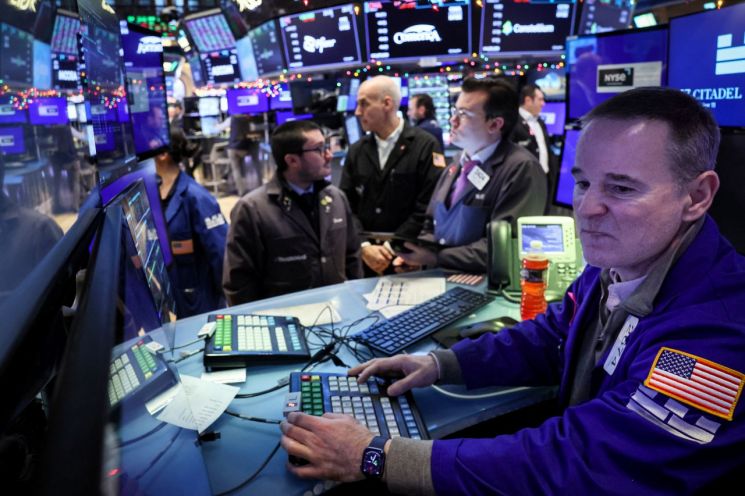
Investors are closely watching economic indicators such as the CPI released that morning and the resulting movements in Treasury yields ahead of the Federal Open Market Committee (FOMC) results for December, which will be announced the following afternoon. According to the U.S. Department of Labor, the November CPI rose 3.1% year-over-year, in line with expert expectations. This was lower than the previous month's increase of 3.2%, continuing the trend of slowing inflation. The October CPI rose 0.1% month-over-month, exceeding the expected 0.0%. The core CPI, which excludes volatile energy and food prices, increased 4.0% year-over-year and 0.3% month-over-month, both matching market expectations.
Ian Linzen, Head of U.S. Rate Strategy at BMO Capital Markets, evaluated the November CPI report, which generally met expectations, stating, "There are no details that would immediately impact the Fed's thinking." Christopher Rupkey, Chief Economist at FWD Bonds, described the market mood that day, saying, "Technically, inflation met core CPI expectations, so the market doesn't know what to do." However, he also added that the report is not good news for Fed officials.
Particularly concerning is the so-called ‘supercore’ inflation, which excludes housing costs from the core CPI and shows little sign of easing. According to Bloomberg News, the November supercore CPI rose 3.93% year-over-year and 0.44% month-over-month. Shima Shah, Chief Global Strategist at Principal Asset Management, pointed out, "Month-over-month CPI did not slow down, and looking at the supercore figures, the pace even accelerated. Given the labor market remains robust, this is not enough inflation deceleration to justify the market's expectations for monetary policy easing."
The December FOMC results, which will include the final interest rate decision of the year, will be released at 2 p.m. on the 13th. The market expects the Fed to keep rates unchanged at the current 5.25?5.50%. The key focus will be the dot plot containing officials' rate projections and Chairman Powell's press conference. Linzen said, "The supercore figures in the CPI report released today reinforce the need for a hawkish hold," and he expects the 2024 dot plot will not fully reflect the market's expectations for rate cuts. Chairman Powell is also expected to emphasize again during the subsequent press conference that the fight against inflation is not over, aiming to temper market hopes for rate cuts.
According to the CME Group's FedWatch tool, federal funds futures currently price in over a 98% probability that the Fed will hold rates steady at this month's meeting. The probability of a hold in January next year exceeds 94%. The chances of a rate cut of 0.25 percentage points or more in March or May next year are over 43% and 75%, respectively.
A survey released by economic media CNBC on the same day showed that 69% of respondents expect the Fed to begin cutting rates in June next year. This is not as soon as the market expects. Kathy Bostanich, Chief U.S. Economist at Nationwide, noted, "The market hastily priced in a high chance of cuts in the first quarter, but we expect cuts to begin around mid-next year." She explained that if the Fed turns to rate cuts too quickly, there is a risk of inflation rebounding as it did in the late 1960s to early 1970s, so Chairman Powell is likely to maintain a tighter policy longer than expected.
On the other hand, voices supporting a rate cut in March next year are also heard. Anna Wong, Economist at Bloomberg Economics, said, "The Fed has made significant progress in disinflation over the past six months. There are signs that deflation in China is further easing inflation. Short-term inflation expectations have also dropped sharply," and predicted, "The Fed will start cutting rates in March next year."
U.S. Treasury Secretary Janet Yellen, attending a summit in Washington D.C. that day, assessed that inflation is "definitely coming down meaningfully."
This week, in addition to the Fed, monetary policy meetings will be held by the European Central Bank (ECB) and the Bank of England (BOE). The ECB, which is likely to hold rates steady, is also expected to release revised economic forecasts. Additionally, Brazil, Norway, Mexico, Taiwan, the Philippines, and Russia will also decide on their interest rates.
In the New York bond market that day, the 10-year U.S. Treasury yield slightly declined to around 4.23%. The 2-year yield, which is sensitive to monetary policy, rose slightly to about 4.79%. The dollar index, which measures the value of the U.S. dollar against six major currencies, fell more than 0.1% to 103.9. The Chicago Board Options Exchange (CBOE) Volatility Index (VIX), known as Wall Street's fear gauge, dropped more than 2% to around 12.2.
International oil prices are on a downward trend. On the New York Mercantile Exchange, January delivery West Texas Intermediate (WTI) crude oil prices fell more than 3% from the previous close, trading around $69 per barrel. Brent crude also dropped more than 3%, trading near $73 per barrel.
European stock markets are also showing slight gains. Germany's DAX index rose 0.04%, the UK's FTSE index increased 0.08%, and France's CAC index was up 0.1%.
© The Asia Business Daily(www.asiae.co.kr). All rights reserved.

















