"Even with More Audience, No Increase in Workforce"
Director Kim Seong-su's film Seoul's Spring has attracted 7 million viewers in just 20 days since its release on the 11th, revitalizing the long-stagnant theater industry. However, voices from industry workers who do not welcome this rare warmth have become a hot topic.
A person claiming to be a theater worker, identified as Mr. A, recently expressed his difficulties on an anonymous bulletin board, saying, "Please stop coming to watch movies. It is really too hard."
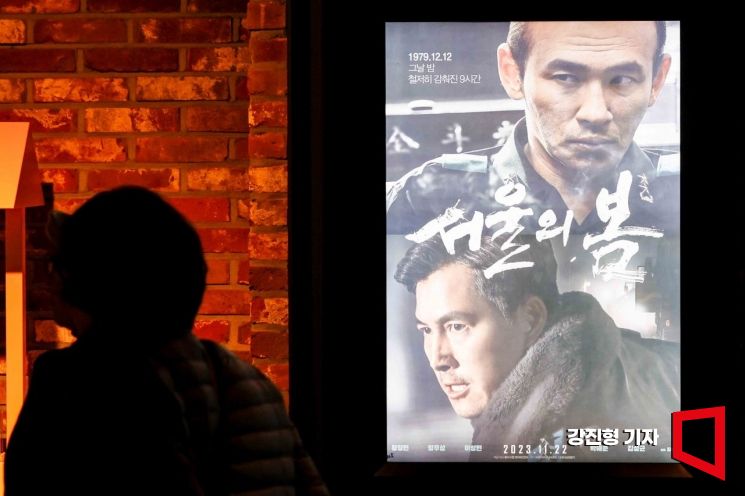 On the 44th anniversary of the December 12 military coup, the film "Spring in Seoul," which is based on the December 12 military coup, is being screened at a movie theater in Seoul on the 12th. Photo by Jinhyung Kang aymsdream@
In his post, Mr. A conveyed consumers' frustrations, stating, "Recently, Seoul's Spring has been a huge hit, and the number of attendees is enormous, so you might wonder why there are no staff. The screening rooms are dirty, and if you ordered at the concession stand, you probably waited a long time," lamenting that "it's because there are no staff."
He added, "The workforce has been reduced by more than half compared to last year. At the same time, only one or two people are barely managing to handle every sold-out show," and confessed, "In the past, when business was good, labor costs increased, so we hired part-timers, and even though it was tough, company sales increased, so treatment improved, which made me happy. But now, when business is good, only I suffer, so I just wish the audience wouldn't come."
He also claimed, "Although we have scheduled shifts, actual clock-in and clock-out checks are not done, so even if we work overtime, it is not properly calculated. Overtime is only recognized if you submit an application form, and there is a limit on how many overtime hours you can apply for in a month."
He continued, "Break times must be forcibly entered into the system as one hour each, but if one staff member takes a break at the same time, the part-timer alone has to handle both concession sales and screening room exit duties. Is this realistically possible?" He lamented, "We stand for nine hours straight without even eating and then go home. I sincerely hope you go to another nearby theater."
By criticizing the management for not increasing staff despite the rise in users, he confessed the harsh working conditions of frontline workers.
Theater Industry Faces Harsh Voluntary Retirement Wave
In fact, even after the end of COVID-19, theaters, which had long seen a drop in visitors, have recently introduced voluntary retirement programs. According to industry sources on the 7th, Lotte Cultureworks, the movie screening business division within the Lotte Group, is currently conducting voluntary retirements.
Lotte Cultureworks operates the Lotte Cinema theaters and the distributor Lotte Entertainment. Since the 29th of last month, it has been accepting voluntary retirement applications from employees with more than three years of service.
In reality, Lotte Cultureworks recorded sales of 154 billion KRW in the third quarter, down 18.2% compared to the same period last year, and operating profit plummeted 85.1% to just 3 billion KRW.
© The Asia Business Daily(www.asiae.co.kr). All rights reserved.

















