Gyeonlimangui, Jeokbanhajang, Namuchungsu...
Four-Character Idioms of the Year
Daegu Mayor Hong Joon-pyo commented on the selection of this year's four-character idiom by professors, "Gyeonlimangui (見利忘義)," which means "forgetting righteousness in pursuit of profit," saying, "It is truly shameful and embarrassing."
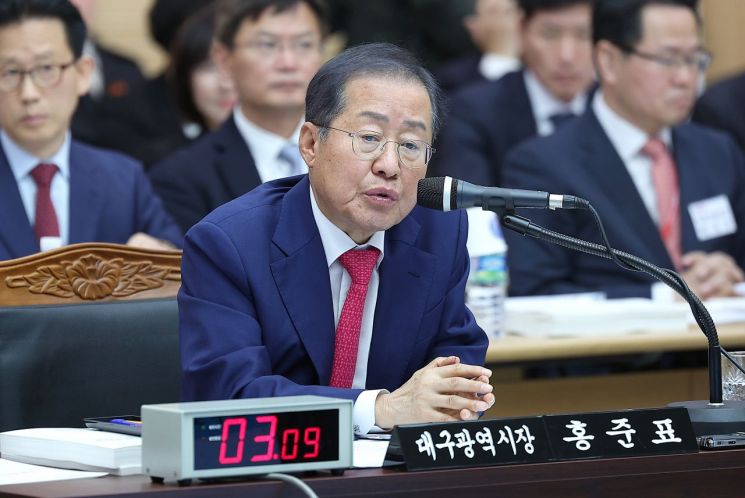
On the afternoon of December 10, Mayor Hong wrote on his social media, "Professors have chosen 'Gyeonlimangui (見利忘義)' as this year's four-character idiom. While Ahn Jung-geun advocated for 'Gyeonlisa-ui (見利思義),' meaning to prioritize righteousness over personal gain, professors have described today's society as 'Gyeonlimangui.' It is truly shameful and embarrassing."
He went on to say, "There was a time when I criticized the left for being shameless and the right for being cowardly, but nowadays, both the left and the right seem to live shamelessly."
He then directly addressed the political sphere, stating, "'Gyeonlimangui' and 'Huanmuchi (厚顔無恥)' mean the same thing. At the very least, we should live with a sense of shame."
Gyeonlimangui, Jeokbanhajang, Namuchungsu... Four-Character Idioms of the Year
Previously, the Professor Newspaper announced that, according to a survey of 1,315 university professors nationwide, 'Gyeonlimangui' was selected as the four-character idiom of the year, receiving support from 30.1% (396 votes) of respondents. 'Gyeonlimangui' means "forgetting righteousness in pursuit of profit" and originates from 'Gyeonlisa-ui (見利思義)' found in the Analects of Confucius, specifically the 'Heonmun' chapter.
Kim Byung-gi, Professor Emeritus of Chinese Language and Literature at Jeonbuk National University, who recommended 'Gyeonlimangui,' commented, "Our society is currently overrun with the phenomenon of 'Gyeonlimangui,' making the nation seem like a battlefield where everyone is left to fend for themselves. Politics is supposed to mean 'to govern and lead righteously,' but today's politicians seem more concerned with the interests of their own factions than with leading righteously."
Professors who chose 'Gyeonlimangui' expressed concern over the loss of values and public interest throughout society. They stated, "We are living in an era where the pursuit of profit has led to a loss of values," and, "As people pursue only their own interests, trust among members of society has collapsed, and the direction in which society should move has become uncertain."
The second most selected idiom was 'Jeokbanhajang (賊反荷杖),' which means "the thief turns around and wields the stick," receiving 25.5% (335 votes).
Lee Seung-hwan, Professor Emeritus of Eastern Philosophy at Korea University, said, "The government uses vulgar language and makes inappropriate remarks on the international diplomatic stage, yet blames journalists and the media. The responsibility for incompetent state management is always shifted to the previous administration, and while suppressing press freedom, they hypocritically call for freedom whenever it suits them. This self-deception must be reflected upon."
The third most recommended idiom, with 24.6% (323 votes), was 'Namuchungsu (濫?充數).' This means "someone who cannot play the pipe joins a group of musicians just to make up the numbers," referring to an incompetent person pretending to be talented.
Kim Seung-ryong, Professor of Classical Chinese Literature at Pusan National University, explained, "It is a metaphor for someone without ability occupying a high position," and criticized, "Deception will ultimately only harm oneself."
© The Asia Business Daily(www.asiae.co.kr). All rights reserved.

















