[K-Construction, New Challenge
Water Purification Facilities, Housing Renovation, Park Development
28 Years of Greenhouse Gas Reduction Nationwide
1.34 Million Tons of Carbon Emission Permits Expected in 10 Years]
Korea Land and Housing Corporation (LH) is promoting a new business model that secures greenhouse gas reduction achievements by improving residential environments in slum areas within Pakistan. LH invests in residential environment improvements such as installing water purification facilities, supporting housing renovations, installing streetlights, and creating parks, and sells the greenhouse gas reduction achievements obtained in this process in the form of carbon emission credits.
According to the Paris Agreement, South Korea must reduce greenhouse gas emissions by 40% by 2030 based on 2018 emission levels. However, achieving this goal solely through domestic reductions is challenging. Therefore, LH has been exploring ways to invest in greenhouse gas reduction projects in developing countries and receive carbon emission credits accordingly.
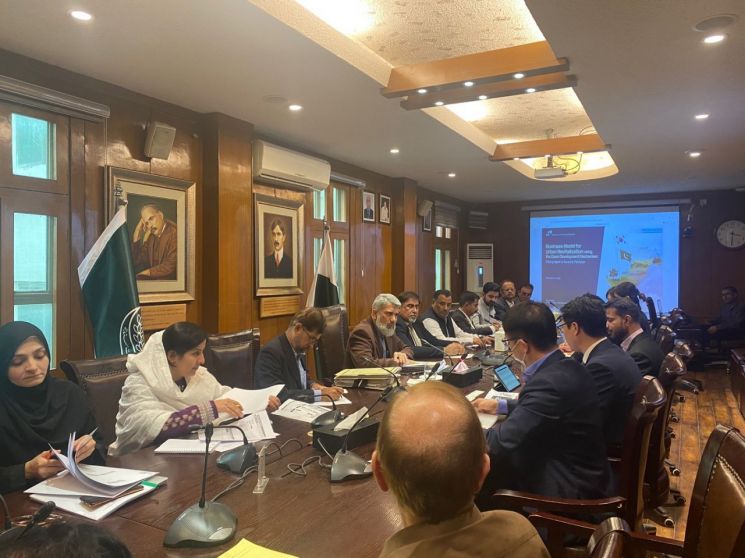 A meeting between LH and relevant Pakistani ministries to improve residential environments and reduce greenhouse gas emissions in the Karachi area of Sindh Province, Pakistan.
 [Photo by LH]
In February, LH secured the right to conduct greenhouse gas reduction projects across Pakistan for 28 years after obtaining national approval from Pakistan. In October, LH signed a memorandum of understanding with the Sindh provincial government and agreed on specific project plans, including the quantity and specifications of facilities. LH plans to complete the registration approval of the project plan with the United Nations Framework Convention on Climate Change (UNFCCC) next year and commence full-scale construction.
While investors in similar projects typically secure only 50-70% of emission credits, LH received national approval under the condition of securing 100% of the emission credits. This is considered an unprecedented achievement globally.
LH plans to implement the Sustainable Development Mechanism (SDM) in 31 slum areas within Karachi City (84,000 households, 530,000 residents). They will install 130 village-level water purification facilities to supply approximately 5 million liters of clean drinking water daily, supply 200 million low-carbon, arsenic-free bricks to support the renovation of old houses, and install or replace about 7,000 high-efficiency LED streetlights to prevent crime and reduce electricity consumption. Additionally, six idle sites will be developed into community parks to improve the urban landscape and enhance the quality of life for slum residents.
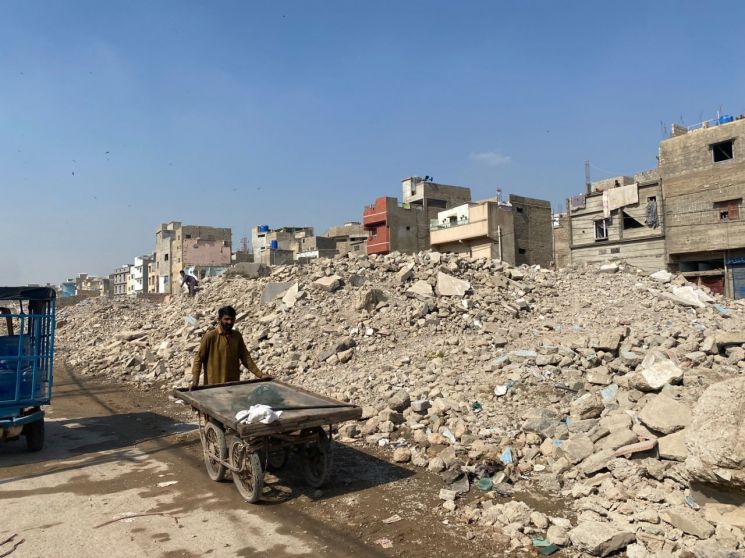 A view of the residential environment improvement target area in Karachi City, Pakistan. [Photo by LH]
The specific project plan was selected considering local demand, technical, and economic feasibility among methodologies recognized by the UNFCCC. LH predicts that this project will reduce 1.34 million tons of greenhouse gases over ten years and secure corresponding carbon emission credits.
Through the project's progress, it is also expected to generate about 39 billion KRW in private overseas orders for construction and service contracts. Domestic private design firms and construction companies will participate alongside LH, creating a new model for overseas projects. Currently, LH is soliciting private partners to jointly implement the project and plans to select a preferred negotiation partner within the year.
An LH official stated, "In the near future, securing carbon emission credits will emerge as a crucial factor for enhancing corporate competitiveness," adding, "LH will do its best to secure carbon emission credits through residential environment improvement projects in developing countries and supply these credits to domestic companies."
Meanwhile, Pakistan, with a land area of 771,000 km² (7.7 times that of South Korea) and a population of 225.2 million (6th largest in the world), is rapidly urbanizing. The urban population surged from about 48 million in 2001 to 82 million in 2020, leading many citizens unable to find housing to move into unauthorized settlements within cities. The slum population in Pakistan accounts for 40% of the total urban population.
© The Asia Business Daily(www.asiae.co.kr). All rights reserved.


















