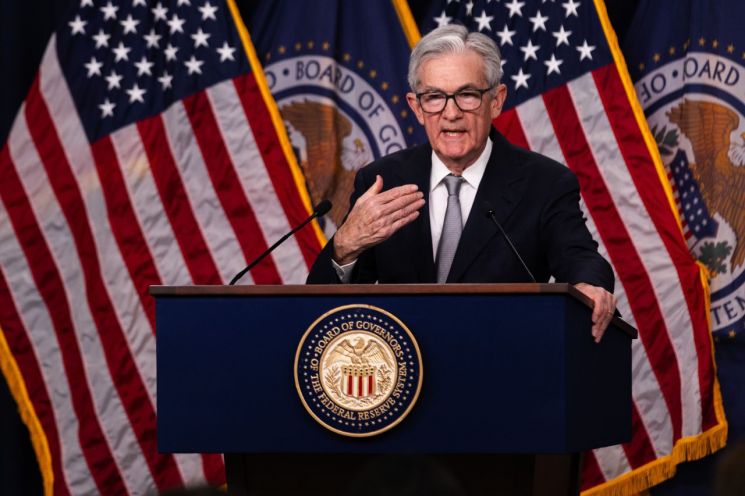
 Jerome Powell, Chairman of the U.S. Federal Reserve (Fed), is holding a press conference in Washington DC on the 1st (local time).
 [Image source=Yonhap News]
The U.S. Federal Reserve (Fed) will hold its final Federal Open Market Committee (FOMC) meeting of the year over two days starting December 12. The FOMC outcome and remarks by Fed Chair Jerome Powell are expected to significantly impact the won-dollar exchange rate and the Bank of Korea's monetary policy.
According to the market and experts on the 10th, a rate hold is almost certain at the December FOMC. According to the Chicago Mercantile Exchange (CME) FedWatch, the probability that the Fed will keep rates unchanged in December stands at 97.1% in the federal funds (FF) futures market.
Therefore, the market appears more focused on hints regarding the timing of next year's rate cuts rather than the rate decision itself. Many financial market participants expect the Fed to begin cutting rates in March or May next year.
FedWatch shows that the probability of a rate cut in March next year is 43.2%, and in May next year, 49.2% in the rate futures market.
However, Chair Powell still considers expectations for rate cuts to be excessive.
On December 1 (local time), during a conversation with President Helen Gail at Spelman College in Atlanta, Georgia, he said, "It is still too early to confidently conclude that we have achieved a sufficiently tight policy stance," adding, "It is the same regarding guessing the timing of rate cuts."
Investors are paying close attention to how Chair Powell's assessment of inflation and comments on the possibility of easing tightening might change.
Notably, this FOMC will release the December economic projections, which include the Fed officials' rate forecasts in the dot plot, as well as growth, inflation, and unemployment rate projections. If the median target for the federal funds rate in the dot plot drops significantly, market expectations for rate cuts could be brought forward.
Since the U.S. Consumer Price Index (CPI) for November will be announced on the first day of the December FOMC, it is expected to be a key indicator.
The CPI results could have a significant impact not only on the FOMC but also on global markets. For now, experts at The Wall Street Journal (WSJ) expect the November CPI to remain at the same level as the previous month and to have risen about 3% compared to the same period last year.
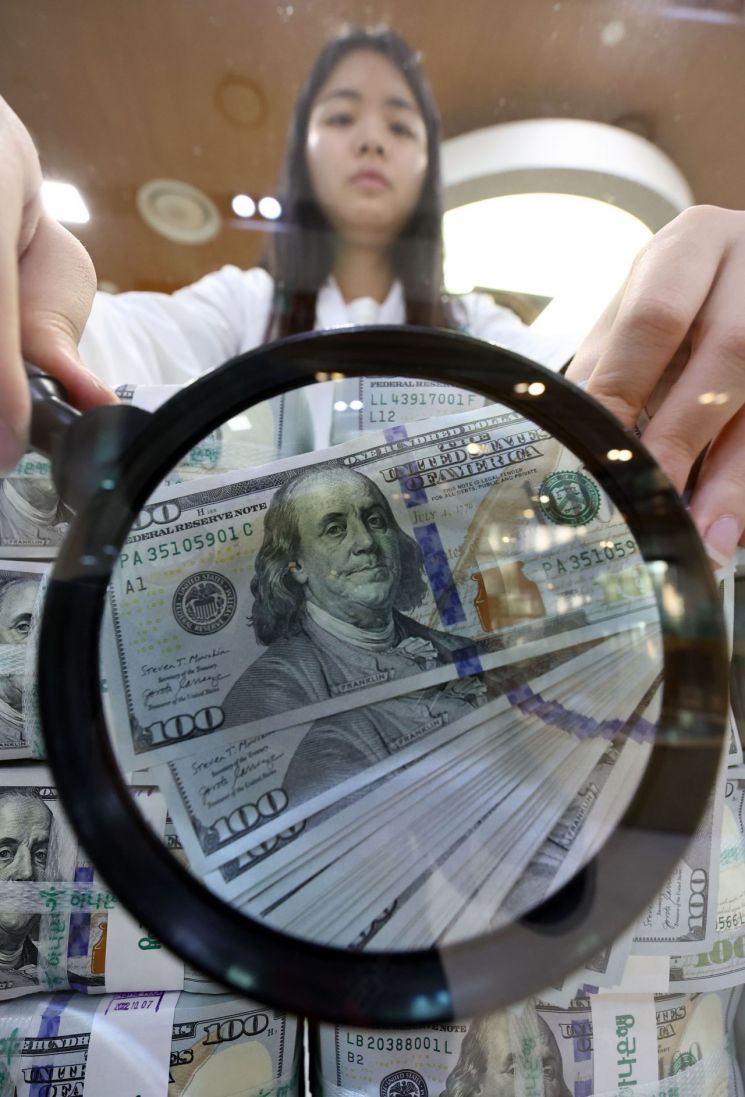 On the 5th, an employee is organizing dollars at the Counterfeit Response Center of Hana Bank Headquarters in Jung-gu, Seoul. [Image source=Yonhap News]
Ahead of the December FOMC, the won-dollar exchange rate has shown high volatility, fluctuating between the 1,280 and 1,320 won levels.
The exchange rate opened at 1,316.0 won on the 8th but closed at 1,306.8 won, down 18.5 won from the previous trading day's closing price of 1,325.3 won. The rate fell more than the previous day's rise of over 12 won.
If the dot plot is revised downward at the FOMC, expectations for rate cuts will increase, and the dollar's value may decline; conversely, if the opposite occurs, the exchange rate could rise again, increasing volatility.
Yumi Kim, a researcher at Kiwoom Securities, explained, "If the dot plot is interpreted hawkishly by the market, the volatility of government bond yields and the dollar, which recently fell amid expectations of up to five rate cuts next year, could increase in the short term. However, since the Fed's tightening is coming to an end, the possibility of a sharp rise in rates or the dollar like last year is limited."
Sojaeyong, a researcher at Shinhan Bank, said, "Ahead of the December FOMC scheduled for the early morning of the 14th Korea time, the market has no choice but to cautiously gauge the Fed's mood once again. Since U.S. November new employment and consumer price data will be released before the FOMC, there is a considerable possibility of sensitive reactions depending on the indicator results."
© The Asia Business Daily(www.asiae.co.kr). All rights reserved.
![Clutching a Stolen Dior Bag, Saying "I Hate Being Poor but Real"... The Grotesque Con of a "Human Knockoff" [Slate]](https://cwcontent.asiae.co.kr/asiaresize/183/2026021902243444107_1771435474.jpg)

















