The 1st Korea-US Next-Generation Core and Emerging Technologies Dialogue Held
Exploring Cooperation for the Korea-US Established 'Semiconductor Technology Center'
$10 Million Support for Research Cooperation in the Bioeconomy Sector
South Korea and the United States agreed on the 9th to expand joint research support in advanced technology fields such as semiconductors, quantum, bio, batteries, and artificial intelligence (AI).
Cho Tae-yong, Director of the National Security Office, and Jake Sullivan, U.S. National Security Advisor, co-chaired the "1st Korea-U.S. Next-Generation Core and Emerging Technologies Dialogue" in Seoul on the same day to explore ways to cooperate on advanced technologies, the Presidential Office said.
This dialogue was newly established following an agreement between President Yoon and U.S. President Joe Biden during the Korea-U.S. summit in April during Yoon’s state visit to the United States. In this dialogue, the two countries discussed comprehensive cooperation measures across the entire technology cycle, including joint research, investment, standards, and workforce development in fields such as semiconductors, quantum, bio, batteries and clean energy, AI, and digital technologies. They also agreed to hold an informal trilateral dialogue among Korea, the U.S., and India early next year.
In his opening remarks, Director Cho stated, "In the recent complex crisis situation, the future of geopolitics depends on each country’s technology and innovation," and explained that Korea is positioning core emerging technology policies as an important pillar of its security policy, promoting related legislation, launching a joint government-wide technology leakage response team, and expanding budgets for global joint research.
Advisor Sullivan responded, "I am pleased to hold this Korea-U.S. Next-Generation Core and Emerging Technologies Dialogue as a result of the Korea-U.S. summit in April, and I hope the two countries, as allies, will strengthen cooperation in core emerging technology fields such as joint research."
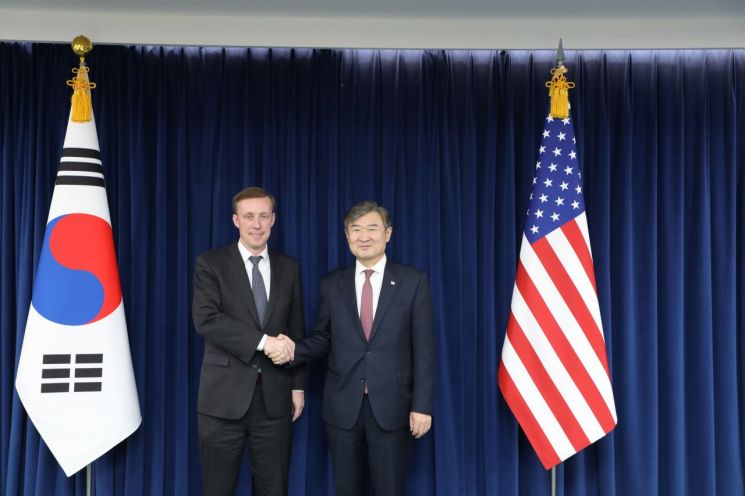 Cho Tae-yong, Director of the National Security Office, and Jake Sullivan, U.S. National Security Advisor at the White House (left), met in Seoul on the 9th to preside over the "1st Korea-U.S. Next-Generation Core and Emerging Technologies Dialogue" and are taking a photo together.
 [Photo by the Office of the President]
First, both sides agreed to expand joint research support opportunities between the Ministry of Science and ICT and the U.S. National Science Foundation in the semiconductor field, and to explore cooperation measures for the semiconductor technology center being established by the two countries’ Ministries of Industry and Commerce.
In the bio field, the Ministry of Science and ICT and the U.S. National Science Foundation agreed to support research cooperation in the bioeconomy sector with at least $10 million. They also agreed on comprehensive cooperation including physician-scientist exchange programs, bio and medical research collaboration, and cooperation between research-oriented hospitals between the Ministry of Health and Welfare and the U.S. National Institutes of Health (NIH). Cooperation related to the U.S. Cancer Moonshot Initiative 2.0 will also be strengthened. A 1.5-track channel involving governments and pharmaceutical companies from both countries will be launched next year to discuss ways to strengthen the pharmaceutical supply chain.
In the battery and clean energy sector, research and development between national research institutes will be expanded for next-generation battery development, and joint research cooperation will be strengthened through a memorandum of understanding (MOU) between the Korea Institute for Advancement of Technology and the U.S. Electric Vehicle Transportation Sector Industry Cooperation Research Center (EVSTS). In the quantum field, the Korea Research Institute of Standards and Science and the U.S. National Institute of Standards and Technology (NIST) decided to enhance cooperation for next-generation quantum computer research and strengthen collaboration among industries and universities in both countries.
In the AI field, the U.S. side agreed to cooperate in events such as the mini AI video summit, the AI Global Forum, and the high-level meeting on the responsible military use of artificial intelligence (REAIM), which Korea plans to host next year. They also agreed to form an AI working group to cooperate on international standards, joint research, and policy interoperability. Furthermore, the two countries will cooperate to promote the establishment of safe and resilient information and communication technology (ICT) infrastructure in third countries such as Southeast Asia, and will collaborate on international standards in areas like 5G and 6G.
On the Korean side, the Ministry of Science and ICT, Ministry of Foreign Affairs, Ministry of Trade, Industry and Energy, and Ministry of Health and Welfare participated, while on the U.S. side, the Department of State, Department of Energy, National Science Foundation, White House Office of Pandemic Preparedness and Response Policy (OPPR), and Office of Science and Technology Policy (OSTP) attended.
© The Asia Business Daily(www.asiae.co.kr). All rights reserved.

















