'Reconstruction Burden Relief Act' Passed by National Assembly
Baehyeonjin Develops 2020 General Election Pledge
"Contributes to Housing Market Stabilization"
If the excess profit gained from reconstruction does not exceed 80 million KRW, no burden charge will be required from March next year.
On the 8th, the ruling and opposition parties held a plenary session of the National Assembly and passed the alternative bill prepared by the National Assembly Land, Infrastructure and Transport Committee based on the Reconstruction Burden Charge Relief Act (Amendment to the Act on the Recovery of Excess Reconstruction Profits) originally proposed by Bae Hyun-jin, a member of the People Power Party.
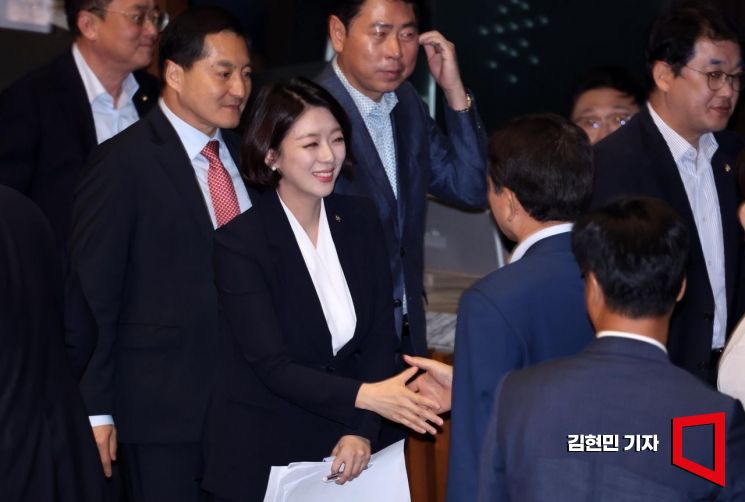 Assemblywoman Baek Hyun-jin of the People Power Party is receiving encouragement from fellow lawmakers after questioning Broadcasting and Communications Commission Chairman Lee Dong-gwan during the education, social, and cultural government questioning session held at the National Assembly plenary session on September 8. Photo by Kim Hyun-min kimhyun81@
The amendment mainly raises the standard for imposing the reconstruction burden charge on excess reconstruction profits from the existing 30 million KRW to 80 million KRW. For single homeowners, the burden charge is also reduced depending on the holding period. The burden is reduced by 70% for over 20 years, 60% for over 15 years, and 50% for over 10 years.
For single homeowners aged 60 or older, if collateral is provided, the payment of the burden charge can be deferred until the time of disposal such as transfer of the relevant house. The starting point for imposing the burden charge has also been changed from the approval date of the association establishment promotion committee to the approval date of the association establishment, reducing the burden on association members. It will be implemented three months after the promulgation.
The excess reconstruction profit recovery system was first introduced in 2006 during the Roh Moo-hyun administration, temporarily suspended during the Lee Myung-bak and Park Geun-hye administrations, but reintroduced under the Moon Jae-in administration. Since it recovers up to 50% of the profits gained from reconstruction, it is considered a major restrictive regulation on reconstruction projects.
Bae’s side explained that this amendment was Bae’s pledge during the 2020 general election. It is a bill prepared after directly listening to the difficulties of residents in apartment complexes in Songpa, such as Jamsil 5 Complex, Asia Athletes' Village, and Olympic Family Town, which are scheduled for reconstruction.
Bae said, "The excess reconstruction profit recovery system, reintroduced by the previous government, increased the burden on association members and lowered private profits, hindering reconstruction promotion," adding, "Through this amendment, the burden on reconstruction association members will be eased, the reconstruction market will be further revitalized, and the housing market will stabilize."
© The Asia Business Daily(www.asiae.co.kr). All rights reserved.

















