Ministry of Health and Welfare Listens to Voices from Low Birthrate Field
"Infinite Competition Society, a Huge Economic Burden"
"Raising Standards to Keep Up with Comparison and Competition"
"It seems that people keep raising the standards to avoid falling behind in comparisons."
Childfree households, such as DINK couples, cited not only time and financial constraints but also the highly competitive atmosphere of Korean society as reasons for not having children.
On the afternoon of the 7th, the Ministry of Health and Welfare held a 'Family Storming' event at Ajitori in Seocho-gu, Seoul, to listen to stories from the low birthrate field and to discover policy tasks. At the event, 12 childfree couples from the younger generation who either had no specific plans for children or had decided not to have children shared their opinions on childbirth.
"A child's grades are essentially the parents' report card... I have no confidence to join the entrance exam war"
Most participants complained that they do not have the economic conditions to raise children and live as comfortably as others.
Participant Lee said, "I have no confidence to join the child's entrance exam war," adding, "A child's grades are essentially the parents' report card. It seems that the competition among parents with higher educational backgrounds has intensified."
Another participant pointed out, "If it weren't so bad, the term 'Gaegungeoji'?which belittles children with perfect attendance by saying they can't go on trips?would not have emerged," emphasizing that the culture of comparing children needs to be improved.
There was also a concern expressed: "From the first birthday party, starting with whether the child can walk, comparisons continue through school and workplace. As a parent, I have no confidence to join that endless competition." One participant confided, "I heard that some parents worry their child might feel inferior when being driven to school, so they go to the extent of switching to foreign cars, which worries me."
Another participant said, "Seeing households with two or three cars, I thought, 'We should have three cars too,'" adding, "It’s sad that people seem to keep raising the personal standards they feel they need to avoid losing in comparisons."
"Night shifts and rotating shifts... worried about parents' old age if we leave children with them"

Many also cited long working hours and poor childcare environments as reasons for not having children. Participant Baek said, "We are a dual-income couple, but when we get home, we barely sleep and mostly eat out," expressing concern, "I worry that I won’t be able to take care of the child and that the child might blame me."
Issues regarding entrusted childcare were also raised. Typical opinions included, "It’s very hard to find a good daycare," and "If you work night shifts or rotating shifts, there’s nowhere to leave the child."
One participant worried, "If we leave the child with elderly parents, we worry about their old age," adding, "I’m concerned that grandparents might have to watch their grandchildren without being able to take care of their own retirement as they get older."
Lee Gi-il, the first vice minister of the Ministry of Health and Welfare who presided over the event, said, "The choice not to have children is the result of intense deliberation," and added, "We will quickly prepare policies reflecting the participants’ opinions to prevent Korea from becoming like a frog in slowly boiling water due to low birthrates."
177,000 babies born in the first to third quarters this year, 'lowest ever'
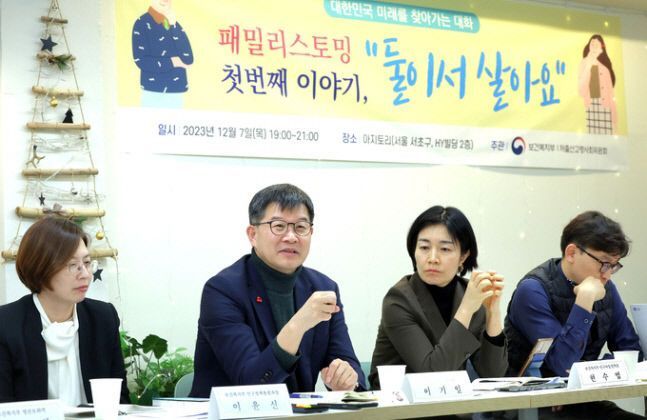 Lee Gi-il, the 1st Vice Minister of Health and Welfare (second from the left), is speaking at the low birthrate planning meeting held on the 7th at Ajitori in Seocho-gu, Seoul.
 [Photo by Ministry of Health and Welfare]
Meanwhile, the number of babies born up to the third quarter this year has fallen to the 170,000 range, marking the lowest ever and signaling a growing red light for Korea’s low birthrate. According to the National Statistical Office’s National Statistics Portal (KOSIS) on the 8th, the cumulative number of births from the first to third quarters this year was 177,000, the lowest since statistics began in 1981.
The total fertility rate by quarter has also continued to decline. The first quarter’s total fertility rate was 0.81, down 0.06 from the same period last year. The second quarter (0.70) decreased by 0.05, and the third quarter (0.70) also dropped by 0.10. Considering the trend of decreasing births toward the end of the year, it is highly likely that the total fertility rate will fall into the 0.6 range for the first time in the fourth quarter. The total fertility rate refers to the average number of children a woman is expected to have in her lifetime.
The Ministry of Health and Welfare plans to hold Family Storming sessions with unmarried households and multi-child households to find solutions to the low birthrate. The proposed alternatives will be reflected in policies through meetings of the Population Policy Planning Division of the Low Birthrate and Aging Society Committee.
© The Asia Business Daily(www.asiae.co.kr). All rights reserved.

![A Woman with 50 Million Won Debt Clutches a Stolen Dior Bag and Jumps... A Monster Is Born [Slate]](https://cwcontent.asiae.co.kr/asiaresize/183/2026021902243444107_1771435474.jpg)

















