Supplementing Limitations of Shortwave Infrared Sensors
Published in 'Advanced Science'
The research team at Ajou University has succeeded in manufacturing a new eco-friendly quantum dot exhibiting optical performance in the short-wave infrared (SWIR) range and applying it to photodetection devices.
According to Ajou University on the 8th, Professor Sangwook Kim's research team (Department of Applied Chemistry and Life Science & Graduate School of Molecular Science and Technology) treated InSb quantum dots with chlorine ion surface treatment to maximize optical performance. To apply this to devices, they combined it with inorganic ligand exchange technology and succeeded in fabricating a high-performance photodiode-type photodetector.
The related paper, titled "Colloidal InSb Quantum Dots for 1500nm SWIR Photodetectors with Suppressed Surface Oxidation," was published in the December online edition of the prestigious materials engineering journal Advanced Science. The study involved Professor Jonghyun Kim (Department of Applied Chemistry and Life Science & Graduate School of Molecular Science and Technology at Ajou University) and Dr. Haenggeun Lee from the Korea Research Institute of Chemical Technology.
Short-wave infrared refers to a wavelength range longer than the near-infrared region, offering better transmittance due to its longer wavelength. It has the advantage of significantly less interference from sunlight or moisture compared to the visible and near-infrared regions. SWIR is used for environmental recognition in autonomous driving and unmanned vehicles and can be utilized even on cloudy, foggy days or dark nights.
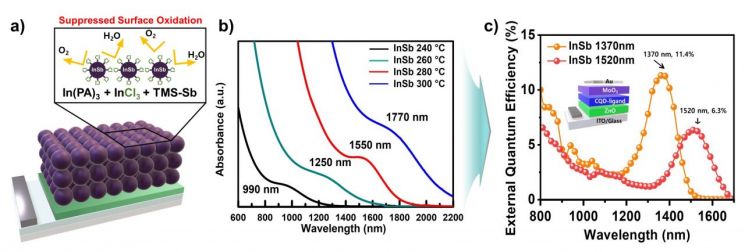
However, device performance and cost for efficient SWIR detection have shown limitations. In response, the Ajou University research team focused on InSb quantum dots that do not use lead or mercury. By adding chlorine ions during the synthesis stage, they maximally suppressed surface oxidation of the quantum dots to enhance optical performance and combined inorganic ligand exchange technology to stably process them into a form applicable to devices.
This research was supported by the National Research Foundation of Korea’s Nano Material Technology Development Project, KIURI, and Basic Research Projects, and domestic patent applications have been completed.
Professor Sangwook Kim stated, "The InSb quantum dot manufacturing technology developed this time is an eco-friendly technology that does not use toxic heavy metals such as lead and mercury. It offers high price competitiveness and efficiency, making it the most practical alternative for industrial use in short-wave infrared detection. We hope to apply it to future technologies such as autonomous driving through continuous additional research."
© The Asia Business Daily(www.asiae.co.kr). All rights reserved.