Porter·Bongo LPG Truck Reservations Up
Electric Trucks Also Popular
Incentives for New Vehicle Purchases Cited
Acceleration Expected with Enforcement of Air Quality Control Zone Act Amendment
However, Courier Drivers' Preference Declines and Charging Infrastructure Issues Remain
As eco-friendly policies are strengthened, the sales landscape of 1-ton trucks, known as the "people's vehicle," is changing. Some trucks that were only equipped with diesel engines now offer liquefied petroleum gas (LPG) options, and demand for electric (EV) trucks is steadily increasing. This is due to the amendment of the Air Quality Control Zone Act, which bans the operation of diesel vehicles. However, both LPG and electric trucks have shortcomings compared to diesel trucks, leading the delivery industry to request a grace period for the law's enforcement.
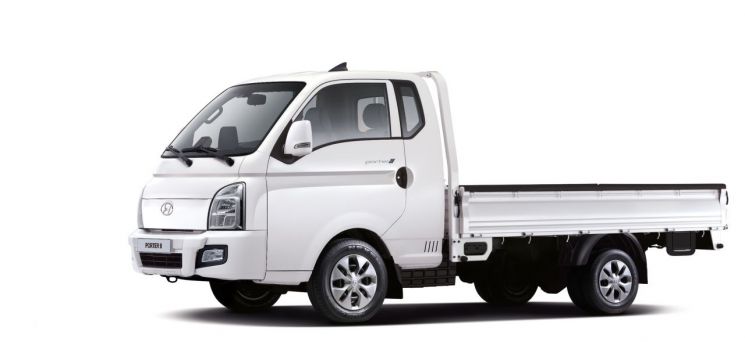
Hyundai Motor Company and Kia launched 1-ton trucks Porter II and Bongo III equipped with LPG engines last month. Diesel models will be produced only until this year. For Porter, an LPG trim was added for the first time in 20 years since 2003, and for Bongo, after 4 years. Both vehicles are equipped with the newly developed Smartstream LPG 2.5 turbo engine. The maximum output is 159 horsepower, 24 horsepower higher than the existing diesel engine. The companies explained that adopting a turbocharger system improved instantaneous output (torque) at low speeds. A turbocharger is a device that compresses the air supplied to the engine. Compressed air contains more oxygen during combustion, causing a stronger explosion and enhancing engine output.
Although the vehicles have not yet been delivered, they are popular based on contract numbers. The Korea LPG Association reported that 25,180 Porters and 5,517 Bongos were contracted within one week of launch.
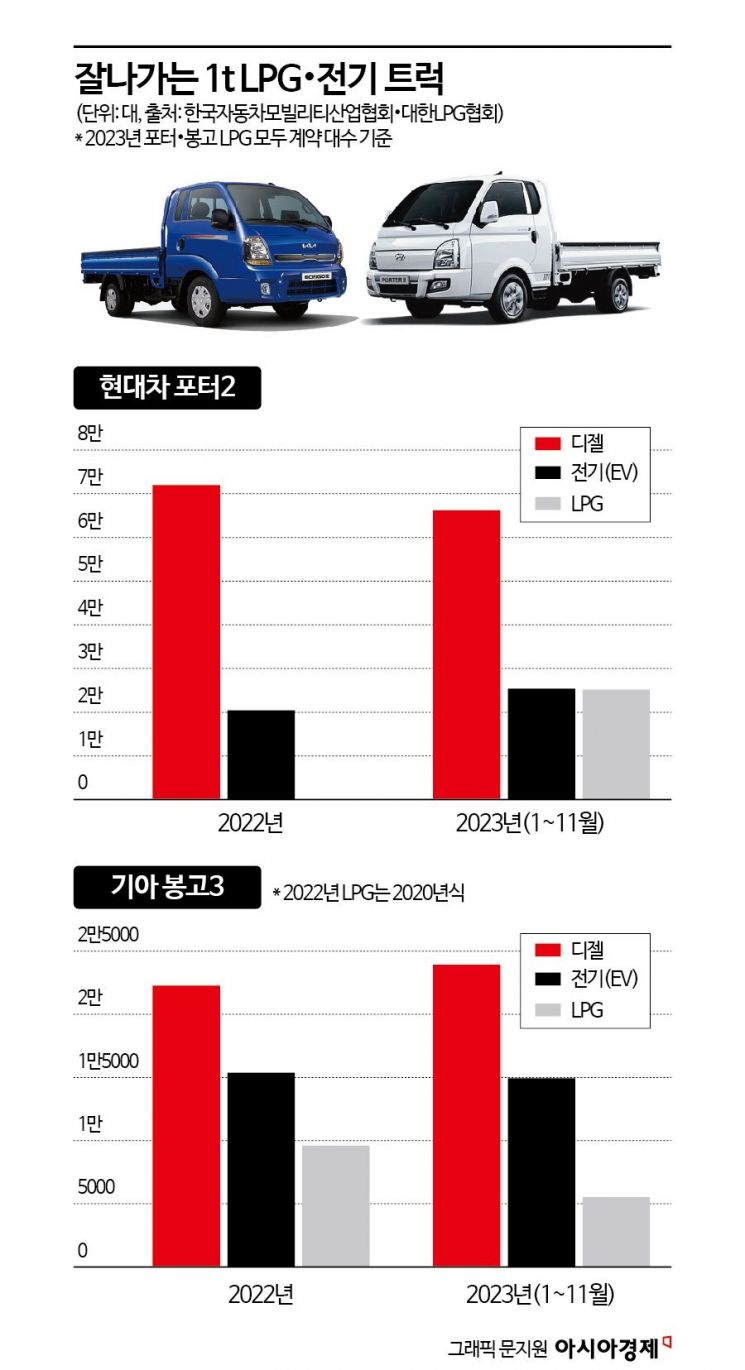
Sales of existing 1-ton electric trucks are also on the rise. According to data from the Korea Automobile Mobility Industry Association, 25,404 Porter EVs were sold from January to November this year, already surpassing last year's total sales of 20,418 units. Bongo EV sold 15,373 units last year and 14,931 units this year. If more than 443 units are sold this month, it will exceed last year's sales. Meanwhile, Porter diesel vehicle sales are declining. Last year, 71,993 Porters were sold, but only 66,218 units were sold up to November this year.
The popularity of eco-friendly 1-ton trucks is due to incentives when purchasing new vehicles. If a diesel truck currently in use is scrapped and replaced with an LPG truck, the government provides up to 9 million KRW (1 million KRW for new vehicle purchase subsidy and up to 8 million KRW for early diesel vehicle scrappage support). LPG trucks are classified as Class 3 low-emission vehicles and receive discounts on fees at public parking lots nationwide (30-50%) and airport parking lots (20-30%). Electric vehicles also receive purchase subsidies. In Seoul, both Porter and Bongo EVs receive a 16 million KRW purchase subsidy. The Porter starts at 43.75 million KRW, and the Bongo at 43.65 million KRW, making it possible to purchase them in the 27 million KRW range after subsidies.
The reason for providing subsidies for LPG and electric trucks is the amendment to the Air Quality Control Zone Act, which will be enforced next year. According to this law, small delivery cargo vehicles and children's school buses must not use diesel vehicles. In other words, only LPG and electric vehicles can be used.
However, there are challenges to further popularizing eco-friendly trucks. Delivery drivers do not prefer LPG trucks. A delivery industry official said, "Delivery vehicles carry a lot of cargo, and in situations requiring high engine output such as uphill or snowy roads, LPG trucks are often considered less powerful compared to diesel trucks." Regarding electric trucks, the problem is the short driving range after a full charge. The Porter and Bongo EVs can travel 220 km on a single charge. The industry estimates that delivery work in urban areas involves an average daily travel distance of 50 km. With cargo loaded and temperature control devices operating, more than half of the battery is used even after a full charge. Ultimately, logistics industry officials stated that daily charging is necessary.
© The Asia Business Daily(www.asiae.co.kr). All rights reserved.


















