Changwon City Policy Research Institute Hosts Korea-Japan International Seminar on Major Transformation of Changwon City in the Era of Local Extinction Crisis
The "Changwon Special City Grand Transformation Korea-Japan International Seminar in the Era of Local Extinction Crisis," co-hosted by the Changwon City Policy Research Institute, Changwon Special City, and the Changwon Special City Council, was held on the 7th at the Changwon Grand Mercure Ambassador Hotel.
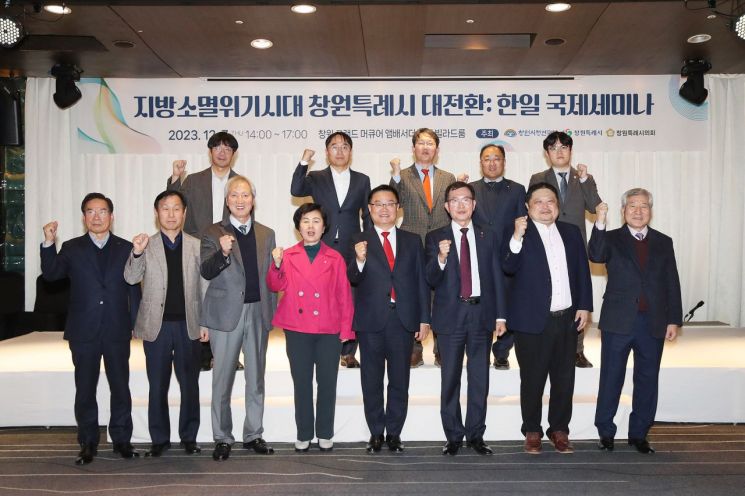 'International Korea-Japan Seminar on the Great Transformation of Changwon Special City in the Era of Local Extinction Crisis'.
This seminar was organized as an opportunity for Changwon Special City to review Japan's cases in response to the local extinction crisis and to explore new policy directions in an era demanding new local decentralization and balanced development strategies.
Kim Sun-bae, Senior Research Fellow at the Korea Institute for Industrial Economics and Trade, who was the first presenter at the seminar, argued that a new era for the South Coast region must be opened through strategic investment. Although the East Asian market, including Southeast Asia and India, is emerging as an alternative to the Chinese supply chain, the South Coast region, including Changwon, has remained stagnant despite its potential as a trading outpost.
Accordingly, Senior Research Fellow Kim asserted that the South Coast region's sluggishness negatively affects not only the decline of the region itself but also the overall national growth and regional balance. Therefore, by establishing a smart green convergence hub in the South Coast area, a new growth path must be created.
Professor Kawamura Kazunori of Tohoku University emphasized regional revitalization through transportation infrastructure such as the Shinkansen and local universities in his presentation titled "Population Decline in Japanese Localities and Municipal Responses." He suggested that by highlighting the "strengths" of new regions, strengthening transportation infrastructure, and enabling local universities to act as dams preventing the outflow of young populations, effective responses to the population decline era could be achieved, citing the cases of Kanazawa City and Tagaoka City.
Research Fellow Koo Bon-woo of the Changwon City Policy Research Institute argued that population decline and youth outflow in Changwon are the results of a complex interplay of limited appropriate job opportunities, lack of human capacity-building systems, insufficient social care, low cultural receptivity, and imbalanced residential environments. Accordingly, he proposed moving away from the past growth hub industrial city model to envision a new urban model where diverse value creation occurs and a solid foundation for basic capacity building is established.
Kim Young-pyo, Director of the Changwon City Policy Research Institute, stated, "Facing the significant contemporary challenge of local extinction, this seminar must serve as a wise means to overcome the current crisis," adding, "I hope it becomes the starting point for the grand transformation of Changwon Special City."
Kim Yi-geun, Chairman of the Changwon Special City Council, said, "We will strive to create a new paradigm suitable for a new era of balanced development where the leadership of local governments is emphasized."
Hong Nam-pyo, Mayor of Changwon Special City, remarked, "Changwon has established itself as the only special city with a population of one million outside the metropolitan area, serving as a model for the government's local decentralization and balanced development. However, if current trends continue, significant efforts will be required just to maintain the population of one million," adding, "We will endeavor to make Changwon a future-oriented self-sufficient city where young people stay, learn, and dream, becoming a turning point in Korea's local extinction phase."
© The Asia Business Daily(www.asiae.co.kr). All rights reserved.

















