Announcement of Evaluation Institute's CSAT Score Analysis Results
High Discrimination in Korean, Math, and English
Exploration Subjects Still Show 'Advantages and Disadvantages Between Elective Subjects'
Evaluation Institute "Will Adjust Difficulty and Make Improvements"
The 2024 College Scholastic Ability Test (CSAT) was more difficult than last year. The highest standard score in Korean increased by 16 points compared to last year, and in Mathematics, it rose by 3 points, enhancing the discrimination power among top scorers. English was also identified as the most difficult since the introduction of the absolute evaluation system. An analysis suggested that the surge in repeat test-takers (graduates or above) due to the 'killer question exclusion policy' may have influenced the rise in standard scores.
On the 7th, the Korea Institute for Curriculum and Evaluation (KICE) announced the '2024 CSAT Scores and Analysis Results' at the Government Seoul Office. Oh Seung-geol, President of KICE, stated, "Although killer questions were excluded in this CSAT, the test maintained its discriminatory power, and it was confirmed that the questions were designed so that students who have faithfully completed school education centered on the public education curriculum could solve them."
However, contrary to KICE's position that the test was within the scope of public education, an analysis from the examinees' perspective indicated that it felt like a 'bul-suneung' (extremely difficult test). The highest standard score in the Korean section was 150 points, 16 points higher than last year's highest standard score of 134. The standard score shows how much a student's raw score deviates from the average score. When the test is difficult and the average drops, the highest standard score rises; when the test is easy and the average rises, the highest standard score falls.
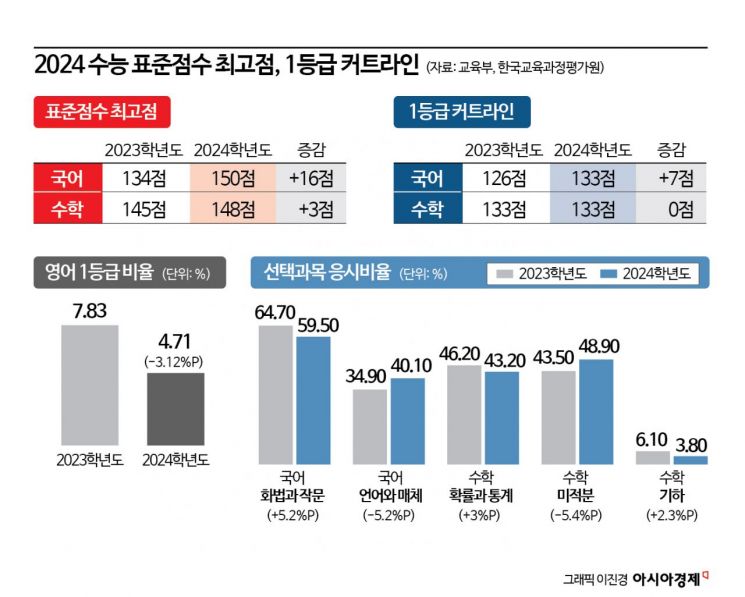
Moreover, compared to last year, the number of top scorers with the highest standard score (64 people) decreased, and the score difference between grades 1 and 2 increased, indicating higher discrimination among top-tier students. On the other hand, the cutoff score for grade 3 (116 points) was 1 point lower than last year's CSAT, suggesting that the perceived difficulty for mid-tier students was similar to last year.
In Mathematics, the highest standard score rose by 3 points from last year to 148, indicating that examinees likely felt the difficulty was similar or slightly harder. The number of top scorers significantly decreased compared to the September mock test (2,520 to 612), suggesting increased discrimination.
In English, the proportion of students achieving grade 1 was 4.17%, which is 3.12 percentage points lower than last year's CSAT (7.8%) and similar to the September mock test. The discrimination among top scorers was high, and the proportions of students in grades 2 and 3 were similar to last year's CSAT.
Regarding the difficulty of Korean, Mathematics, and English, Lim Seong-ho, CEO of Jongro Academy, commented, "Since the introduction of the integrated CSAT, Korean, Mathematics, and English were set as historically difficult 'bul-suneung' tests. If there is no change in this year's test setting trend, next year's examinees will need to prepare for all subjects and areas with difficulty."
The inquiry subjects were set at a level similar to last year's CSAT. The score difference for grade 1 among social inquiry subjects was up to 5 points, similar to the September mock test (4 points). The score difference for grade 1 among science inquiry subjects was up to 6 points, significantly reduced from the September mock test (12 points).
The issue of advantage and disadvantage among elective subjects, which arose after the integrated CSAT, continued this year as well. Among Korean test-takers, 59.8% chose 'Speech and Composition,' and 40.2% chose 'Language and Media.' According to analysis by Uway, the higher highest standard score for Language and Media led to an increase in students selecting this subject. In Mathematics, the selection rate for 'Probability and Statistics,' mainly taken by humanities students, decreased compared to last year (46.2% to 43.2%), while the selection rate for 'Calculus' increased (43.5% to 48.9%).
 On the 7th, Oh Seung-geol, President of the Korea Institute for Curriculum and Evaluation, announced the 2024 College Scholastic Ability Test scores and grading results at the Government Seoul Office in Jongno-gu, Seoul. Photo by Jo Yong-jun jun21@
Regarding the high difficulty of this CSAT, CEO Lim explained, "The number of repeat test-takers who expected the test burden to decrease due to the sudden exclusion of killer questions surged, and the level of these repeat test-takers may have been lower than expected compared to last year. It is also possible that the decline in scores among repeat test-takers caused the standard scores to be higher than expected." Regarding future application strategies, he analyzed, "Top-tier students may show a tendency to apply upward or confidently rather than downward because discrimination is well secured. Especially, natural science students may have a stronger tendency for confident applications due to the issue of increased medical school quotas next year."
In relation to this, President Oh responded to a question at the press conference about whether there was insufficient analysis of graduate inflow in difficulty composition, saying, "While maintaining the principle of setting questions within the public education curriculum and securing discrimination, we will carefully analyze expert opinions and test results in the future to adjust difficulty accordingly."
Regarding whether the test achieved the intention of reducing private education, Shim Min-cheol, Director of Talent Policy Planning at the Ministry of Education, explained, "The government can only operate the curriculum within the scope of public education, and plans to provide students with as much preparation guidance as possible to help them resist the temptation to resolve difficulties through private education."
Meanwhile, it was confirmed that there was one perfect scorer across all subjects. President Oh stated, "One graduate achieved a perfect score, and it was confirmed that the student took two science inquiry subjects." The proportion of graduates taking this year's CSAT was 35.4%, up 4.3 percentage points from last year (31.1%). The total number of examinees was 447,870, a decrease of 2,799 from last year's 447,669. The number of current students decreased by 20,782 compared to last year, while the number of graduates increased by 17,983.
KICE will notify examinees of their CSAT scores on the 8th. Individual score reports will be distributed to examinees through the places where they registered (current schools, district education offices, or alma maters).
© The Asia Business Daily(www.asiae.co.kr). All rights reserved.


















