Major New Solutions Unveiled in Medical, Manufacturing, and Logistics
Automation Cell to Be Established Next Year... Annual Production of 4,000 Robots
Factory Transformed Where Robots Make Robots
App Platform Launched to Increase Collaborative Robot Utilization
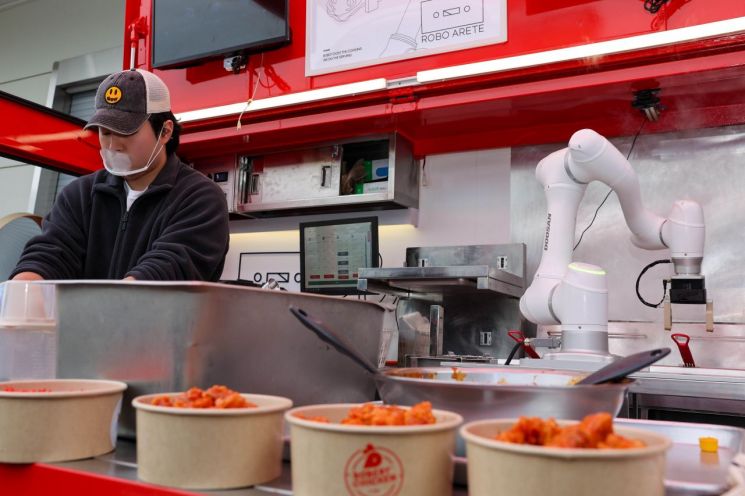
Doosan Robotics' robot arm is frying chicken by repeatedly lifting and lowering a frying basket. The robot arm, composed of six joints, performed the task of moving and placing the frying basket steadily even in tight spaces. The robot arm worked continuously, frying 50 chickens per hour. The only tasks for the chicken store employees are placing the batter-coated chicken into the frying basket or packaging the fully fried chicken. All tasks in front of the oil are entirely entrusted to the robot. In actual chicken stores, people get injured due to repetitive tasks of oil splashing or lifting heavy frying baskets. Using robots reduces the risk of injury and prevents direct exposure to oil mist containing carcinogens such as benzene.
Doosan Robotics entrusts chicken frying, welding, and loading/unloading to robots
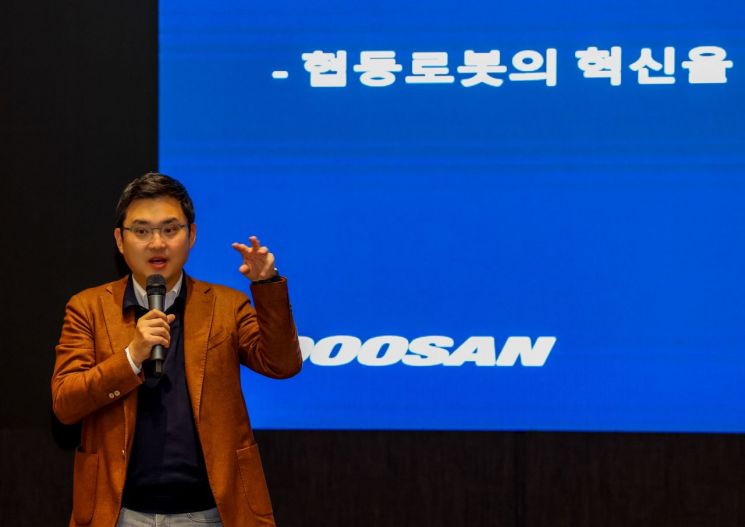
Ryu Jeong-hoon, CEO of Doosan Robotics, said, "The robots made by Doosan Robotics perform all the tasks that used to require risking danger in front of the fryer at a monthly rental fee of about 1 million won," adding, "We aim to pioneer a market where robots replace existing dangerous, health-threatening, simple, and repetitive tasks such as welding and palletizing (stacking products on pallets)."
On the 5th, Doosan Robotics unveiled new collaborative robot solutions at its production plant in Suwon, Gyeonggi Province. These include ▲group meal service solutions ▲laparoscopic surgery assistance solutions ▲airport baggage handling solutions ▲laser welding solutions ▲bin-picking solutions (technology to pick specific objects from randomly mixed items).
Doosan Robotics' strength lies in collaborative robots. Unlike industrial robots, they work alongside humans. Therefore, precise collision detection capability is required. The most important aspect considered by Doosan Robotics is safety.
There are mainly two collision detection methods for collaborative robots: current control and torque sensor methods. Doosan Robotics adopted the torque sensor method, which uses sensors that change resistance according to applied force to directly measure the weight of objects and forces or torque (twisting) generated during movement. Collaborative robots equipped with torque sensors can perform delicate and safe movements. The torque sensor technology has reduced the price to about one-third of the previous cost. These torque sensors are installed on each of the six joint axes of the collaborative robot, enabling force control and compliance control functions. Currently, Doosan Robotics' collaborative robots have acquired a total of 20 safety features and have obtained industry-leading safety certifications (PLe·Cat4).
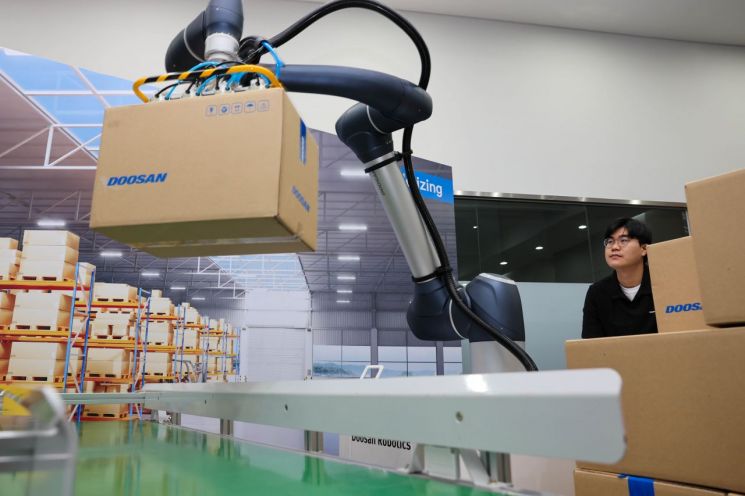
In manufacturing, applications include ▲vehicle inspection ▲bolt fastening ▲polishing (a surface finishing process that adds shine) ▲welding ▲palletizing (stacking products on pallets). In the service sector, they collaborate with various F&B companies on ▲frying solutions (Robot Chicken) ▲noodle solutions (CJ Foodville) ▲group meal service solutions (Ourhome) ▲ice cream solutions (XYZ), among others. Recently, they signed a memorandum of understanding (MOU) with Kyochon F&B, which operates Kyochon Chicken, to expand the 'chicken robot solution' and plan to gradually introduce it to Kyochon Chicken stores nationwide.
CEO Ryu said, "Doosan Robotics will continuously develop new solutions and apply technologies such as AMR (autonomous mobile robots) and AI to collaborative robots to develop complex solutions that were previously impossible," adding, "Especially, combining AMR with collaborative robots will create next-generation solutions that maximize convenience in areas closely related to human life, such as outdoor cleaning and crop harvesting."
A 'robot app' market opens like Apple and Google
Another innovative result from Doosan Robotics is the 'Dart Suite.' It provides a smartphone-like user environment where users can program the movements of collaborative robots themselves and share them through a platform. This system is similar to how Google or Apple allow users to participate directly in their platforms and earn money through app markets.
From the early stages of the business, Doosan Robotics has focused on building a user-centered collaborative robot ecosystem by developing not only hardware but also software. As a result, last October, they launched Dart Suite, a software-centric ecosystem that provides a smartphone-like user environment, making it easy for both developers and users to operate collaborative robots. By registering collaborative robot functions as applications on the Dart Store using this platform, users can download them for free or for a fee. They can quickly switch tasks, such as making coffee in the morning and palletizing in the afternoon. This increases the utilization of collaborative robots.
Lee Jae-seok, Executive Director of Doosan Robotics' Software Innovation Research Institute, said, "Dart Suite is an innovative software that enables collaborative robots to continuously learn and multitask. We expect that AI will make it easier and faster to create and share collaborative robot functions."
Doosan Robotics plans to build automated cell facilities on the second floor of its Suwon factory to improve production efficiency and scale. Automated cells are facilities where collaborative robots and humans work together to assemble collaborative robots. Doosan Robotics' collaborative robots consist of six axes, each called a module. One module requires about 70 bolt fastening tasks, and after humans prepare the preliminary work, the collaborative robot fastens the bolts directly. Currently, the production time per collaborative robot module is about 60 minutes, but with the introduction of automated cells, it will decrease to about 37 minutes, increasing production efficiency by approximately 38%.
Doosan Robotics plans to establish a total of nine automated cell facilities next year. This will nearly double the production capacity of the Suwon factory from the current 2,200 units to 4,000 units. In the future, they also plan to integrate AMR into automated cells to promote logistics automation. Through this, tasks such as delivering parts from the material warehouse, transporting and stacking modules after assembly, and moving them to the module coupling process will be automated to enhance efficiency.
© The Asia Business Daily(www.asiae.co.kr). All rights reserved.



















