AliExpress and Temu Mislabel Kimchi as Paocai
"Popular Korean Shopping Malls... Acts Deceiving Consumers"
When searching for 'Kimchi' on Chinese shopping malls AliExpress and Temu, which are gaining more users domestically, bowls for 'Pao cai (泡菜)', a Chinese-style pickled vegetable, appear, causing controversy.
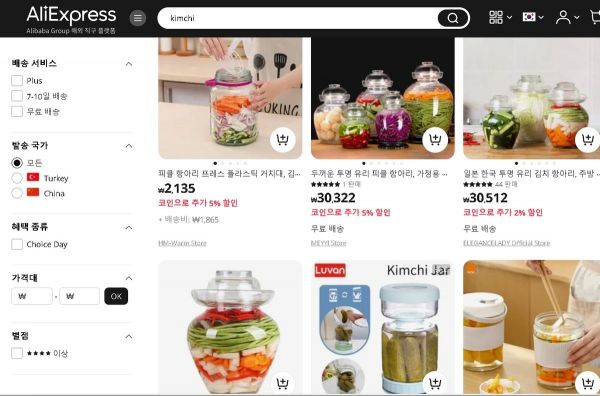 Search results for 'Kimchi' on the Chinese shopping app 'AliExpress'.
 [Photo by Seokyungdeok Professor SNS capture]
On the 7th, Professor Seokyung Deok from Sungshin Women's University posted on his social media (SNS), "Recently, through reports from netizens, I was able to confirm the 'Kimchi process' on a famous Chinese shopping mall again," informing about this fact.
Professor Seo stated, "'AliExpress' operates only for overseas customers excluding Chinese, and the number of monthly Korean users is said to exceed about 6 million," adding, "'Temu' also operates mainly for overseas customers, with more than 4 million Korean monthly users."
He then raised the issue that when searching 'Kimchi' in English and '김치' in Korean on AliExpress and Temu, most results showed 'glass jars' containing 'Pao cai', which refers to Chinese-style pickled vegetables.
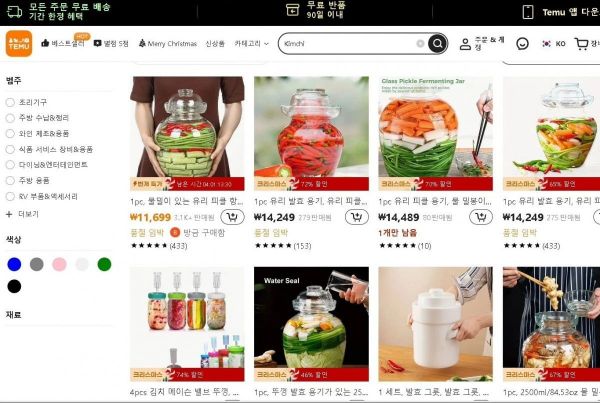 Search results for 'Kimchi' on the Chinese shopping app 'Temu'.
 [Photo by Professor Seokyungdeok SNS capture]
Professor Seo said, "Especially on 'Temu', some sellers introduced their products as 'Chinese traditional kimchi jars'," and added, "This is a part that must be corrected because netizens worldwide can get incorrect information when searching for 'Kimchi'."
He also argued, "These shopping malls are popular in Korea as well, so this is an act of deceiving Korean consumers," and stated, "If global companies do business targeting Koreans, they should prioritize understanding the basic sentiments of Koreans rather than viewing it only from a commercial perspective."
"Kimchi Originates from China"... 'Pao cai' Labeling at Hangzhou Asian Games
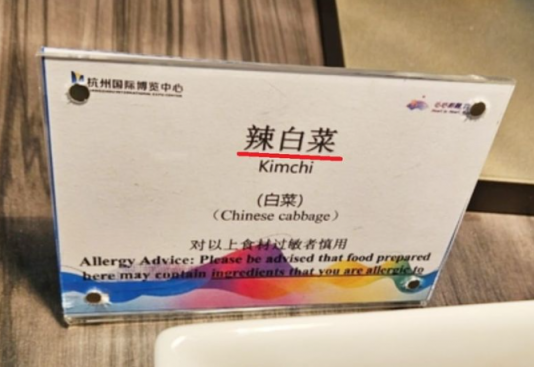 A photo showing kimchi labeled as 'Paochai' (泡菜) at the Main Media Center (MMC) and the Media Village restaurant of the Hangzhou Asian Games.
 [Photo by Professor Seokyung Deok SNS capture]
Meanwhile, Pao cai refers to pickled vegetables from the Sichuan (四川) region of China, and China has usually claimed that Kimchi originated from China based on this. At the 2022 Hangzhou Asian Games Main Media Center (MMC) and Media Village restaurants, Kimchi was labeled as 'Pao cai' (泡菜), causing controversy, but only the English notation was changed while the Chinese characters remained the same.
Professor Seo has been continuously protesting against China's 'Kimchi process.' Not only at the Asian Games but also by informing and protesting against China's labeling of Kimchi as 'Pao cai,' he has worked to have it corrected. Regarding AliExpress and Temu, Professor Seo stated, "I will strongly demand corrections through protest emails."
© The Asia Business Daily(www.asiae.co.kr). All rights reserved.
![Clutching a Stolen Dior Bag, Saying "I Hate Being Poor but Real"... The Grotesque Con of a "Human Knockoff" [Slate]](https://cwcontent.asiae.co.kr/asiaresize/183/2026021902243444107_1771435474.jpg)


















