Caregivers: More Turnover Than New Hires
Supply Crisis Expected with 690,000 Shortage by 2040
In Japan, often called the "country of the elderly" due to early progress in low birth rates and aging population, a large number of 'kaigo' (介護) workers who serve as nursing care assistants are leaving their workplaces, triggering a crisis in workforce supply. With a shortage expected to approach 700,000 people starting from 2040, voices both inside and outside the Japanese government are urging swift action to improve the labor shortage.
On the 7th, Asahi Shimbun cited the Ministry of Health, Labour and Welfare's employment trend survey, reporting that last year, the number of people leaving jobs in the kaigo sector exceeded new hires by 63,000 for the first time, marking a "net turnover." According to the survey, the net employment rate?calculated by subtracting the turnover rate from the hiring rate?in the kaigo sector was -1.6% last year. Asahi noted, "Although this sector has suffered from chronic labor shortages, this is the first time since the survey began in 2009 that net turnover has occurred."

According to surveys by kaigo-related associations, the average monthly number of leavers this year among full-time employees with over 10 years of service was 199, an increase of 38 from the previous year, while for those with less than 10 years of service, it was 821, up by 65. The number of part-time and other non-regular workers leaving was 1,244, an increase of 100 over the same period.
This is due to poor working conditions for nursing care assistants. Including bonuses and other allowances, the average monthly wage for nursing care assistants last year was 293,000 yen (approximately 2.6 million KRW), significantly below the overall industry average of 361,000 yen per month. Asahi quoted a 30-year-old woman who switched from nursing care to an IT company, saying, "My take-home pay was about 150,000 yen per month, an amount insufficient to live alone. Although I chose this field because I liked it, I eventually had many doubts and, after my condition worsened, I had no choice but to change jobs."
Despite physical and mental stress, wages remain disproportionately low compared to other sectors, continuing to be a problem. The government has been supplementing nursing care assistant wages since 2012, responding to criticism that wages in the kaigo sector lag about 100,000 yen per month behind the overall industry average. However, even this is said to be far from sufficient.
Kaigo services are usually included in the elderly nursing care insurance system, so salaries for nursing care assistants and nursing aides are set at fair prices by the government. Revisions to raise or lower these prices can be made every three years. Since next year marks the third year requiring revision, decisions on wage increases must be made by the end of this year.
However, the government states that since nursing care assistant remuneration is linked to social insurance, the extent of wage increases cannot be freely adjusted. Currently, Japan's kaigo insurance is subscribed to by those aged 40 and above, who pay premiums; when services are used, half of the costs excluding the user's share are covered by the premiums already paid, and the other half by taxes. Therefore, increasing wages inevitably raises the burden on insurance subscribers. When wages were urgently raised by 9,000 yen last year, the government maintained that an increase of 70 yen (627 KRW) per person per month for those aged 65 and over was unavoidable.
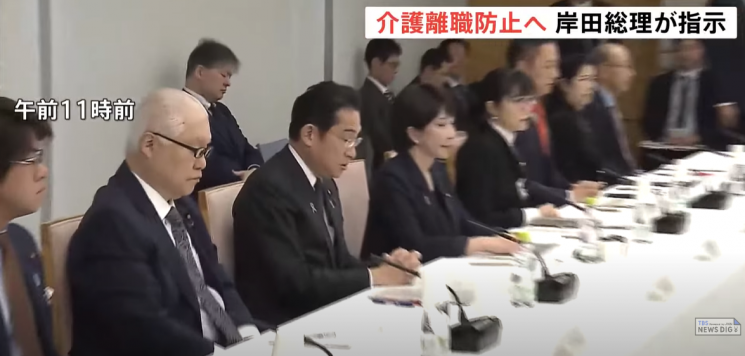 Prime Minister Kishida instructing measures to prevent the turnover of caregiving personnel. (Photo by TBS)
The problem is that while the government’s concerns deepen, the number of workers leaving the field continues to rise. The shortage is especially severe in home care. According to Tokyo Shoko Research, the number of bankruptcies among home care providers reached 44 from January to August this year, the highest since the survey began in 2000. The main reason cited was "lack of workers."
With fewer young people entering this field, the existing workforce is rapidly aging. According to last year's survey by the Kaigo Labor Stability Center, the average age of 'home helpers' providing home care services was 54.7 years, with 38.1% aged 60 or older and 13.5% aged 70 or older. Voices expressing concern about a "collapse of kaigo services" five to ten years after these elderly helpers retire are emerging. Asahi explained, "In home care, there are increasing cases where services are refused despite applications due to staff shortages, and facilities have vacancies but cannot accept people due to lack of personnel."
To compensate for the shortage, efforts are underway to significantly recruit foreign workers and develop and introduce kaigo robots. Comprehensive support for Japanese language lessons is provided to facilitate smooth work by foreign workers. Additionally, the Ministry of Health, Labour and Welfare actively encourages the introduction of care robots and IT devices in care settings.
However, it is still pointed out that the number of nursing care assistants cannot keep pace with the increasing elderly population. Due to the rise in elderly people, by 2040, the number of elderly requiring nursing care is expected to increase by 45% to nearly 10 million. The required number of nursing care assistants is 2.8 million, but there is a shortage of 690,000.
Asahi stated, "A difficult problem is approaching: whether the collapse of kaigo services is due to labor shortages or the collapse of insurance due to increased burdens. To avoid linking burden increases, it is time to consider securing resources separate from the government-set kaigo remuneration."
© The Asia Business Daily(www.asiae.co.kr). All rights reserved.

![Clutching a Stolen Dior Bag, Saying "I Hate Being Poor but Real"... The Grotesque Con of a "Human Knockoff" [Slate]](https://cwcontent.asiae.co.kr/asiaresize/183/2026021902243444107_1771435474.jpg)
















