Kevin McCarthy, a Republican and the first Speaker of the House in U.S. congressional history to be removed from office, announced that he will resign from his congressional seat by the end of this year. However, he plans to remain politically active by supporting the next generation of Republican leaders.
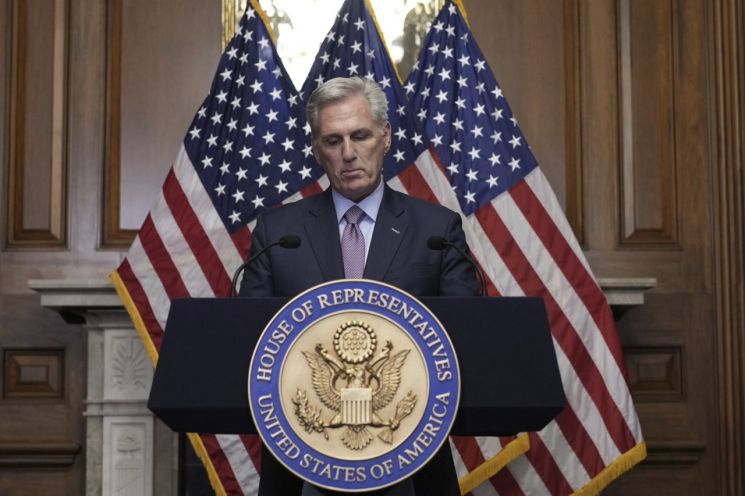
In a Wall Street Journal (WSJ) column published on the 6th (local time), former Speaker McCarthy stated, "I have decided to leave the House at the end of this year to serve America in a new way." This announcement comes about two months after the historic removal from the Speaker position on October 3rd, when a resolution to remove the Speaker, led by hardline Republican members, passed in the House floor session.
McCarthy said, "I now know that my work is just beginning," adding, "I will recruit the best talent for our country," and emphasized, "The Republican Party is improving day by day, and I promise to contribute my experience to support the next generation of leaders." He also remarked, "Sometimes, the more Washington (Congress) steps in, the worse America gets," and said, "I started as a small business owner. I hope to help entrepreneurs and risk-takers realize their full potential." He further added, "The challenges we face are more likely to be solved through innovation rather than legislation."
It is reported that McCarthy has been contemplating his future course of action over the past few weeks. Representing California, McCarthy entered politics as an intern in the office of Representative Bill Thomas while attending California State University. He was first elected to the U.S. House of Representatives in 2006 and has since been re-elected nine times, making him a senior member. He was chosen as the House Republican Leader in 2014 and again in 2018, contributing to the party's victory in last year's midterm elections. In his column, he also mentioned, "I have served as a member of Congress for 17 years," and "I helped lead the Republican Party to become the majority in the House twice."
Once called "Trump's bodyguard," McCarthy's leadership was damaged amid repeated clashes with hardliners within the Republican Party. In January, despite former President Donald Trump's support, he only secured the Speaker position after 15 rounds of voting. In October, he became the central figure in the unprecedented removal of a Speaker in U.S. congressional history after hardliners within his party opposed a temporary budget bill he passed to prevent a federal government shutdown.
The New York Times (NYT) reported, "McCarthy's early resignation was not unexpected," but added, "It will be a headache for his successor, Republican Speaker Mike Johnson, who aims to maintain a majority in the House." Earlier, after stepping down as Speaker at the end of October, McCarthy responded to rumors about his future plans by telling reporters, "I will take some time to consider."
If McCarthy resigns from his congressional seat by the end of this year, according to state law, a special election will be held about four months later. Until then, the House seat count will be 220 for Republicans and 213 for Democrats. Although the Republican Party will still hold the majority in the House, the margin will narrow to seven seats. Consequently, if four or more Republicans defect on a vote, passing legislation will become difficult. McCarthy is also considered a major political figure within the party, ranking among the top in campaign fundraising.
© The Asia Business Daily(www.asiae.co.kr). All rights reserved.

















