Wobong-sik, Director of the Medical Policy Research Institute, Strongly Criticizes Government
"Misdiagnosis of Essential Medical Service Gaps like Emergency Room Overcrowding"
"Pediatrician Open Run Influenced by Young Mothers Eating Brunch"
Woo Bong-sik, Director of the Medical Policy Research Institute at the Korean Medical Association, strongly criticized the government's 'Essential Medical Innovation Strategy.' He argued that the government has made a wrong diagnosis regarding phenomena caused by gaps in essential medical care, such as 'emergency room spinning' and 'pediatric open-run.'
"Emergency Room Spinning Happened Because the '1339 Emergency Call' Was Abolished"
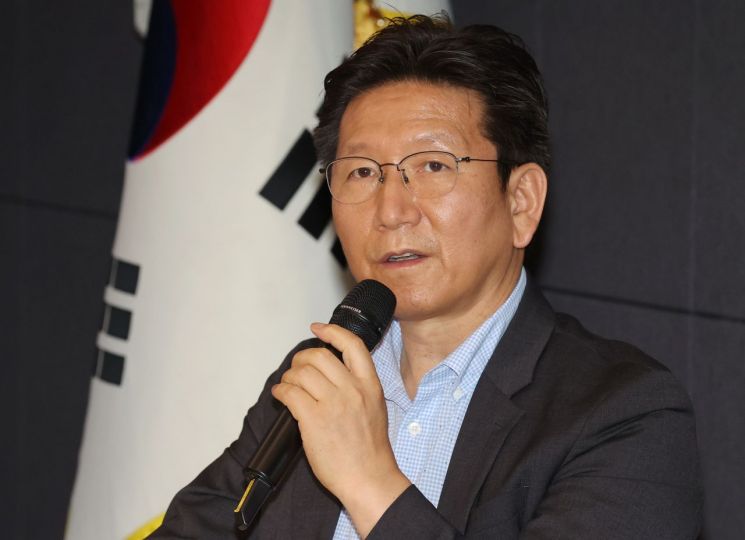 Woo Bong-sik, Director of Medical Policy Research Institute, Korean Medical Association. [Image source=Yonhap News]
On the 4th, Woo published an editorial titled "Essential Medical Crisis and Medical School Quotas" in the Korean Medical Association's quarterly journal, Medical Policy Forum. He is a leading opponent of expanding medical school quotas in the medical community and believes that institutional solutions, not increasing the number of doctors, are necessary.
Woo first diagnosed that "'Emergency room spinning' occurred when the '1339 Emergency Call,' which was responsible for classifying and transporting emergency patients in Korea, was merged into 119 due to legal amendments."
He added, "After the legal amendment, firefighters without expertise sent emergency patients only to large hospitals, causing mild patients to account for nearly 90% of emergency room visitors. This led to 'spinning,' where severe patients could not receive timely treatment."
The emergency medical consultation service through the '1339 Emergency Call' mentioned by him was integrated into the well-known 119 service in June 2013 for public convenience.
"Young Mothers Only Run During Pediatric Clinic Opening"
 This is a pediatric and adolescent department of a university hospital in Daegu and is unrelated to the specific content of the article. [Image source=Yonhap News]
Woo pointed out that "'Pediatric open-run' fundamentally stems from the difficulty of maintaining clinics due to the declining pediatric population caused by low birth rates." He also claimed, "Young mothers often spread malicious rumors on mom cafes if they are dissatisfied with even a little treatment, leading to many clinics closing. Additionally, the increase in working mothers causes patient concentration during morning hours, which is another cause."
He said, "Sometimes young mothers finish early appointments, send their children to daycare centers, and then gather during pediatric clinic opening hours to enjoy brunch with friends," adding, "'They only run during pediatric clinic opening,' but 'stop during the day.'"
"The Number of Doctors Is Not Low... Increasing Quotas Will Ruin Health Insurance Finances"
Woo criticized the government's claim that "the number of doctors must be increased to prepare for a super-aged society." He argued, "Korea ranks first among OECD countries in annual doctor visits per capita (14.7 times) and hospital beds per 1,000 people (12.7 beds)." He added, "This is even higher than Japan, where nearly 30% of the population is elderly."
In July, the Ministry of Health and Welfare announced based on 'OECD Health Statistics 2023' that as of 2021, the number of clinical doctors in Korea (including oriental medicine doctors) was 2.6 per 1,000 people, the second lowest among OECD countries after Mexico. The OECD average is 3.7 clinical doctors per 1,000 people.
Woo cited "health insurance financial collapse" as a reason to oppose expanding doctor quotas. He said, "Every choice has a cost," and "According to a 2007 report by the National Health Insurance Corporation, increasing one doctor per 1,000 people raises per capita medical expenses by 22%."
He continued, "Our health insurance finances are very precarious," emphasizing, "If we endlessly expand university hospital branches in the metropolitan area and increase doctors and nurses to operate those beds, health insurance finances will collapse far sooner than the national pension."
Claim That Korean Doctors Have the Highest Income in OECD Is 'Hatred of the Wealthy'
Regarding statistics that Korean doctors have the highest income in the OECD, Woo labeled them as 'fake news.' According to 'OECD Health Statistics 2023,' the annual wage income of salaried specialists affiliated with hospitals and clinics in Korea was $192,749 (about 246 million KRW) in 2020, the highest among 28 OECD member countries that submitted related statistics.
Woo explained, "When purchasing power parity (PPP) is applied, Korea ranks 2nd among 31 OECD countries for salaried specialists and 3rd among 11 countries for private practitioners. However, when using exchange rates (USD), Korea ranks 8th for salaried specialists and 6th for private practitioners, placing it in the middle range."
He criticized, "The controversy over doctors' income is driven by a class struggle ideology fueled by 'hatred of the wealthy.' The collapse of China's healthcare system after the Cultural Revolution clearly shows what happens when doctors are targeted in this way."
Government Gains Momentum from Medical School Demand Survey... KMA Announces General Strike
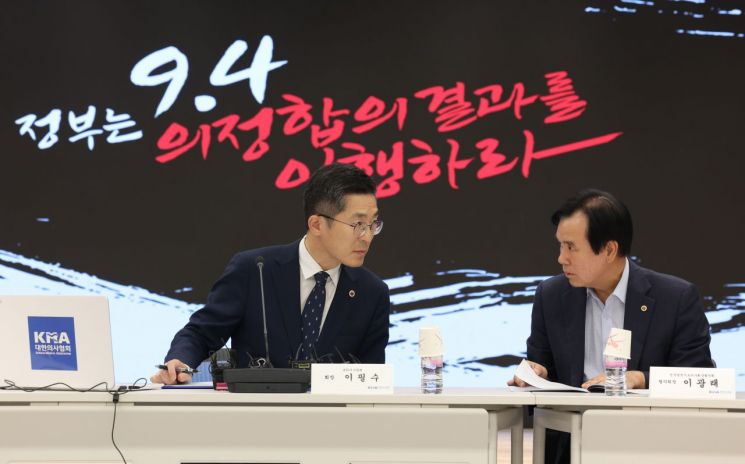 The Korean Medical Association held an "Emergency Meeting of Medical Representatives to Respond to the Expansion of Medical School Quotas" on October 17.
 [Image source=Yonhap News]
Woo also harshly criticized universities that responded to the government's 'medical school quota demand survey' hoping to more than double the current quotas. According to the survey conducted by the Ministry of Health and Welfare on 40 medical schools nationwide on the 21st of last month, medical schools requested an increase in quotas to 2,151?2,847 students by 2025 and up to 3,953 by 2030.
Woo pointed out, "Medical school hospitals that want to increase cheap residents to exploit them, or university presidents who openly say this is a rare opportunity to double quotas, are the ones conducting the doctor demand estimation survey."
He added, "It is proper policy to first conduct thorough research analyzing the impact of increasing medical school quotas on the overall healthcare system. Rushing is not the answer."
Meanwhile, the government is pushing to expand medical school quotas citing manpower shortages in essential medical fields and public opinion. In response, the Korean Medical Association has formed the 'Special Committee for Countermeasures to Prevent the Collapse of Korean Healthcare' and will begin overnight protests in front of the Yongsan Presidential Office this week. Additionally, from the 11th, they plan to hold a vote on whether to proceed with a 'total strike of medical services' scheduled for the 17th.
© The Asia Business Daily(www.asiae.co.kr). All rights reserved.
![Clutching a Stolen Dior Bag, Saying "I Hate Being Poor but Real"... The Grotesque Con of a "Human Knockoff" [Slate]](https://cwcontent.asiae.co.kr/asiaresize/183/2026021902243444107_1771435474.jpg)












