Victor Manuel Rocha, Former Diplomat with Over 20 Years at the State Department
The espionage activities of a former U.S. diplomat who acted as a secret agent for the Cuban government have finally been uncovered. He is accused of serving as a secret agent for Cuba's intelligence agency, the General Directorate of Intelligence (DGI, Direcci?n de Inteligencia), for about 40 years, from his first year at the State Department until after his retirement.
On the 4th (local time), the U.S. Department of Justice announced in a press release that federal prosecutors have indicted Victor Manuel Rocha, former U.S. Ambassador to Bolivia, on charges including espionage.
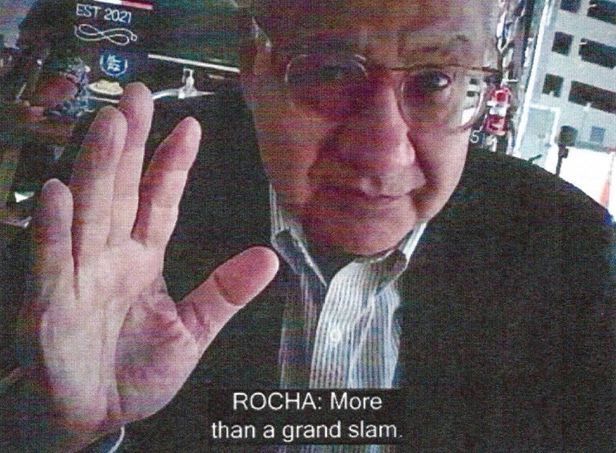 Victor Manuel Rocha, former US Ambassador to Bolivia, was arrested and charged on the 4th (local time) for allegedly acting as a spy for Cuba for about 40 years.
 [Photo by AP Yonhap News]
Former Ambassador Rocha held a director-level position at the National Security Council (NSC), which had access to classified information.
Born in Bolivia in 1950, Rocha immigrated to the United States with his parents and grew up in New York. He obtained U.S. citizenship in 1978 and, based on degrees from prestigious universities such as Yale, Harvard, and Georgetown, joined the U.S. State Department in 1981. From 1995 to 1997, he also served as Deputy Chief of Mission at the U.S. mission in Havana, Cuba.
He worked at the State Department from November 1981 to August 2002, retiring after serving as U.S. Ambassador to Bolivia. After retirement, he worked as a consultant for the U.S. Southern Command from 2006 to 2012.
Federal prosecutors stated in the indictment that Rocha collected confidential information for Cuba's General Directorate of Intelligence (DGI) from his first year at the State Department until recently.
Merrick Garland, Attorney General, described the case as "one of the instances where a foreign agent infiltrated the highest levels of the U.S. government for the longest period."
Rocha is also accused of spreading false information to the U.S. government and meeting with Cuban agents overseas.
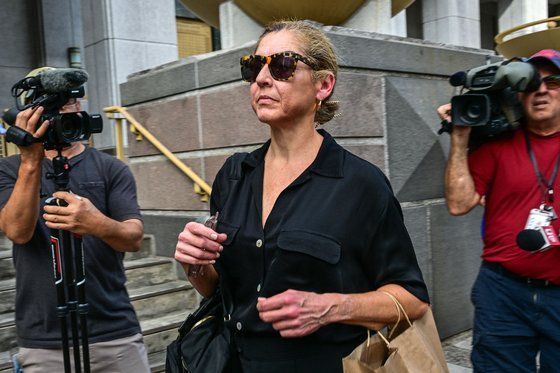 Victor Manuel Rocha, the wife of the former ambassador, leaving the federal courthouse in Miami, Florida, on the 4th (local time).
 [Photo by AFP/Yonhap News]
According to the Department of Justice, Rocha repeatedly admitted to an FBI agent posing as a Cuban intelligence officer last year and this year that he had worked for Cuba for over 40 years.
In February, when an FBI undercover agent posing as a Cuban intelligence officer met Rocha and asked how he entered the State Department, Rocha said, "It was a very delicate process," adding, "But I knew what to do, and headquarters was involved. It was a long process and not easy." This implies he was recruited by the Cuban General Directorate of Intelligence before entering the State Department.
The FBI undercover agent introduced himself as the Miami officer in charge for the Cuban General Directorate of Intelligence. Gradually trusting the agent more, Rocha took him to a food court, saying, "It's a place where people without money go, so no one is likely to see me."
Rocha is believed to have trusted the FBI agent after hearing that he "helped (Cuba) from Chile." Although Rocha worked in several Latin American countries during his State Department tenure, he never served in Chile. In this conversation, he referred to the U.S. as the enemy and called his acquaintances in the Cuban intelligence agency comrades.
Later, on the 1st, the State Department's Diplomatic Security Service conducted a voluntary interview with Rocha. He denied meeting any Cuban intelligence officers and repeatedly denied meeting the FBI undercover agent even when shown a photo of the agent posing as such. When presented with a photo of Rocha sitting face-to-face with the FBI undercover agent, he said, "This person approached me, but only once." Subsequently, the FBI concluded that Rocha, who continued to lie, was still a Cuban spy and arrested and indicted him.
FBI Director Christopher Wray criticized, "A U.S. diplomat acting as an agent for a hostile foreign power like Cuba is a betrayal of the public's trust."
Meanwhile, Cuba has faced U.S. embargoes, blockades, and isolation since the missile crisis triggered by the Soviet Union's attempt to deploy intermediate-range nuclear missiles in 1962 during the Cold War. Although there was a brief "thaw" during the Obama administration, sanctions intensified under the Trump administration, and the situation has not improved under the Biden administration.
Earlier, on the 2nd of last month, the United Nations passed a resolution urging the U.S. to lift its economic embargo on Cuba, which is experiencing food shortages and an economic crisis. During the general assembly, UN member states overwhelmingly adopted the resolution condemning the U.S. economic embargo against Cuba and calling for sanctions relief, with 187 out of 193 member countries voting in favor. Only the U.S. and Israel opposed it.
© The Asia Business Daily(www.asiae.co.kr). All rights reserved.


















