Hankyung Association Surveys Investment Plans of Top 500 Companies for Next Year
Only 45% Have Plans
28.8% of Planning Companies Say "Expansion Compared to This Year"
Due to ongoing domestic and international uncertainties such as high interest rates and high exchange rates, the Middle East and Ukraine wars, and delayed economic recovery in China, the economic outlook for next year has become uncertain, resulting in more than half of large corporations failing to establish investment plans for the coming year. However, among companies that have formulated investment plans, the proportion expecting to expand investments next year has more than doubled compared to last year, indicating positive signs.
The Korea Economic Association (KEA) announced on the 4th that, based on a survey commissioned to the polling agency Monoresearch targeting the top 500 companies by sales, 55.0% of the 131 responding companies either have not yet established investment plans for next year (49.7%) or have no investment plans at all (5.3%).
Companies that have established investment plans account for 45% of the total, of which 61.0% responded that they would maintain investment levels "similar to this year." Companies planning to "expand investments compared to this year" accounted for 28.8%, while those planning to "reduce investments" accounted for 10.2%.
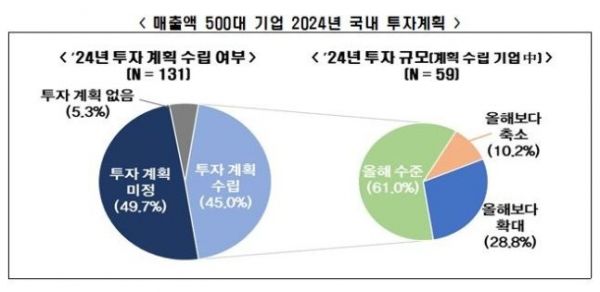
The proportion of companies indicating "investment expansion" increased by 15.3 percentage points compared to last year's survey (13.5%).
KEA analyzed this by stating, "Although many companies still postpone investments due to the continued uncertain business environment, more companies than last year have shown a willingness to expand investments to enhance their competitiveness and prepare for future market changes."
As the reason for expanding investments, companies most frequently cited securing future new growth engines (37.3%). Other reasons included a favorable economic outlook for next year (25.5%), expectations of business condition improvements (15.7%), and securing competitiveness through active investment during a recession (7.8%).
On the other hand, companies that plan to reduce investments or have no investment plans cited reasons such as an uncertain economic outlook (31.6%), increased risk of rising costs (26.6%), and difficulties in financing due to a contraction in financial markets (14.3%).
Regarding risk factors that could negatively impact corporate investment activities next year, the most frequently mentioned was the continuation of high interest rates (33.6%). This was followed by the persistence of high exchange rates and high prices (24.2%), global economic slowdown (21.6%), and private sector debt risks (9.4%).
When asked about the timing for investment to become fully active, about one in three companies answered "the second half of next year."
Additionally, the biggest difficulty companies currently face when investing was cited as regulations related to new or expanded facility investments (28.8%). For key policy tasks to improve the investment environment, companies proposed interest rate cuts (28.8%) and corporate tax reductions and strengthened tax support (22.6%).
Choo Kwang-ho, head of the Economic and Industrial Division at KEA, emphasized, "It is an encouraging sign for our economy that despite ongoing economic uncertainties and poor business performance, the number of companies planning to expand investments compared to last year has increased. We must continue institutional improvements such as deregulation to decisively reverse investment sentiment, and urgently prepare financial and tax support measures that can alleviate companies' difficult funding situations."
© The Asia Business Daily(www.asiae.co.kr). All rights reserved.
![Clutching a Stolen Dior Bag, Saying "I Hate Being Poor but Real"... The Grotesque Con of a "Human Knockoff" [Slate]](https://cwcontent.asiae.co.kr/asiaresize/183/2026021902243444107_1771435474.jpg)
















