Professor Seokyeongdeok: "We Must Clearly Define What Is Korean"
Amid the Japanese government's announcement to promote the registration of the Goryeo Tripitaka woodblock prints preserved at a temple in Tokyo as a UNESCO Memory of the World, Professor Seo Kyung-deok of Sungshin Women's University stated, "It must be clearly established that these belong to Korea."
On the 4th, Professor Seo criticized Japan's recent efforts to register the item as a UNESCO Memory of the World through social networking services (SNS), saying, "The Memory of the World is a project by UNESCO to select valuable documentary heritage for preservation and utilization," and added, "It is generally agreed that it is possible to apply for registration of documentary heritage originating from other countries, so there is no justification to block Japan's registration efforts themselves."
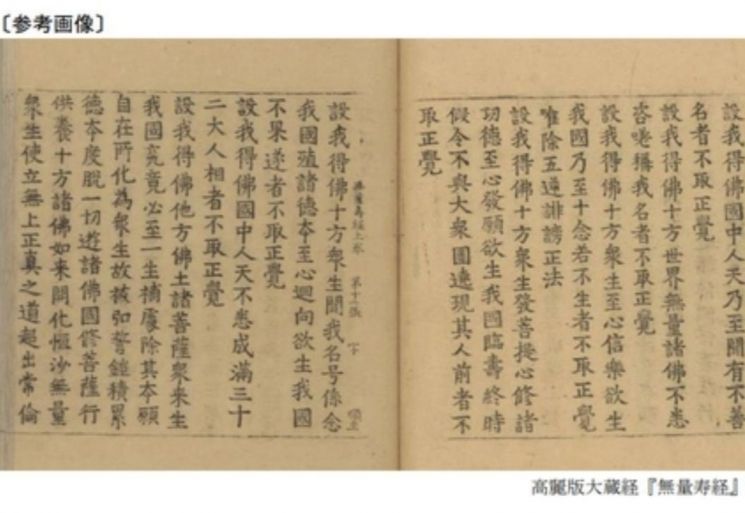
Recently, the Japanese government selected as candidates for UNESCO Memory of the World registration the "Three Buddhist Scriptures Collections" held by Zojoji Temple (?上寺) in Tokyo and photographs showing the devastation caused by the atomic bombing of Hiroshima.
The Zojoji "Three Buddhist Scriptures Collections" are Buddhist printed materials made from Tripitaka woodblocks during the Southern Song Dynasty of China (12th century), the Yuan Dynasty (13th century), and the Korean Goryeo Dynasty (13th century), commonly referred to as the Goryeo Tripitaka.
This Goryeo Tripitaka was created with the purpose of "overcoming national crises through Buddhist faith." The woodblocks are preserved at Haeinsa Temple and are widely known under the name "Palman Daejanggyeong."
The Japanese Ministry of Education, Culture, Sports, Science and Technology stated, "These prints were collected by Tokugawa Ieyasu, who established the Edo Shogunate, and donated to Zojoji," and explained the background for the registration push by saying, "While many Tripitaka were scattered or lost due to dynastic changes and wars, it is unprecedented worldwide that three Tripitaka made before the 15th century remain almost intact."
In response, Professor Seo emphasized, "Under the name 'Three Buddhist Scriptures Collections,' it is essential to ensure that the world does not misunderstand their origin as Japanese Buddhism, and to clearly state that the Goryeo Tripitaka belongs to Korea."
He continued, "Another point to watch closely is that Japan has nominated photographs showing the devastation of the Hiroshima atomic bombing. We must thoroughly examine whether there is an intention to exclude records related to war responsibility and only highlight the damage."
The 'Meiji Japan Industrial Revolution Heritage' Registered Amid Controversy
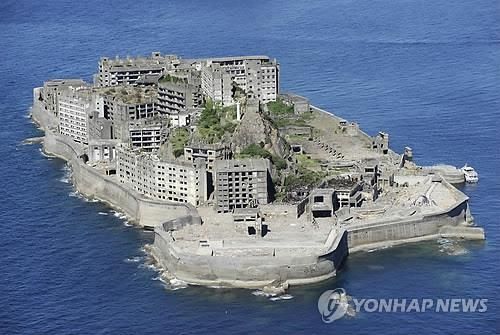 Japan pledged in 2015, when the Meiji Industrial Revolution heritage site Hashima (端島, also known as 'Gunkanjima') coal mine was registered as a World Heritage site, to disclose the 'entire history,' including the forced labor of Koreans. However, it has been criticized for not properly adhering to this commitment.
 [Photo by Yonhap News]
The reason why the application for UNESCO Memory of the World registration of the Goryeo Tripitaka woodblock prints is controversial is that Japan has previously failed to keep promises related to the Memory of the World.
When Japan's Meiji (明治) Industrial Revolution Heritage, including the Hashima (端島, also known as "Gunkanjima") coal mine, was registered as a Memory of the World in 2015, Japan pledged to disclose the "entire history," including the forced labor of Koreans, but has been criticized for not properly fulfilling this promise.
At the time of the initial registration attempt, there was naturally public opposition in Korea against registering Hashima, which carries the painful history of forced mobilization of Koreans, as a Memory of the World.
Despite the controversy, after intense diplomatic negotiations between South Korea and Japan, a compromise was reached where Japan acknowledged that forced labor of Koreans occurred at these facilities, and Korea agreed not to oppose the registration.
This acceptance was based on the argument that negative heritage, like the Auschwitz concentration camp registered as a Memory of the World in 1979, also holds value as world heritage.
Accordingly, at the 39th UNESCO World Heritage Committee held in Bonn, Germany, on July 5, 2015, Kunio Sato, Japan's ambassador to UNESCO, promised to take measures such as establishing an information center to honor the victims, acknowledging that "in the 1940s, Koreans and others were mobilized against their will and forced to work at some industrial facilities including Gunkanjima."
However, after the information center in Tokyo was opened in June 2020, it was confirmed that the Japanese government had not kept this promise, and the issue resurfaced as a diplomatic concern between the two countries.
Meanwhile, as Japan once again applied to register the "Three Buddhist Scriptures Collections" and photographs showing the devastation of the Hiroshima atomic bombing as Memory of the World, the Korean Buddhist community and historians have strongly opposed the move.
© The Asia Business Daily(www.asiae.co.kr). All rights reserved.
![Clutching a Stolen Dior Bag, Saying "I Hate Being Poor but Real"... The Grotesque Con of a "Human Knockoff" [Slate]](https://cwcontent.asiae.co.kr/asiaresize/183/2026021902243444107_1771435474.jpg)

















