Durable Goods Prices Fall 2.2% in October
PCE Growth Expected at 1.8% Next Year
Powell Signals End of Monetary Tightening
60% Chance of 0.25%P Cut in March Next Year
Bloomberg: 1.25%P Cuts Each in Next Two Years
With the decline in U.S. durable goods prices, there is a forecast that the consumer price inflation rate could return to the Federal Reserve's (Fed) target of 2% in the second half of next year. As indicators suggesting a slowdown in inflation continue to emerge, market interests are also shifting. While previously the focus was on the timing of the pivot (a change in monetary policy direction), recently the discussion has moved toward how much the interest rate cuts might be, given the increased likelihood of a pivot occurring next year.
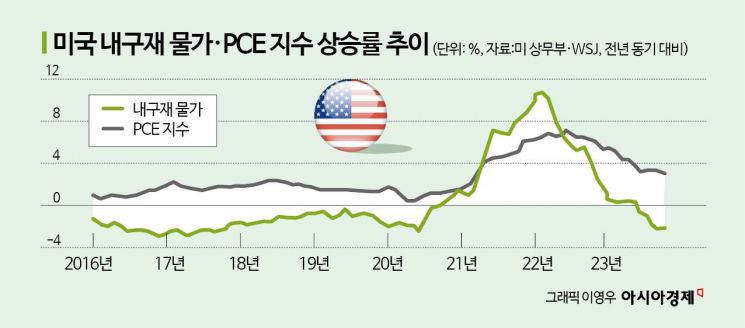
On the 3rd (local time), the Wall Street Journal (WSJ) analyzed data from the U.S. Department of Commerce and found that durable goods prices in October fell by 2.2% compared to the same period last year. After a 0.5% drop in June, marking the first decline in two years and four months, prices have continued to fall for five consecutive months. By category, automobile and auto parts prices dropped 1.5% from a year earlier, and home appliances fell by 2.2%. Supported by the decline in durable goods prices, the personal consumption expenditures (PCE) inflation rate, a key indicator monitored by the Fed, also fell to 3% in October, less than half of the 6.3% recorded a year ago.
The U.S. durable goods price inflation rate averaged -1.9% annually from 1995 to 2020 but surged to 10.7% in February last year amid soaring inflation. This was analyzed as a result of supply chain disruptions and a surge in demand following the COVID-19 pandemic. The Federal Reserve Bank of San Francisco also diagnosed that half of the inflation increase in 2021 and 2022 was due to supply chain issues such as factory shutdowns and logistics difficulties.
Since then, durable goods prices have stabilized as supply chains normalize. According to the White House Council of Economic Advisers, about 80% of the inflation decline since last year is estimated to be due to weakened demand and supply chain stabilization.
With durable goods prices, which had driven inflation along with service prices, falling, inflation is expected to ease rapidly. U.S. investment bank Morgan Stanley forecast that the core durable goods price decline will accelerate until mid-next year, offsetting the rise in service prices, resulting in the PCE inflation rate dropping to 1.8% by September next year. Swiss bank UBS predicts that inflation will fall to 1.7% in the fourth quarter of next year as the U.S. economy enters a recession. Previously, the Fed expected inflation to return to 2% by 2026, but both institutions foresee the target being achieved much earlier than the Fed's projection. Alan Detmeister, an economist at UBS, said, "The decline in automobile prices next year is likely to pull down a significant portion of inflation," adding, "If supply chain problems pushed prices up, resolving those problems means prices will return to a balanced state."
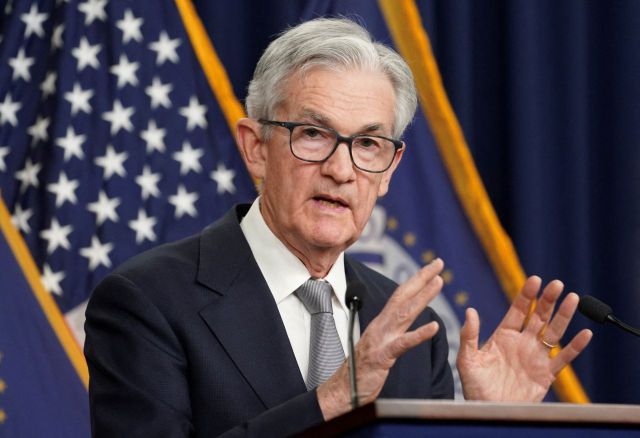
Fed Chair Jerome Powell also hinted that the 'end' of the unprecedented pace of monetary tightening over the past year and a half is near. In a speech at Spelman College in Atlanta on the 1st, ahead of the final Federal Open Market Committee (FOMC) meeting of the year on the 13th-14th, Powell mentioned the possibility of further tightening but said, "Policy has entered a restrictive territory," and "The risks of over- and under-reacting to inflation are balanced." The market interpreted this as a 'dovish' statement disguised as hawkish. U.S. Treasury yields responded immediately. The 10-year U.S. Treasury yield was at 4.22% at 9:45 a.m. that day, down from 4.33% before Powell's remarks. The 2-year Treasury yield, sensitive to policy rates, also fell from around 4.69% to 4.58%.
Market attention is now focused on the scale of interest rate cuts next year. According to the Chicago Mercantile Exchange (CME) FedWatch tool, federal funds futures on that day priced in about a 60% chance that the Fed will cut rates by 0.25 percentage points in March next year. Bloomberg Economics, the economic research arm of Bloomberg, also expects the Fed to cut rates by 1.25 percentage points each in 2024 and 2025, starting in March next year. Anna Wong, an economist at Bloomberg Economics, said, "The unemployment rate is expected to steadily rise to 5% by the end of next year, which corresponds to a mild recession," adding, "As signs of an economic downturn become clearer, the Fed is expected to cut rates for the first time in March next year."
© The Asia Business Daily(www.asiae.co.kr). All rights reserved.
![Clutching a Stolen Dior Bag, Saying "I Hate Being Poor but Real"... The Grotesque Con of a "Human Knockoff" [Slate]](https://cwcontent.asiae.co.kr/asiaresize/183/2026021902243444107_1771435474.jpg)











