Areca Nut Fruits Sold in Taiwan
"87% of Samples Contain Unapproved Pesticides"
Korea Imports Tens of Tons Annually as Herbal Medicine
A Taiwanese civic group has warned of the dangers after detecting unauthorized highly toxic pesticides in a significant number of betel nut fruits sold in Taiwan. Betel nut contains arecoline, a Group 1 carcinogen that causes oral cancer.
According to Taiwan's Central News Agency on the 2nd, the Taiwanese civic group "Betel Nut Cancer Prevention and Control Alliance (hereafter, the Alliance)" held a press conference the previous day and stated, "As a result of an investigation of 116 betel nut samples sold nationwide in Taiwan, pesticide residues of various unauthorized substances were detected in 87% of the samples, rendering them unfit as food."
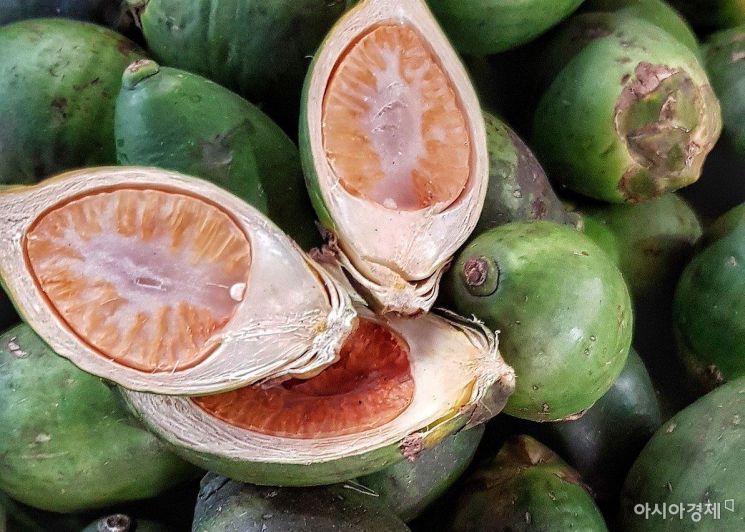
The Alliance warned, "When pesticides are added to betel nut, which is a Group 1 carcinogen, it can pose serious risks to human health," adding, "Chewing betel nut increases the likelihood of developing oral cancer by 28 times compared to those who do not consume it." They continued, "Many people mistakenly believe that betel nut without other additives is safe, but this is incorrect common knowledge," emphasizing, "Betel nut contains Group 1 carcinogenic components, so regardless of processing, the risk of oral cancer is significantly high." The Alliance urged health authorities to recognize the dangers of betel nut and promptly establish strict regulations on its consumption.
In China, Taiwan, India, and other countries, many people chew betel nut like gum, and it has also been used as a traditional medicine for treating cold symptoms, strengthening intestinal function, and expelling parasites. Betel nut is consumed as a kind of recreational product because chewing the fruit or its outer shell produces a stimulating effect. During the early stages of the COVID-19 pandemic in 2020, sales surged due to false information claiming it had virus-fighting properties.
However, the arecoline component in betel nut is a carcinogen that causes oral cancer and addiction. A study conducted several years ago in Hunan Province, China, involving about 8,000 oral cancer patients revealed that 90% of them had consumed betel nut. The World Health Organization (WHO) International Agency for Research on Cancer designated betel nut as a Group 1 carcinogen in 2003, and China classified arecoline as an oral cancer-causing substance in 2017.
China excluded betel nut from food items in 2020, followed by a complete ban on online promotion and sales in 2021. Some regions also conducted full recalls of betel nut processed products displayed on sales counters, imposing consumption restrictions. Earlier, a Chinese food magazine reported in 2020 that betel nut consumption in China reached 1,033,780 tons, with about 15,000 related companies.
In September last year, Chinese singer Bosong (博松), who died of oral cancer, emphasized on social media to people, "Never eat betel nut." Bosong had enjoyed chewing betel nut for about six years before his cheeks gradually swelled, leading to an oral cancer diagnosis. He battled the disease for a year before passing away at the age of 36.
In South Korea, betel nut is used as a herbal medicine ingredient and is imported by tens of tons annually. According to data obtained by Hong Seong-guk, a member of the Democratic Party of Korea, from the Korea Customs Service during a national audit in October last year, 103 tons of betel nut were imported into the country from 2018 to August of last year.
At that time, the Korea Customs Service stated that betel nut is managed as a herbal medicine under the Pharmaceutical Affairs Act, and as long as an inspection certificate is present, there are no particular restrictions on import customs clearance. The Ministry of Food and Drug Safety announced plans to conduct safety evaluation research related to betel nut by 2025, but it is known that no lead research institution had been selected as of last year.
Regarding this, Representative Hong emphasized, "Since no safety evaluation has been conducted from the start, the risk cannot be guaranteed, and the Ministry of Food and Drug Safety and the Korea Customs Service are playing ping-pong," adding, "The relevant authorities need to promptly establish measures such as rapid safety evaluations."
© The Asia Business Daily(www.asiae.co.kr). All rights reserved.
![Clutching a Stolen Dior Bag, Saying "I Hate Being Poor but Real"... The Grotesque Con of a "Human Knockoff" [Slate]](https://cwcontent.asiae.co.kr/asiaresize/183/2026021902243444107_1771435474.jpg)
















