US Announces IRA Foreign Concern Designation
All Chinese Companies Excluded from Subsidies
Korean Battery Firms with Chinese Joint Ventures
May Need to Adjust Shareholdings
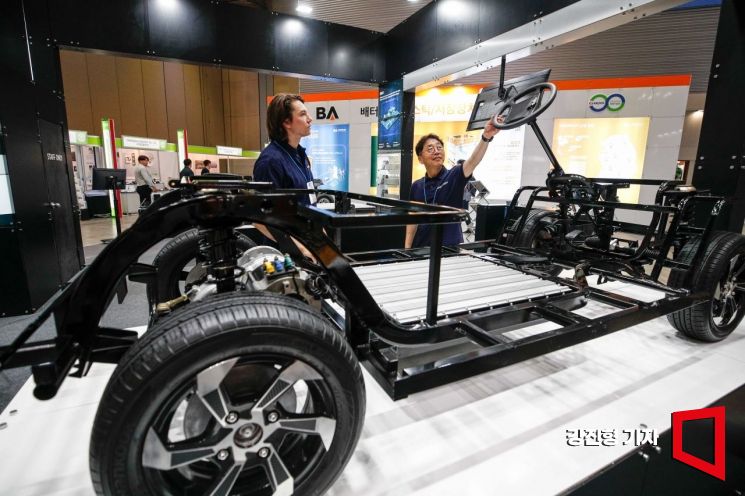 On June 27, 2023, automotive lithium-ion batteries were exhibited at the "2023 World Battery & Charging Infrastructure Expo - 2023 World Solar Energy Expo" held at KINTEX in Goyang, Gyeonggi. Photo by Jinhyung Kang aymsdream@
The U.S. government has effectively decided to exclude all companies based in China from eligibility for U.S. electric vehicle subsidies. Additionally, if a Chinese company forms a joint venture with a foreign company outside China, such as in the U.S. or a third country, the joint venture will not qualify for subsidies if the Chinese government-related ownership stake is 25% or more. This is expected to place a considerable burden on domestic battery companies that have formed joint ventures with Chinese firms.
On the 1st (local time), the U.S. Department of the Treasury and Department of Energy announced detailed regulations regarding the 'Foreign Entity of Concern' (FEOC), which are entities ineligible for electric vehicle tax credits under the Inflation Reduction Act (IRA).
Currently, the U.S. offers up to $7,500 in tax credits for electric vehicles that meet battery component and critical mineral origin requirements and are finally assembled in North America. However, to qualify for these benefits, battery components must not be sourced from FEOCs starting in 2024, and critical minerals used in batteries must not be sourced from FEOCs starting in 2025.
Given that the global battery industry, including South Korea, has been heavily dependent on Chinese critical minerals, there has been significant interest in how strictly the U.S. government would enforce the FEOC regulations. On this day, the U.S. Department of Energy defined FEOCs by referencing the Infrastructure Act as companies "owned, controlled, or directed" by the governments of China, Russia, North Korea, or Iran.
Accordingly, companies located in China or registered as legal entities in China that source critical minerals will be ineligible for subsidies. Any company, regardless of nationality, that mines, processes, recycles, manufactures, or assembles battery components and materials or critical minerals in China will be considered an FEOC.
Instead, the U.S. government will allow joint ventures formed outside China between Chinese and foreign companies, provided that the Chinese government's ownership stake is limited. Specifically, if the Chinese government directly or indirectly holds 25% or more of the joint venture's board seats, voting rights, or equity, the joint venture will be defined as "owned, controlled, or directed" by China.
This is the same standard as the Semiconductor Act, which prohibits companies receiving subsidies from engaging in joint ventures with companies where the Chinese government holds 25% or more ownership. Recently, Chinese companies have been investing in foreign battery industries, including in South Korea, to circumvent IRA origin requirements, and joint ventures with Korean companies are expected to qualify for subsidies if they comply with the '25%' rule. However, since the term 'Chinese government' is broadly defined to include not only central and local governments and government agencies but also the Chinese Communist Party, current and former senior officials, and their immediate families, joint ventures with Chinese private companies may not automatically qualify for subsidies.
The U.S. government's move is interpreted as an effort to prevent U.S. electric vehicle subsidies from flowing to China and to exclude China as much as possible from the U.S. electric vehicle supply chain. However, it is also seen as partially reflecting the reality that the global battery industry currently must rely on supply chains in China.
AP and Bloomberg News have forecast that the strict regulations could reduce the number of electric vehicles eligible for subsidy benefits. The Department of Energy stated that even if the Chinese government does not hold equity, joint ventures that exercise substantial control over battery components, materials, and critical mineral production through contracts, including patent licensing agreements, will be subject to FEOC control. To avoid issues with contracts including licensing, the company contracting with China must directly determine production volume and schedules, observe all production sites and processes, independently operate all necessary equipment, and have access to all intellectual property and information.
The domestic battery industry views the immediate impact as limited but is paying close attention to future repercussions such as additional burdens from adjusting ownership stakes. Chinese companies have previously established joint ventures with Korean companies as a means to bypass U.S. export restrictions. Korean companies have also benefited from stable raw material supplies through these partnerships, aligning the interests of both sides.
LG Chem, together with Huayou Cobalt, plans to invest 1.2 trillion won to build a battery precursor joint venture factory in Saemangeum and has signed a comprehensive memorandum of understanding (MOU) with Huayou Group for the cathode material supply chain, aiming to build a joint venture factory producing 50,000 tons per year of lithium iron phosphate (LFP) cathode materials in Yusan, Morocco, targeting mass production in 2026.
LG Energy Solution also signed an MOU earlier this year with Chinese lithium compound manufacturer Yahua for lithium hydroxide production in Morocco and plans to establish the first Korea-China joint battery recycling joint venture (JV) with Huayou Cobalt in China.
SK On and EcoPro plan to establish a three-party joint venture in Saemangeum for precursor production with Chinese precursor manufacturer Gelinmei (GEM). POSCO Holdings and POSCO Future M signed a joint venture agreement (JVA) in June to build nickel and precursor production plants for secondary batteries in Pohang, Gyeongbuk, in partnership with China's CNGR.
Last month, the Wall Street Journal (WSJ) reported, after reviewing securities exchange disclosures, that Chinese battery-related companies are targeting the U.S. market through indirect routes such as joint investments with South Korea and Morocco, announcing at least nine joint venture plans in South Korea this year.
In the case of LG Energy Solution, the production volume from the JV with Huayou Cobalt is mostly consumed within China, and the MOU with Yahua is still at an early stage, so the detailed regulation announcement is not expected to have a significant impact. For companies like LG Chem, which have joint ventures in China producing supplies for the North American market, plans are underway to adjust ownership ratios and prepare countermeasures. Earlier, in an earnings conference call in April, LG Chem stated, "If FEOC regulations require complete exclusion of Chinese company ownership, we are considering acquiring all shares of Huayou Cobalt if necessary."
© The Asia Business Daily(www.asiae.co.kr). All rights reserved.

















