Democratic Party to Hold Party Meeting on 30th for Heated Debate on 'Electoral System'
Hong Ik-pyo: "If Political Responsibility is Required, We Must Bear It"
Lee Suggests Return to 'Parallel System', Breaking Presidential Pledge
Kim Jong-min: "Promises Must Be Kept, No Future as Is"
On the 30th, the Democratic Party of Korea held a three-hour heated debate over the 'electoral system reform' but failed to reach a conclusion on whether to 'maintain the mixed-member proportional representation system' or 'return to the parallel system.' However, Floor Leader Hong Ik-pyo stated that if 'political responsibility' follows, it must be borne, leading to speculation that the party leadership may be leaning toward choosing the parallel system. Since Representative Lee Jae-myung recently remarked, "(In the general election) what use is it to lose gracefully," seemingly hinting at a return to the parallel system, there are also forecasts that internal conflicts over electoral reform could escalate into factional disputes.
After the afternoon caucus meeting, Floor Leader Hong Ik-pyo told reporters, "There were many opinions expressed regarding the mixed-member proportional system, the parallel system, and regional proportional representation," adding, "Opinions are about evenly split between maintaining the mixed-member proportional system and returning to the parallel system." He continued, "Even if we keep the mixed-member proportional system, the important thing is that institutional improvements to prevent satellite parties must come first," and explained, "Because of this, there were many requests for negotiations to reach an agreement between the ruling and opposition parties within the Political Reform Special Committee on institutional improvements to prevent satellite parties."
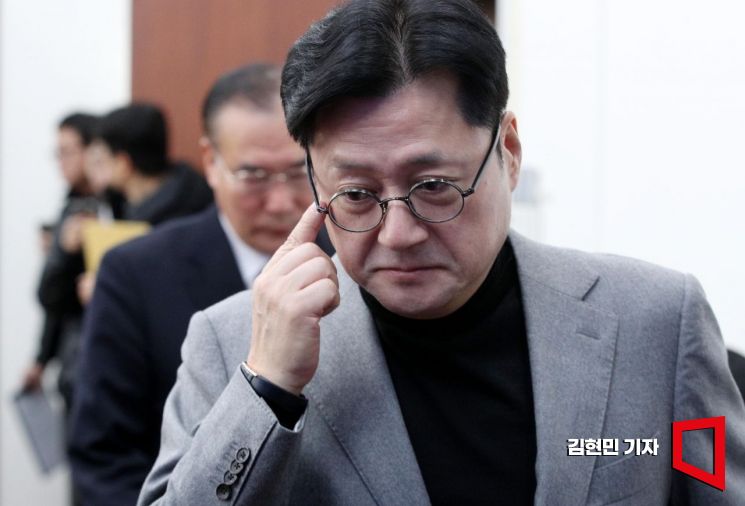 Hong Ik-pyo, the floor leader of the Democratic Party of Korea, is attending the policy coordination meeting held at the National Assembly on the 30th. Photo by Hyunmin Kim kimhyun81@
When asked about the burden of breaking campaign promises if returning to the parallel system, he replied, "There is no significant difference among lawmakers regarding the values or direction the Democratic Party should pursue, but there are disagreements about which path to take," adding, "If there is 'political responsibility' to be borne in the process of choosing a path, it must be borne." He further stated, "For example, if a promise is broken, I think there is a need to offer a public apology to the people or present a reasonable justification."
The 'political responsibility' mentioned by Floor Leader Hong is interpreted as a willingness to bear the burden of breaking the Democratic Party's electoral reform promise based on the semi-proportional system, leaving open the possibility of returning to the parallel system. Earlier, on the 28th, Representative Lee Jae-myung said in a YouTube live broadcast, "(In the general election) what use is it to lose gracefully," and "We cannot ignore the harsh realities," which was interpreted as suggesting a possible return to the parallel system to secure victory in the general election, fueling the debate.
Democratic Party, which led the 'semi-proportional system,' considering parallel system to win?
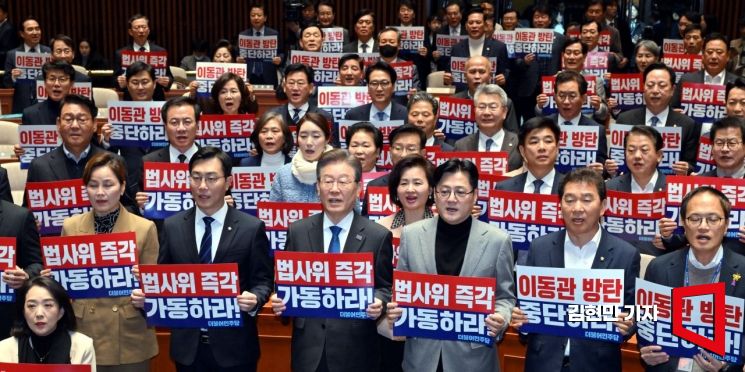 Lee Jae-myung, leader of the Democratic Party of Korea, and Hong Ik-pyo, floor leader, along with other lawmakers, are holding placards reading "Activate the Legislation and Judiciary Committee Immediately, Stop Shielding Lee Dong-gwan" and shouting slogans at a party meeting held at the National Assembly on the 30th. Photo by Kim Hyun-min kimhyun81@
As the 'largest party in the National Assembly' holding the key to electoral reform, the Democratic Party is deliberating whether to maintain the semi-proportional system or revert to the parallel system. The semi-proportional system, introduced from the last general election, allocates seats based on party vote share, filling 50% of proportional representation seats after subtracting district winners. The parallel system, applied until the 20th general election, simply distributes proportional seats according to party vote share and is the reform plan advocated by the ruling party.
Originally, the Democratic Party led the introduction of the semi-proportional system under the banner of 'expanding proportionality.' In particular, Representative Lee Jae-myung pledged a 'proportional representation system banning satellite parties' during the last presidential election. However, as analyses suggest that the parallel system is advantageous for securing more proportional seats in next year's general election, the party leadership has yet to decide on a party stance even with less than five months remaining before the election, continuing to deliberate.
The problem with the semi-proportional system is the 'trick' of satellite parties. When the People Power Party used satellite parties to secure proportional seats in the last general election, the Democratic Party, which had called for electoral reform, also created a satellite party for the purpose of winning the election. Within the Democratic Party, the opinion to maintain the semi-proportional system while separately enacting laws to prevent satellite parties is gaining traction. On the 28th, 75 Democratic Party lawmakers expressed this view and urged the party to adopt a 'satellite party prevention law' as party policy. This number is close to half of the Democratic Party's 168 seats in the National Assembly.
"Why doesn't Lee Jae-myung clarify his position?"... Internal conflicts intensify
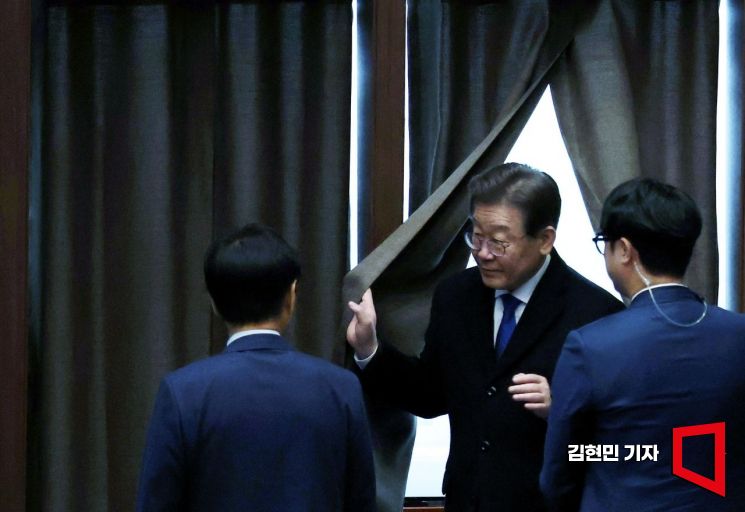 Lee Jae-myung, leader of the Democratic Party of Korea, is voting on the appointment consent bill for Lee Jong-seok, Chief Justice of the Constitutional Court, at the plenary session held at the National Assembly on the 30th. Photo by Hyunmin Kim kimhyun81@
At the caucus meeting, so-called 'pro-Lee' lawmakers reportedly made statements advocating a 'return to the parallel system,' such as "If we lose the general election, how will we stop the Yoon Seok-youl government's tyranny?", "Not fielding proportional candidates removes the people's right to choose," and "Winning first is the best strategy." In response, Representative Kim Jong-min told reporters outside the meeting, "The way to win public support is not to retreat to the parallel system but to keep promises," adding, "We've been judged and scolded many times before; if we don't get our act together, the Democratic Party has no future."
There were also reportedly 'pointed remarks' aimed at Representative Lee Jae-myung. Representative Lee Tan-hee, who recently declared a 'challenging district' candidacy demanding the maintenance of the semi-proportional system, criticized, "The party leader had several opportunities to clarify his position on electoral reform but did not do so," and said, "The leadership must organize its stance for this issue to be resolved." However, according to Floor Leader Hong Ik-pyo, Representative Lee did not make any remarks regarding the electoral system during the caucus meeting. Even when leaving the meeting room, he did not respond to reporters' questions about his 'position on electoral reform.'
Given the situation within the party, lawmakers who have not decided on a course of action appear to have complicated calculations. A senior lawmaker from the Seoul metropolitan area admitted, "Simply considering election results, the parallel system seems advantageous," but confessed, "If the Democratic Party breaks its promise (to the semi-proportional system), we cannot ignore how public opinion will turn and the aftermath." Another lawmaker predicted, "Even if we try to block satellite parties, if the People Power Party does not agree, we have no way to counter it," adding, "Maintaining the semi-proportional system is right to keep our principles, but in the end, I think we will go with the parallel system."
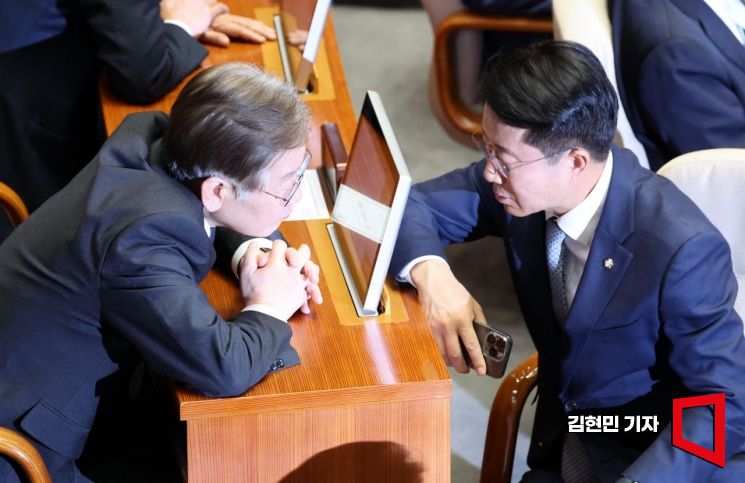 Lee Jae-myung, leader of the Democratic Party of Korea, is talking with Assemblyman Jo Jeong-sik at the plenary session held at the National Assembly main chamber on the 9th. Photo by Hyunmin Kim kimhyun81@
Meanwhile, at the caucus meeting, opposition was also raised against the 'criteria for evaluating elected officials' and the 'reduction of the proportion of delegate votes in the party convention,' which are scheduled for approval by the Central Committee on the 7th of next month following the Supreme Council's resolution on the 24th. Representative Park Yong-jin argued, "Systematic nominations should be predictable, but the General Election Planning Team is making decisions that overturn that, and the Central Committee is only planning to hold a yes/no vote," and urged, "Let's hold a face-to-face Central Committee meeting for intense debate." The Democratic Party plans to hold additional caucus meetings as necessary to continue discussions on these opinions and electoral reform.
© The Asia Business Daily(www.asiae.co.kr). All rights reserved.



















