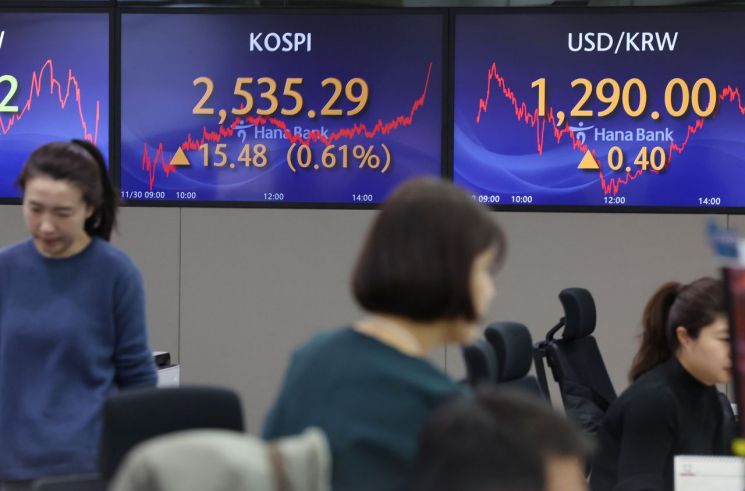
Foreign investment banks (IBs) have projected that the KOSPI could rise to the 2700?2830 range next year.
According to the International Finance Center on the 30th, the year-end KOSPI target prices presented in recent reports by five major IBs ranged from a minimum of 2700 to a maximum of 2830.
HSBC announced the highest target price at 2830, while Goldman Sachs and Citi both set it at 2800. Morgan Stanley and UBS set relatively lower targets at 2700.
Most investment opinions were 'neutral.' HSBC, Citi, and Morgan Stanley gave 'neutral' ratings, while Goldman Sachs and UBS recommended 'overweight.'
The relatively positive stock market outlook from these IBs is mainly based on the semiconductor industry improvement that began to appear in the fourth quarter of this year. The Bank of Korea recently announced that the export price index rose 0.5% month-on-month in October, led by flash memory (13.5%) and DRAM (9.9%).
The Korea Customs Service reported that semiconductor export value from November 1 to 20 increased by 2.4% compared to the same period last year, confirming a rebound after 14 months.
Additionally, among KOSPI-listed companies, the operating profit share of the electrical and electronics sector, centered on semiconductor manufacturing, averaged 33% from 2017 to 2022.
Lee Eun-jae, Deputy Specialist at the International Finance Center, stated in the report, "The memory semiconductor market shrank by more than 35% year-on-year this year, but a rebound of over 43% is expected next year." It was introduced that Morgan Stanley's analysis suggests that the semiconductor supply shortage will continue next year and may peak in the first half of 2025.
Accordingly, the annual earnings per share (EPS) of the domestic stock market is expected to record the highest level among emerging markets, increasing by 61% next year after a 33% decline this year.
However, HSBC indicated that next year's EPS will improve by only 2% compared to 2022, citing this volatility as the basis for their 'neutral' opinion, according to Deputy Specialist Lee.
Meanwhile, the International Finance Center forecasted that the global economic growth rate will slow from 3.1% this year to 2.7% next year, based on major IB projections. Growth rates in advanced countries are expected to decline from 1.5% to 0.9%, and in emerging countries from 4.1% to 3.9%.
The International Finance Center stated, "Monetary tightening will act as a downward pressure on growth due to increased financial costs and worsening loan conditions," adding, "Deferred demand for services will gradually weaken, and the manufacturing recovery may be limited."
It further noted, "There is a possibility that major countries' inflation rates will enter the 2% range by the second quarter of next year," and "The expected order of convergence to inflation targets is the Eurozone, Japan, the United States, and the United Kingdom."
Jung Hyung-min, Head of the Global Economic Analysis Office at the International Finance Center, said, "Next year's financial markets will be influenced by whether the U.S. economy achieves a soft landing and the direction of interest rates, with an expected improvement trend amid high volatility." He added, "Important elections are scheduled in many countries such as Taiwan and the United States, and their outcomes could impact the global economy."
© The Asia Business Daily(www.asiae.co.kr). All rights reserved.
![Clutching a Stolen Dior Bag, Saying "I Hate Being Poor but Real"... The Grotesque Con of a "Human Knockoff" [Slate]](https://cwcontent.asiae.co.kr/asiaresize/183/2026021902243444107_1771435474.jpg)
















