Duksan Neolux, PNH Tech, LX Semicon Stocks Rise 12-20%
iPad OLED Adoption in Automotive Displays Expected to Increase, Acting as Positive Catalyst
Organic Light Emitting Diode (OLED) stocks are rebounding after a long time. This is attributed to expectations that the number of devices applying OLED, from Apple's iPad to vehicles, will increase.
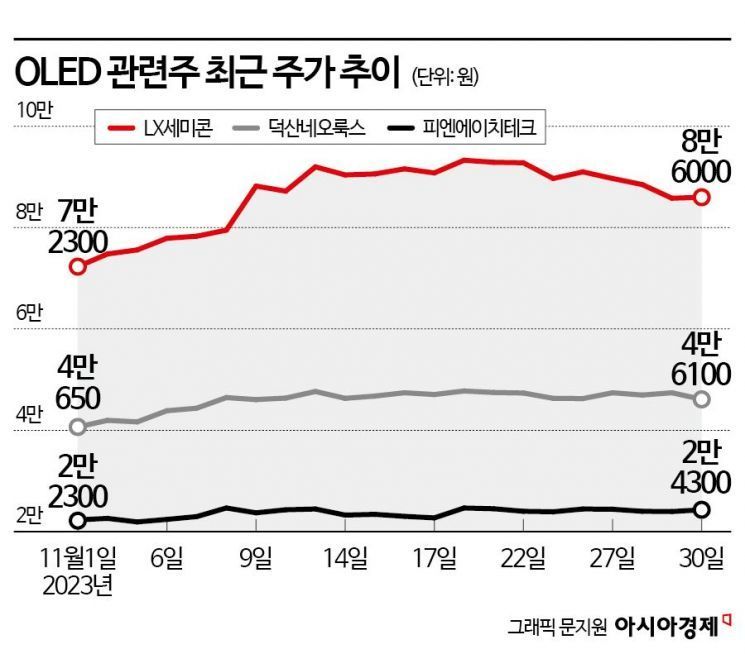
Duksan Neolux closed at 46,100 won on the 30th of last month, up 19.43% compared to the end of the previous month. During the same period, PNH Tech rose 12.76%, and LX Semicon increased by 20.11%. Duksan Neolux and PNH Tech are specialized companies in OLED materials. LX Semicon sells components such as display driver ICs (DDI) that drive display panels.
The rise in OLED-related stocks is largely due to the diversification of devices using OLED. Apple is especially at the forefront. The industry expects Apple to apply OLED to iPads starting next year. It is anticipated that OLED will be applied first to the 11-inch and 12.9-inch Pro lines of the iPad. The expected volume is 8 to 10 million units.
Namgung Hyun, a researcher at Shinhan Investment Corp., said, "The estimated volume for the iPad Pro 11-inch is 6 to 6.5 million units, and for the iPad Pro 12.9-inch, it is 3.5 to 4 million units," adding, "In 2027, the transition of MacBook Pro to OLED is expected."
Because of this, the earnings growth of OLED companies is anticipated. Kim Sowon, a researcher at Kiwoom Securities, explained, "The launch of OLED iPads next year will act as a new growth driver for the stagnant OLED market and will be a positive factor for display companies. Just as Apple raised the average selling price (ASP) and boosted earnings in the stagnant smartphone market by upgrading specs such as OLED panel adoption in 2017, the high-spec OLED iPad is also expected to become a new growth momentum for Apple and its supply chain."
Another promising area is automotive displays. The Korea Display Industry Association forecasted that the global display market size will grow from $8.86 billion (approximately 11.4 trillion won) last year to $12.63 billion (approximately 16.3 trillion won) in 2027, with an average annual growth rate of 7.8%. By type, the market share of OLED is expected to rise from 2.8% last year to 17.2% in 2027.
The reason OLED adoption is expected to become mainstream in automotive displays is due to its various advantages compared to Liquid Crystal Displays (LCD). Researcher Kim Sowon said, "OLED can reduce power consumption and weight compared to LCD, and it can offer design competitiveness, so sales are expected to increase along with the expansion of the electric vehicle and autonomous driving markets. Recently, premium car manufacturers have been adopting OLED panels one after another."
© The Asia Business Daily(www.asiae.co.kr). All rights reserved.

















