Expansion of Child Tax Credit and Monthly Rent Tax Credit Scope
Includes Measures to Ease Gift Tax on Business Succession
Budget-Related Bills Head Straight to Plenary Session
The tax bracket for the minimum gift tax rate on business succession has been expanded to up to 12 billion KRW, and a bill providing newlyweds with a gift tax deduction of up to 300 million KRW has passed the National Assembly's standing committee.
On the 30th, the National Assembly's Planning and Finance Committee held a plenary session and approved the gift tax amendment bill and other tax law amendments containing these provisions.
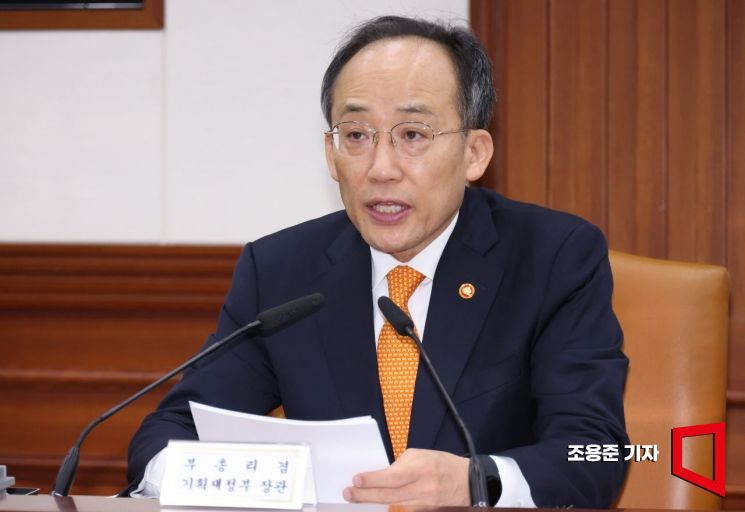 Deputy Prime Minister and Minister of Economy and Finance Choo Kyung-ho is delivering opening remarks at the Emergency Economic Ministers' Meeting and Export Investment Measures Meeting held at the Government Seoul Office in Jongno-gu, Seoul on the 27th. Photo by Jo Yong-jun jun21@
On that day, the Planning and Finance Committee approved an amendment to the Gift Tax Act that increases the tax bracket for the minimum gift tax rate (10%) applied when a business owner passes the business to their children from the current 6 billion KRW or less to 12 billion KRW or less. The original government proposal was to increase it to 30 billion KRW or less, but following the Democratic Party's criticism that it had been expanded from 3 billion KRW to 6 billion KRW last year, the range was revised to 12 billion KRW or less through negotiations between the ruling and opposition party floor leaders. Additionally, the current 5-year installment payment period for gift tax will be extended to 15 years. The government had proposed 20 years.
The amendment also includes provisions to provide newlyweds with a gift tax deduction of up to 300 million KRW. It exempts an additional 100 million KRW of property inherited from parents within two years before or after the marriage registration date. Under current law, when parents gift property to their children, up to 50 million KRW is tax-exempt over 10 years, but the amendment allows an additional 100 million KRW exemption at marriage, raising the tax-exempt limit to 150 million KRW. Combined for both spouses, the deduction limit increases to 300 million KRW.
Ruling and opposition parties also expanded options to allow deductions at childbirth. Individuals can choose an additional deduction of 100 million KRW either at marriage or childbirth, and deductions are available even for unmarried couples who have children and for childless unmarried couples.
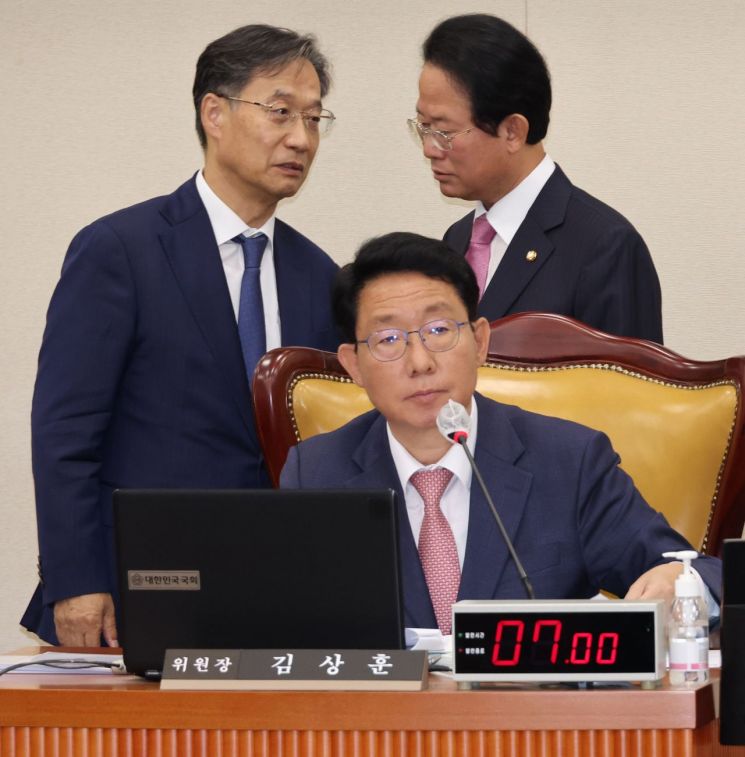
The ruling and opposition parties agreed to expand the current child tax credit as well. Currently, the first child receives 150,000 KRW, the second child 150,000 KRW, and the third child 300,000 KRW in credits, but this will be revised to 150,000 KRW for the first child, 200,000 KRW for the second, and 300,000 KRW for the third. Additionally, the monthly rent tax credit will be expanded from the current salary cap of 70 million KRW and 7.5 million KRW limit to 80 million KRW and 10 million KRW, respectively.
Regarding the agreement on this tax law amendment, Justice Party lawmaker Jang Hye-young told reporters, "Only Democratic Party lawmaker Yang Kyung-sook raised objections to the marriage gift deduction and business succession issues, and voted against along with me," adding, "An explanation is needed regarding the Democratic Party's change in stance on marriage inheritance and business succession, which the government has focused on."
Meanwhile, the National Finance Act, which includes a provision exempting the preliminary feasibility study (PFS) for the project to extend Subway Line 5 to Gimpo, was not approved. Although it was originally scheduled to be on the agenda, the ruling and opposition party floor leaders agreed not to approve it that day. It is reported that concerns arose that if the review took too long, it could exceed the deadline for reviewing the tax law amendment bill (November 30). Earlier, the Democratic Party had unilaterally approved the agenda item at the Economic and Fiscal Subcommittee on the 23rd.
The tax law amendment bill that passed the Planning and Finance Committee plenary session will proceed directly to the plenary session if designated as a supplementary bill to the revenue budget by the Speaker of the National Assembly, but if not designated as a supplementary bill, it is expected to go through the Legislation and Judiciary Committee before being presented to the plenary session.
© The Asia Business Daily(www.asiae.co.kr). All rights reserved.


















