Hyundai Motor Company and Kia ranked 4th in global electric-powered vehicle sales through the third quarter of this year. Their strong performance was largely influenced by securing the 2nd place in global sales in the hybrid (HEV) market, following Toyota.
According to the '2023 Q1-Q3 Global Electric-Powered Vehicle Sales Status' report released on the 30th by the Korea Automobile Manufacturers Association (KAMA), Hyundai and Kia sold 963,544 electric-powered vehicles in the global market during the first three quarters of this year, a 22.3% increase compared to the previous year. Their market share stood at 6.1%.
In this report, electric-powered vehicles include battery electric vehicles (BEV), plug-in hybrid electric vehicles (PHEV), hybrid electric vehicles (HEV), and hydrogen electric vehicles (FCEV). During the same period, the top sellers were China's BYD (2.14 million units), Toyota (2.09 million units), and Tesla (1.58 million units).
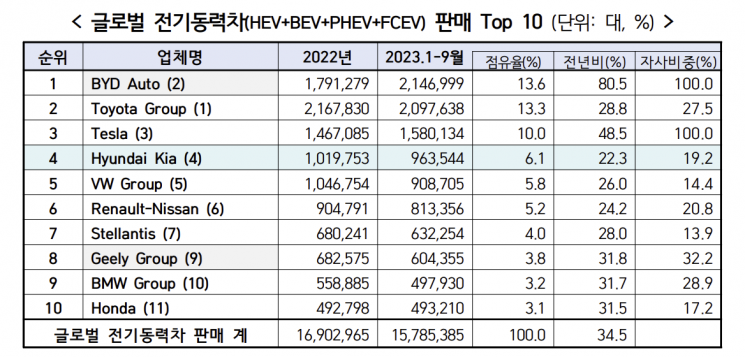
Notably, Hyundai and Kia aggressively increased their HEV sales, securing a significant share in the global eco-friendly vehicle (electric-powered vehicle) market. Their HEV sales in the first three quarters rose 35% year-on-year to 585,082 units. Toyota led HEV sales with 1.96 million units sold.
On the other hand, Hyundai and Kia ranked 8th in BEV sales, dropping three places from the previous year. Their BEV sales during this period were 293,767 units, a 5.9% increase compared to the previous year.
Chinese companies stood out in the global BEV market. BYD maintained its 2nd place position with 1.1 million units sold, following last year. Other Chinese manufacturers such as Shanghai Automotive (rising from 11th to 4th), Guangzhou Automobile (from 9th to 5th), and Geely Automobile (holding 6th place) occupied half of the top 10 rankings.
This was mainly due to increased electric vehicle sales in China, the world's largest EV market. Especially, BYD has fully transitioned to a NEV (new energy vehicle) production system since April last year and has been continuously expanding its factories. Chinese companies are increasing exports not only in the domestic market but also overseas markets such as Europe by leveraging price competitiveness.
A KAMA official stated, "After the early adopter demand in the electric vehicle market has been exhausted, the influx of price-sensitive general consumers is expanding," adding, "Companies that achieve economies of scale early and secure price competitiveness will become game changers in the electric vehicle market facing a downturn."
© The Asia Business Daily(www.asiae.co.kr). All rights reserved.

















