The Korea Disease Control and Prevention Agency (KDCA) announced on the 30th that the number of Norovirus infection patients, which commonly occurs in winter, has doubled in one month. In particular, infants and young children (0-6 years old) accounted for 38.6% of the total cases. The KDCA urged strict adherence to hygiene rules in facilities related to young children, such as daycare centers and kids cafes.
Norovirus is highly contagious and can survive for three days in everyday environments. Additionally, the immunity period is short, so people who have been infected before can be reinfected. In Korea, it mainly occurs from winter to early spring of the following year (November to April). It tends to occur primarily among infants and young children (0-6 years old), who have weaker personal hygiene and often live in group settings.
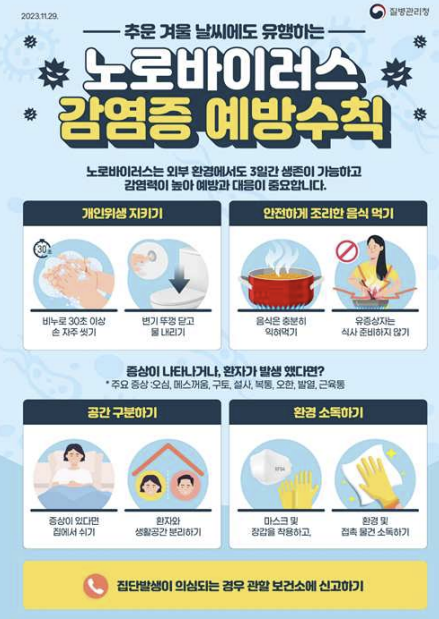
The main infection route is through consuming water (groundwater) or food (such as shellfish) contaminated with Norovirus. Transmission between people through contact with patients or infection via droplets from patient secretions is also possible. Symptoms such as vomiting and diarrhea appear within 12 to 48 hours after infection. Some people may also experience abdominal pain, chills, and fever.
For prevention, it is recommended to wash hands with soap for more than 30 seconds rather than using hand sanitizer, wash ingredients under running water, and consume food that is safely and hygienically cooked by heating it to at least 85℃ for more than one minute. Norovirus infection patients should refrain from attending daycare, school, or work for 48 hours after symptoms disappear and should live separately from other family members in shared spaces such as bathrooms.
Also, when using the bathroom, close the toilet lid before flushing after defecation to prevent the spread of Norovirus through droplets. Items contaminated by the patient’s space, bathroom, or secretions (feces or vomit) should be disinfected by wiping with a cloth soaked in diluted commercial bleach (1 part bleach to 50 parts water). When removing patient secretions, masks (KF94) and gloves must be worn to prevent infection through droplets. Disinfection should focus on objects frequently touched by hands (door handles, faucets, etc.), and laundry should be washed at temperatures above 70℃ or rinsed for more than 5 minutes with diluted bleach solution (1 part bleach to 330 parts water).
© The Asia Business Daily(www.asiae.co.kr). All rights reserved.

















