Inflation Outlook Raised to 3.6% This Year, 2.6% Next Year
Experts Forecast "Interest Rate Cut in Second Half of Next Year"
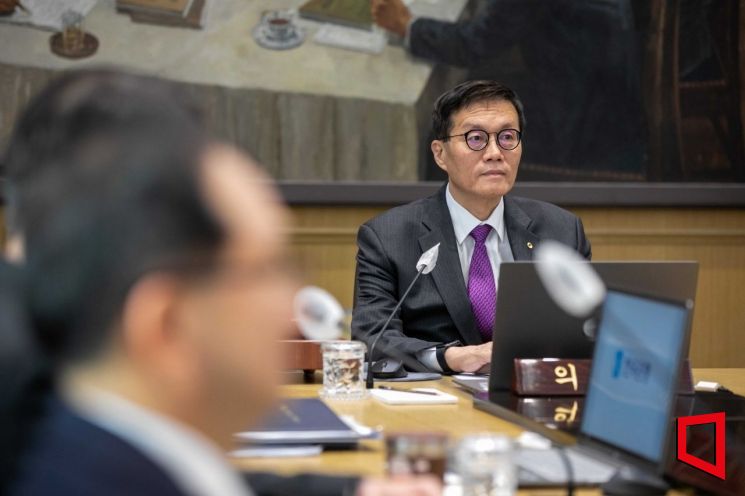 Lee Chang-yong, Governor of the Bank of Korea, is presiding over the Monetary Policy Committee meeting held on the 30th at the Bank of Korea in Jung-gu, Seoul. Photo by Joint Press Corps
The Bank of Korea on the 30th lowered its economic growth forecast for next year to 2.1%, signaling an economic slowdown. This is a 0.1 percentage point decrease from the 2.2% forecast released in August. Although exports are showing signs of recovery, consumption remains sluggish due to high interest rates, reflecting downside risks to the economy. Amid growing concerns over the economic slowdown, the Bank of Korea kept the base interest rate unchanged at 3.50% per annum for the seventh consecutive time.
The Monetary Policy Board of the Bank of Korea held a monetary policy meeting starting at 9 a.m. on the same day and decided to maintain the base interest rate at the current 3.50% per annum. The board had previously kept the rate unchanged in meetings held in February, April, May, July, August, and October. By holding the rate steady again at this final meeting of the year, the Bank of Korea continued its streak of seven consecutive rate freezes. Although the consumer price inflation rate in October exceeded expectations at 3.8%, and the timing for reaching the inflation target (2%) is expected to be delayed?factors that could justify a rate hike?the sluggish recovery in exports due to the economic slowdown in China and the significantly increased financial interest burden made additional rate hikes burdensome.
In particular, the perception that the U.S. Federal Reserve (Fed) has effectively ended its rate hikes has eased concerns about the widening interest rate gap between Korea and the U.S., supporting the Bank of Korea’s decision to hold rates steady. Christopher Waller, a prominent hawk on the Fed, recently expressed confidence that the current policy is in a "good place" to slow growth and bring inflation back to the 2% target. As the possibility of the Fed’s rate hikes ending gains traction, market expectations for rate cuts next year are rising. Since the interest rate gap with the U.S. has widened to a record high of up to 2 percentage points, further widening could lead to financial and foreign exchange market instability. Therefore, the end of the Fed’s rate hikes reduces the burden on Korea’s monetary policy decisions.
Joo Won, head of economic research at Hyundai Research Institute, said, "At the December Federal Open Market Committee (FOMC) meeting, the Fed is expected to hold rates steady due to recent inflation stabilization and concerns over a real economic downturn, and rate cuts will begin as the global economic slowdown intensifies next year." He added, "Due to domestic financial market instability caused by high interest rates, the possibility of a Fed pivot (monetary policy shift), and weak domestic economic recovery, Korea is unlikely to raise rates further." Although high inflation in the high 3% range and rising household debt remain burdens, recent easing of the won-dollar exchange rate and international oil prices suggests that monetary policy decisions will place greater emphasis on economic slowdown and financial stability.
Even if Semiconductors Recover Next Year...Concerns Over Weak Domestic Demand and Exports
In its revised economic outlook released on the same day, the Bank of Korea maintained this year’s economic growth forecast at 1.4% but lowered next year’s forecast to 2.1%. Previously, in August, the Bank had lowered next year’s growth forecast from 2.3% to 2.2% while keeping this year’s forecast unchanged at 1.4%. Thus, within just about three months, it further reduced the growth outlook for next year. Considering that the OECD raised Korea’s growth forecast for next year from 2.1% to 2.3% the day before, the Bank of Korea’s lower forecast indicates a more pessimistic view of the Korean economy next year. Compared to the Ministry of Economy and Finance (2.4%) and the International Monetary Fund (IMF, 2.2%), the Bank’s forecast is relatively low.
The Bank of Korea’s downward revision of Korea’s economic growth forecast to 2.1% for next year reflects the significant uncertainties surrounding the economy. Although the semiconductor sector is gradually recovering from its worst phase, the tightening effects over the past two years are now fully impacting domestic demand, especially consumption, which is deteriorating. The outlook that major economies affecting Korea, such as the U.S. and China, may experience sluggish growth next year is also interpreted as a reason for the Bank’s conservative growth forecast.
First, the semiconductor sector, Korea’s main export item, is expected to show signs of recovery next year. According to the Korea Customs Service, exports from the beginning of this month through the 20th reached $33.79 billion, up 2.2% from the same period last year. This increase was largely influenced by the recovery in semiconductor trade volume, the largest export item. The rebound in prices for memory products such as DRAM and NAND flash suggests that semiconductor exports have bottomed out and are reviving. The Bank of Korea’s November Business Survey Index (BSI), released the day before, also showed a significant improvement in manufacturing sentiment centered on semiconductors, electronics, video, and communication equipment.
However, excluding semiconductor exports, many risk factors remain. In particular, consumption, which had compensated for the semiconductor slump due to pent-up demand after the COVID-19 pandemic, has recently weakened. Inflation remains high in the 3% range, and the full effect of high interest rates has dampened consumer sentiment. The non-manufacturing business sentiment index this month fell to its worst level in 1 year and 11 months since December 2020. The Korea Development Institute (KDI) and the Korea Institute for Industrial Economics and Trade recently forecast relatively low economic growth rates of 2.2% and 2%, respectively, citing weak private consumption as a key factor.
Concerns are also mounting that the sluggish housing market and massive household debt will weigh down next year’s growth. Although the real estate market showed signs of price rebounds centered on Seoul earlier this year, it has recently stalled again due to the impact of high interest rates. Experts predict that while semiconductor and other facility investments may increase slightly, construction investment will decline due to rising unsold housing units. Since Korea has a large amount of household debt related to real estate, such as mortgage loans, a sluggish housing market negatively affects consumption. As of the end of September, household credit balances reached 1,875.6 trillion won, and if the high interest rate environment continues into next year, the increased household interest burden will inevitably hurt consumption and domestic demand. The continued high interest rates have significantly increased interest burdens on households and businesses, and financial market instability remains due to issues such as real estate project financing (PF) defaults, further complicating monetary policy challenges.
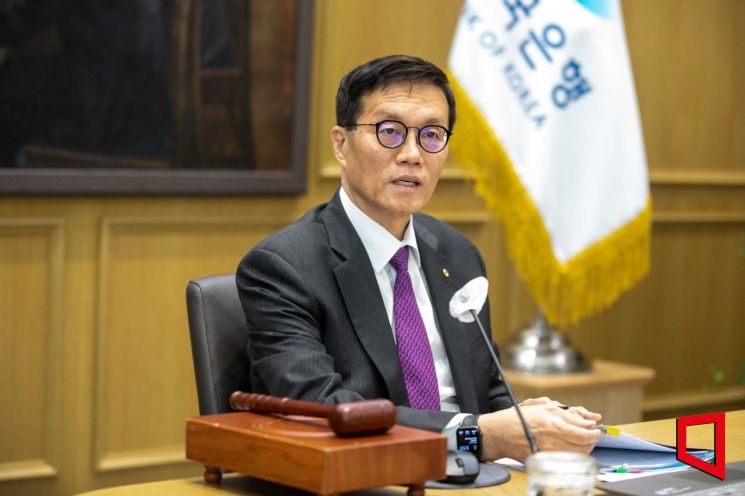 Lee Chang-yong, Governor of the Bank of Korea, is presiding over the Monetary Policy Committee meeting held on the 30th at the Bank of Korea in Jung-gu, Seoul. Photo by Joint Press Corps
Potential Growth Rate Expected to Decline...Concerns for the Following Year
The Bank of Korea forecasts the economic growth rate for 2025 at 2.3%. This implies that the Korean economy will find it difficult to regain past growth momentum. With aging and low birth rates intensifying and no clear new growth engines identified, a decline in potential growth rate is inevitable.
The Bank of Korea raised its consumer price inflation forecast for next year from 2.4% to 2.6%, an increase of 0.2 percentage points. This year’s forecast was also raised by 0.1 percentage points to 3.6%. Last month, the Monetary Policy Board indicated the possibility of upward revisions to inflation forecasts, citing increased upside risks to inflation due to the ripple effects of international oil prices, exchange rates, and the Israel-Hamas conflict, which could delay the timing of inflation converging to the target. Park Seok-gil, an economist at JP Morgan, said, "October’s Korean consumer price inflation rate exceeded expectations at 3.8%, reigniting inflation concerns," and added, "The pace of inflation slowdown is not fast, so the timing for inflation to converge to the target will likely be delayed compared to earlier expectations."
As the Bank of Korea lowers its economic growth forecast for next year, attention is focused on the impact this will have on future monetary policy. The prolonged Ukraine crisis, the Middle East war, global economic slowdown, and the impact of China’s economic weakness are expanding the slowdown in exports, weakening growth momentum. The continuation of tight monetary policy to counter high inflation is causing investment and consumption to contract, which is also worrisome. Seok Byung-hoon, a professor of economics at Ewha Womans University, said, "The recovery speed of the semiconductor sector, Korea’s main export item, is slower than expected, delaying the recovery of export growth," and added, "With exports and consumption weak, and the government unable to boost spending due to tax revenue shortfalls, a worst-case scenario of growth in the 1% range next year is not impossible."
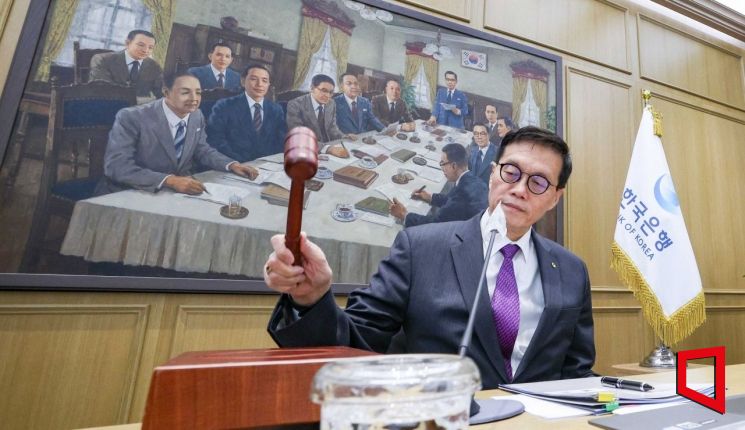 Lee Chang-yong, Governor of the Bank of Korea, is striking the gavel at the Monetary Policy Committee meeting held on the 30th at the Bank of Korea in Jung-gu, Seoul. Photo by Joint Press Corps
Final Interest Rates in Korea and the U.S., Rate Cuts Expected in Q3 Next Year
As perceptions grow that the base interest rates in the U.S. and Korea have effectively reached their peak, market attention is turning to rate cuts. Kwon Hyo-sung, an economist at Bloomberg Korea, said, "Due to the slower-than-expected pace of inflation slowdown, the Bank of Korea has revised its expected timing for rate cuts from Q2 to Q3 next year," and added, "With the U.S. economy also more resilient than expected, no rate cuts are expected until mid-next year." Yu Hye-mi, a professor at Hanyang University’s College of Economics and Finance, said, "Since inflation is slowing faster in the U.S. than in Korea and considering the interest rate gap between the two countries, it will be difficult for Korea to cut rates before the U.S." She predicted, "If the U.S. cuts rates around the end of Q2 next year, the Bank of Korea will follow with rate cuts in Q3."
© The Asia Business Daily(www.asiae.co.kr). All rights reserved.



















