CU, Disagreement Between Headquarters and Store Owners Over Next Year's Win-Win Plan
Store Owners "Abolish Win-Win Growth System, Support Electricity Bills"
Headquarters "Focus on Improving Store Sales"
Ahead of next year's win-win agreement negotiations, CU and franchise owners have failed to narrow their differences. While the franchisees demand support for fixed costs in the form of ‘electricity bill support,’ the company insists that the support plan should focus on increasing each store's sales rather than simply covering costs.
On the 29th, the CU Franchise Owners Association held a press conference in front of the BGF Retail headquarters in Gangnam-gu, Seoul, to announce a statement and conduct a head-shaving ceremony, calling for the abolition of the unfair Win-Win Growth System and the introduction of a genuine win-win plan. The Win-Win Growth System was introduced by BGF Retail last year, providing support funds up to 150,000 KRW per month proportional to the order volume of new products placed by franchisees. Additionally, stores with high waste volumes receive waste support funds up to 500,000 KRW per month.
Choi Jong-yeol, chairman of the CU Franchise Owners Association, said in the statement, "The Win-Win Growth System is only 'win-win' in words; it pressures franchisees to order new products and causes them burdens," adding, "We urge the abolition of the Win-Win Growth System and the consideration of a system for genuine win-win cooperation."
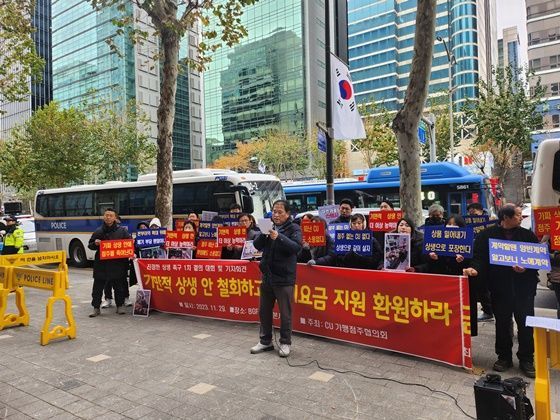 On the 29th, Choi Jong-yeol, chairman of the CU Franchise Store Owners Association, is speaking at a press conference held in front of the BGF Retail headquarters in Gangnam-gu, Seoul.
 [Photo by Lee Seo-hee]
The win-win plans between convenience store headquarters and franchisees were introduced in 2018 amid heated debates over minimum wage increases, mainly by major domestic convenience stores (CU, GS25, 7-Eleven). The purpose was to help franchisees whose management conditions worsened due to labor and raw material cost burdens and to promote mutual growth at the headquarters level. However, as the industry shifted from supporting fixed costs such as electricity bills to an ‘incentive system’ encouraging franchisees to participate more actively in management activities, discord began to arise within the industry. For example, CU supported electricity bills for 24-hour stores from 2018 but changed its policy last year to the Win-Win Growth System, which encourages stores to increase orders of new products. GS25 and 7-Eleven are also following this trend.
The divergence between CU and the Franchise Owners Association over the support method began at this time. The company insists that support should focus on enhancing each store's competitiveness rather than unconditional aid, while franchisees argue that fixed cost support from the company is essential amid rising costs of raw materials and other expenses.
CU plans to continue dialogue with franchisees to narrow differences until next year's win-win plan is finalized. Recently, through an internal dedicated team, they prepared an improvement plan to reduce the proportion of Win-Win Growth products among all new products from the current 80% to about 70%. Starting next year, franchisees will receive the 150,000 KRW support even if they order only 70 out of 100 new products designated by the headquarters, instead of 80. This adjustment slightly lowers the cost support barrier by reflecting franchisees' opinions while focusing on increasing store sales in line with the company's support philosophy. If the order volume falls below 70% of the total, support will be paid on a sliding scale according to the amount ordered.
However, the Franchise Owners Association argues that the company's improvement plan lacks practical effectiveness. Since the number of Win-Win Growth products designated by the headquarters changes monthly, lowering the percentage could actually increase the number of products franchisees must order. For example, if the headquarters designates 200 Win-Win Growth products, 80% equals 160 products, but if 300 products are designated, 70% equals 210 products. Although the percentage is lower, the franchisees' burden actually increases.
The Franchise Owners Association is also demanding the abolition of the Win-Win Growth System, electricity bill support, and an expansion of costs for withdrawing low-turnover products (returns). They propose raising the current ‘60,000 KRW + 0.3% of order amount’ to ‘110,000 KRW + 0.5% of order amount.’ Chairman Choi said, "Due to sluggish domestic demand, sales are declining, and fixed costs such as electricity bills are rising, pushing convenience store profits to the worst situation," adding, "Measures that genuinely help franchisees are necessary."
A CU official said, "Over the past two years, focusing on increasing sales rather than simple cost support has clearly resulted in increased sales of related products," adding, "Once next year's win-win plan is finalized, we plan to proceed with sufficient guidance and consent from individual franchise stores separately from the franchise contract."
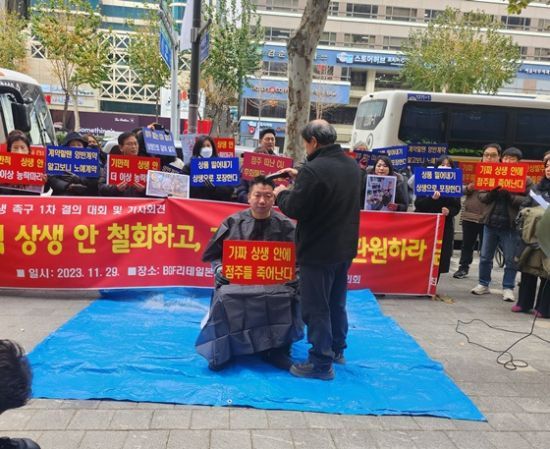 At a press conference held on the 29th in front of the BGF Retail headquarters in Gangnam-gu, Seoul, Pyeon Jong-man, head of the Daejeon, Sejong, and Chungnam branch of the Korea Convenience Store Owners Association, is conducting a head-shaving ceremony.
 [Photo by Lee Seo-hee]
© The Asia Business Daily(www.asiae.co.kr). All rights reserved.
![Clutching a Stolen Dior Bag, Saying "I Hate Being Poor but Real"... The Grotesque Con of a "Human Knockoff" [Slate]](https://cwcontent.asiae.co.kr/asiaresize/183/2026021902243444107_1771435474.jpg)

















