NHIS, "Currently Addressing System Issues"
Public Trust in Online Information Management of Public Institutions Declines
As a cold wave sweeps across the country, the National Health Insurance Service (NHIS) has sparked controversy by warning that "there is a high possibility of heat-related illnesses occurring or spreading." Amid a loss of public trust due to the administrative network paralysis incident, the management of online information by public institutions has also come under scrutiny.
Heat-Related Illness Risk Continues Until the End of November... NHIS Cites "System Error"
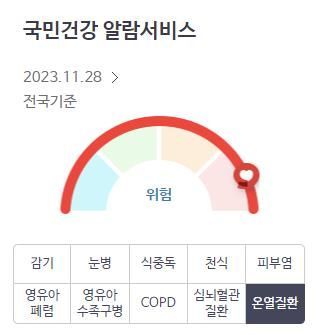 As of November 28, the heat-related illness risk level is warned as dangerous on the National Health Insurance Service website's Health Alarm Service.
 [Photo by National Health Insurance Service website capture]
According to the 'National Health Alarm Service' announced on the NHIS website on the 29th, the risk level for heat-related illness occurrence and spread was marked as "danger" until the previous day.
On the 28th, the nationwide highest temperature was around 10 degrees Celsius, and in the Seoul metropolitan area, the lowest temperature dropped to minus 3 degrees Celsius, indicating severe cold. However, the NHIS warned of the risk of heat-related illnesses, which are acute diseases caused by prolonged exposure to hot environments.
The NHIS uses its own National Health Information database along with data from the Ministry of Environment, the Ministry of Food and Drug Safety, the Korea Meteorological Administration, and private sources such as blogs and news to provide disease information in four levels: "interest," "caution," "warning," and "danger."
The NHIS continued to warn that heat-related illnesses were at a "danger" level well into November.
The alarm service displayed a separate heat-related illness section on its dedicated page, continuously marking it as "dangerous."
Only recently has this item disappeared from the alarm service's dedicated page, but the main website still warns that the risk of heat-related illness occurrence is at a "danger" level.
An NHIS official explained, "We recognized there was a problem with the system and excluded the item from the alarm service's dedicated page, and we are currently taking measures."
In this context, with public distrust of the "digital government" growing due to the administrative network paralysis incident, there are criticisms that the management of online information by public institutions is also in disarray.
In Cold Weather Like These Days, Beware of Cold-Related Illnesses... Warm Clothing Is Necessary
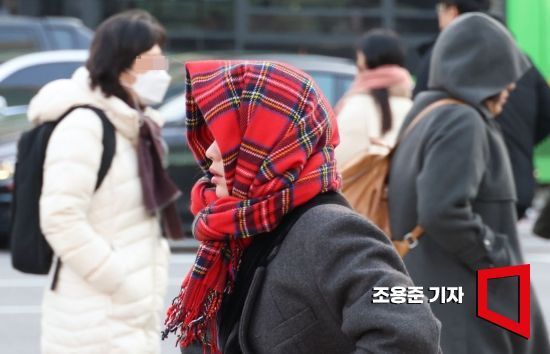 On the 28th, after the rain, the temperature dropped significantly, and citizens wearing scarves and thick clothing hurried their steps at Gwanghwamun Intersection in Jongno-gu, Seoul.
Heat-related illnesses are diseases caused by prolonged exposure to hot environments, showing symptoms such as ▲headache ▲dizziness ▲muscle cramps ▲fatigue ▲consciousness impairment. If left untreated, they can be life-threatening. Representative diseases include heatstroke and heat exhaustion. The Korea Disease Control and Prevention Agency (KDCA) operates an emergency room surveillance system for heat-related illnesses temporarily during midsummer.
Recently, representative diseases related to subzero temperatures on the Korean Peninsula are cold-related illnesses such as hypothermia and frostbite. The KDCA estimates that from 2018 to 2022, 1,877 people suffered from cold-related illnesses, with about 40 deaths.
The KDCA especially warns that people with underlying conditions such as cardiovascular and cerebrovascular diseases, diabetes, and hypertension are at higher risk of experiencing these cold-related illnesses. When temperatures suddenly drop, it is important to pay attention to warm clothing including scarves and hats, and avoid excessive exercise.
© The Asia Business Daily(www.asiae.co.kr). All rights reserved.
!["The Woman Who Threw Herself into the Water Clutching a Stolen Dior Bag"...A Grotesque Success Story That Shakes the Korean Psyche [Slate]](https://cwcontent.asiae.co.kr/asiaresize/183/2026021902243444107_1771435474.jpg)

















